




























Views
Downloads
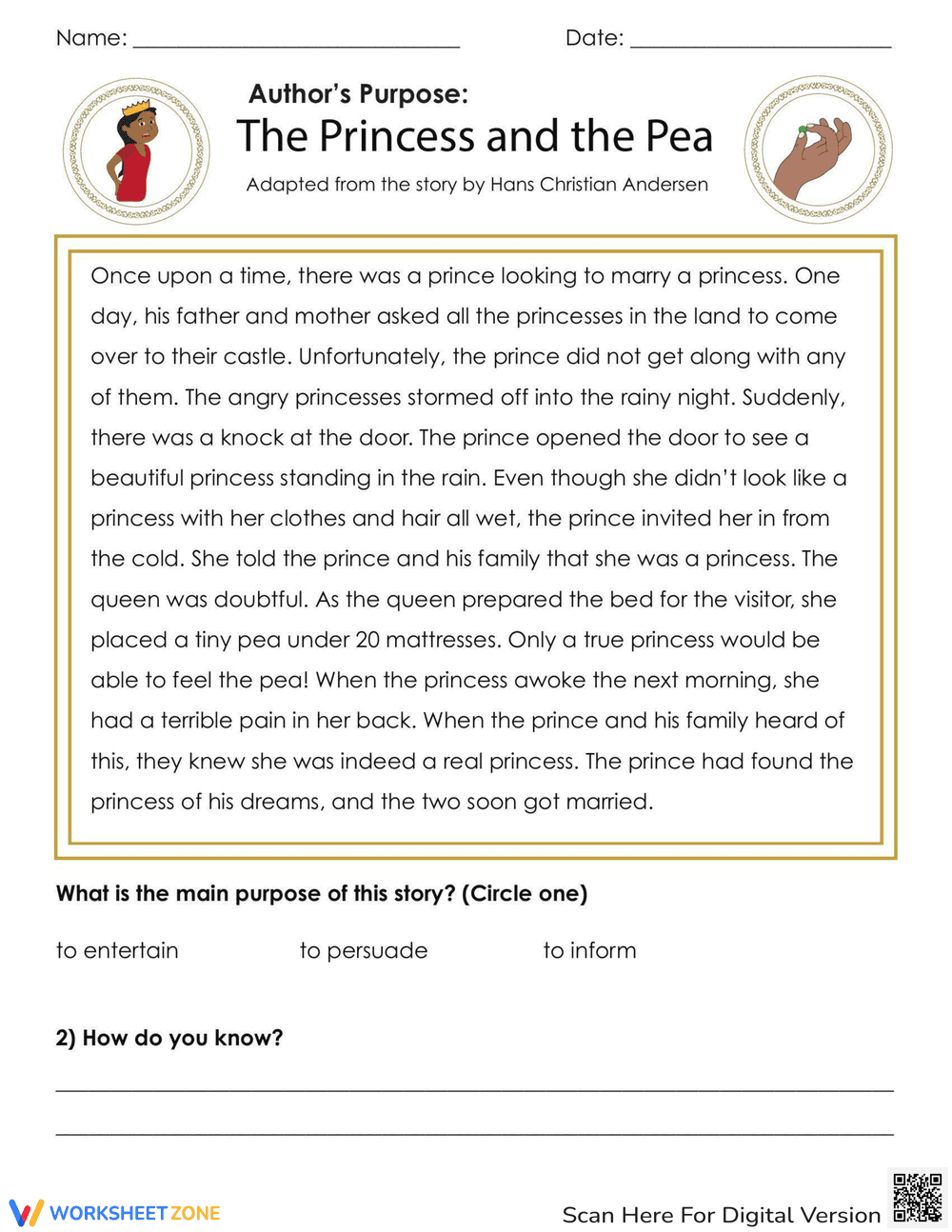

Author's Purpose Printable Worksheet | Grade 2 ELA

Paste this activity's link or code into your existing LMS (Google Classroom, Canvas, Teams, Schoology, Moodle, etc.).
Students can open and work on the activity right away, with no student login required.
You'll still be able to track student progress and results from your teacher account.
Identify Author's Purpose in Fiction
This Grade 2 reading comprehension worksheet helps students identify the author's purpose in fictional texts using an adaptation of the classic fairy tale, "The Princess and the Pea." Students read the short passage and determine if the text aims to entertain, persuade, or inform, building critical analysis skills.
At a Glance
- Grade: Grade 2 · Subject: ELA Reading
- Standard:
CCSS.ELA-LITERACY.RL.2.2— Recount stories and determine their central message, lesson, or moral- Skill Focus: Author's purpose in fiction
- Format: 1 page · 2 problems · Answer key included · PDF
- Best For: Quick reading comprehension assessment
- Time: 15–20 minutes
What's Inside
The worksheet contains a simplified, single-page adaptation of Hans Christian Andersen's classic story. Below the text, students encounter 2 structured tasks: a multiple-choice question to identify the primary purpose (to entertain, persuade, or inform) and an open-ended prompt requiring written evidence to justify their choice. A complete answer key is provided to facilitate rapid grading.
Zero-Prep Workflow
This resource streamlines lesson delivery with a three-step workflow. First, print the single-page PDF in under 1 minute. Second, distribute the sheets to students for a 15-minute independent reading and response session. Third, review the answers as a whole group in 5 minutes using the included key. Total teacher preparation time is under 2 minutes, making this an ideal option for emergency substitute plans or morning work.
Standards Alignment
This activity aligns directly with the Common Core State Standard CCSS.ELA-LITERACY.RL.2.2, which requires students to recount stories and determine their central message or purpose. By analyzing the narrative structure of a classic folktale, students practice identifying the author's underlying intent. Both standard codes can be copied directly into lesson plans, IEP goals, or district curriculum mapping tools.
How to Use It
Use this worksheet during the independent practice phase of a reading lesson or as a quick formative assessment following direct instruction on author's purpose. Teachers can observe student responses to the second question to evaluate their ability to cite textual evidence. The activity takes approximately 15 to 20 minutes to complete.
Who It's For
This resource is designed for second-grade students developing foundational reading comprehension skills. It serves as an excellent remedial tool for third-grade students needing extra support or as an enrichment activity for first-grade readers. Pair this worksheet with a graphic organizer or an anchor chart detailing the PIE (Persuade, Inform, Entertain) concept.
This reading comprehension resource targets the development of critical analysis skills in early readers. By prompting students to evaluate the author's intent behind a classic narrative, the worksheet supports the acquisition of key literacy benchmarks outlined in CCSS.ELA-LITERACY.RL.2.2. According to research by Fisher & Frey (2014) on the gradual release of responsibility, structured tasks that require students to justify their answers with evidence significantly improve text comprehension and retention. This worksheet provides the necessary scaffolding to transition students from guided reading to independent analysis. The inclusion of both multiple-choice and open-ended questions ensures that educators can accurately assess student understanding of narrative structure and purpose. This evidence-based design makes the worksheet a valuable addition to any elementary reading curriculum, helping teachers deliver targeted instruction that yields measurable growth in student literacy outcomes.


