


























0
Views
0
Downloads

0.0
0
Save
0 Likes
Share
Nonfiction Text Structure Worksheet for Elementary
0 Views
0 Downloads
Paste this activity's link or code into your existing LMS (Google Classroom, Canvas, Teams, Schoology, Moodle, etc.).
Students can open and work on the activity right away, with no student login required.
You'll still be able to track student progress and results from your teacher account.
Information
Description
What It Is:
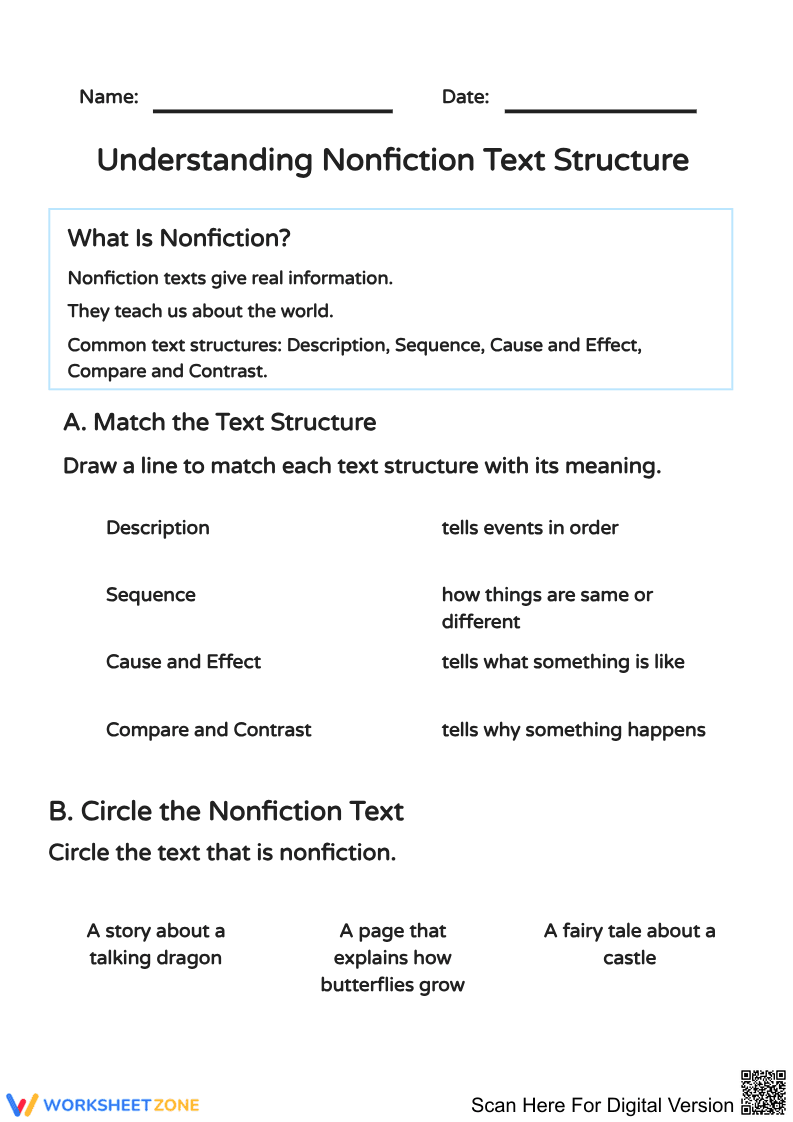
A clear, student-friendly worksheet that introduces nonfiction text and the four common nonfiction text structures: description, sequence, cause and effect, and compare and contrast.
Why Use It:
This worksheet helps students understand how informational texts are organized. It builds early reading comprehension skills by teaching learners to recognize text purpose and structure in a simple, visual way.
How to Use It:
• Review the definition of nonfiction as a class.
• Discuss common nonfiction text structures using the examples provided.
• Match each text structure to its correct meaning.
• Identify which example text is nonfiction by circling the correct choice.
Grade Suitability:
Best suited for Grades 1–3.
• Early readers learning informational text skills.
• Students beginning to analyze how texts are organized.
Target Users:
Elementary students, classroom teachers, reading interventionists, ESL learners, and homeschool families.
A clear, student-friendly worksheet that introduces nonfiction text and the four common nonfiction text structures: description, sequence, cause and effect, and compare and contrast.
Why Use It:
This worksheet helps students understand how informational texts are organized. It builds early reading comprehension skills by teaching learners to recognize text purpose and structure in a simple, visual way.
How to Use It:
• Review the definition of nonfiction as a class.
• Discuss common nonfiction text structures using the examples provided.
• Match each text structure to its correct meaning.
• Identify which example text is nonfiction by circling the correct choice.
Grade Suitability:
Best suited for Grades 1–3.
• Early readers learning informational text skills.
• Students beginning to analyze how texts are organized.
Target Users:
Elementary students, classroom teachers, reading interventionists, ESL learners, and homeschool families.


