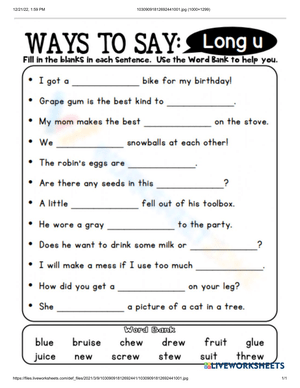
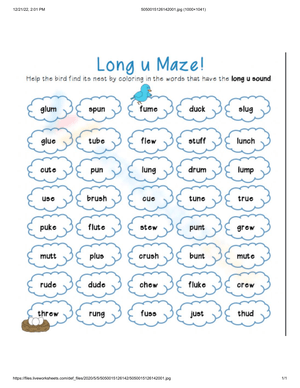
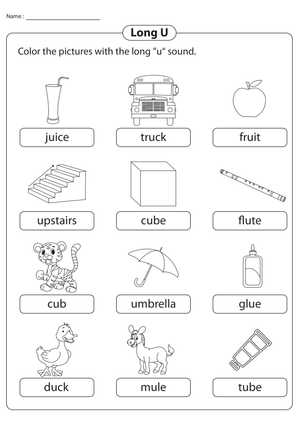
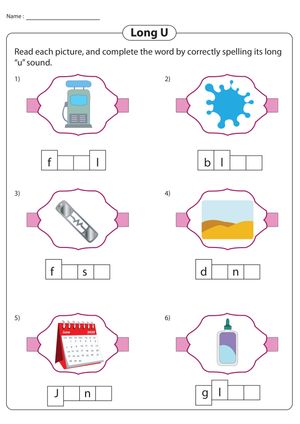
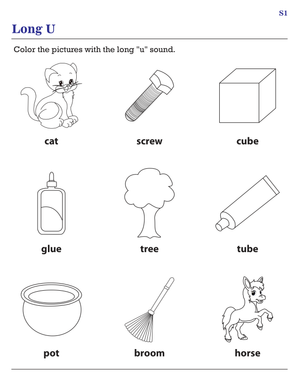
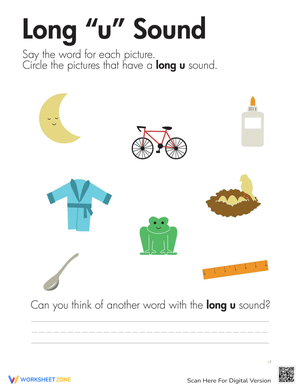
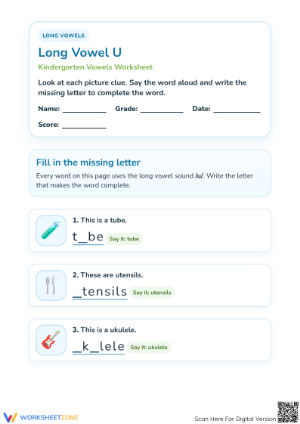
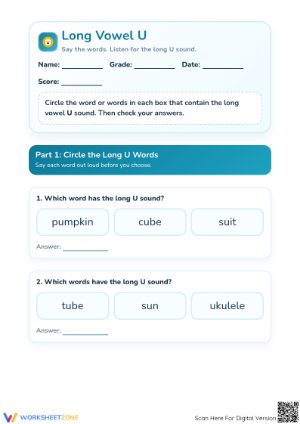
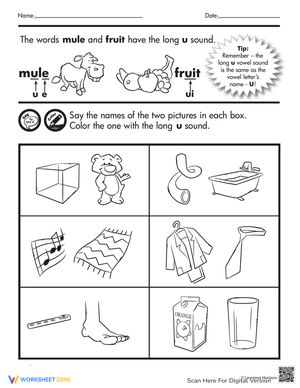
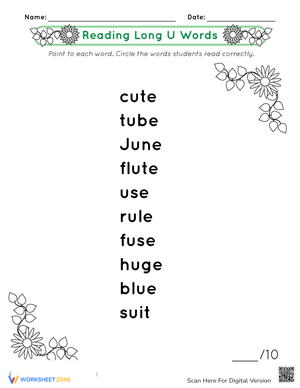
Long u is one of the trickier vowel sounds for early readers because it does not follow one single spelling rule. Teachers who search for long u worksheets are usually looking for a way to give students focused, repeated practice with a pattern that shows up in high-frequency words like cute, blue, few, and tube. Without dedicated practice, students often default to short u or guess based on the first letter, which slows down decoding fluency and shows up in spelling errors during writing time.
The Two Sounds of Long U and Why Students Mix Them Up
Long u carries two distinct pronunciations, and worksheets need to address both directly instead of treating long u as a single sound. The first is the yoo sound heard in words like cube, cute, and few. The second is the oo sound heard in words like tube, blue, and flew. Students who have only been taught one version will often misread words that use the other, especially when the same spelling pattern, such as ue or u_e, can represent either sound depending on the word.
Explicit modeling helps here. When you introduce a new long u word, say the word aloud, ask students to repeat it, and name which of the two sounds they hear before moving to the worksheet practice. This small step prevents a common error pattern where students apply the yoo sound to every u_e word, including ones that should be read with the oo sound.
Long U Spelling Patterns Worksheets Cover
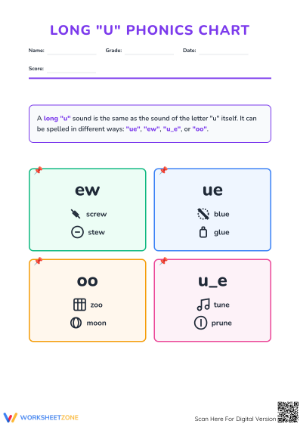
Effective long u worksheets rotate through the main spelling patterns rather than drilling only one. The most common patterns are silent-e words such as cute and tube, vowel-team words with ue such as blue and glue, vowel-team words with ew such as few and chew, and the less frequent oo spelling as in moon, along with u alone as in unit. Covering each pattern across a unit, rather than a single worksheet, helps students generalize the sound-spelling relationship instead of memorizing individual words.
Phonics research on decoding automaticity suggests that a single vowel pattern needs about a week or more of concentrated, routine practice before students reach reliable automaticity and spelling retention, which means one long u worksheet used in isolation rarely builds the skill on its own.
CCSS RF.1.3 requires Grade 1 students to know spelling-sound correspondences for common vowel teams, including final-e patterns, while CCSS RF.2.3 extends this in Grade 2 to additional vowel teams such as ue, ew, and oo, giving teachers a two-year standards arc for long u instruction.
Sequencing Long U Instruction After Short U and Long Vowels
Long u worksheets work best when they come after students have secured short u and at least one other long vowel pattern, such as long a or long o. Because long u introduces two sounds and multiple spellings, students need a stable base of vowel-sound knowledge before adding this layer of complexity. A quick check before starting a long u unit is to see whether students can already read and sort short u words like cup, mud, and bus without hesitation.
If students are still confusing short u and long u, that is a signal to slow down rather than push forward. Long u worksheets that include a short u versus long u sorting activity give you a quick, low-prep way to confirm readiness and to spot individual students who need more short u review before tackling silent-e and vowel-team spellings.
Frequently Asked Questions
1. What are common examples of long u words for each spelling pattern?
Silent-e words include cute, tube, and mule. Vowel-team ue words include blue and glue. Vowel-team ew words include few, chew, and flew. The less common oo pattern appears in words like moon and soon, and u alone appears in words like unit and music.
2. How do teachers know when a student is ready to move from short u to long u instruction?
Students are usually ready once they can read and sort short u words accurately and without hesitation. If a student still confuses short u and long u words during that check, spend more time on short u before introducing the long u worksheets.
3. What is the difference between the two long u sounds?
One version sounds like yoo, as in cute and few. The other sounds like oo, as in tube and blue. Naming both sounds explicitly when you introduce new words helps students avoid applying the same sound to every long u spelling.
4. How can long u worksheets be used for small-group intervention versus whole-class instruction?
In whole-class settings, use long u worksheets as a short daily warm-up before guided practice. In small-group intervention, use them to isolate the exact pattern or sound a student is missing, then reteach that specific pattern rather than repeating the whole unit.
5. How much time should teachers dedicate to a long u unit?
Plan for at least a week or more of concentrated, repeated practice with short daily sessions rather than a single long session, since that repetition is what builds automaticity and supports spelling retention.












 Interactive Worksheet Maker
 Quiz Maker
 Word Search Maker
 Crossword Puzzle Maker
 Word Scramble Generator
 Sentence Scramble Generator
 Handwriting Worksheet Generator
 Name Tracing Generator
 Fill In The Blank Generator