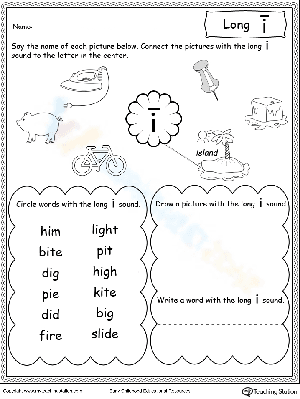
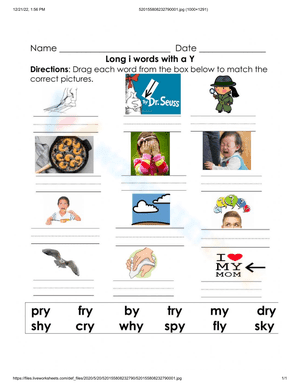
Once your students have a solid handle on short i in closed syllables like pin and sit, they are ready for the next step in your phonics scope and sequence: long i. This shift asks beginning readers to hold two vowel sounds in mind at once and decide which one a word is using, a skill that takes deliberate, repeated practice. Long i worksheets give you a low-prep way to provide that practice during whole-group instruction, small-group intervention, or literacy centers, while keeping your lesson tied directly to foundational reading standards.
Where Long I Fits in a K-1 Phonics Sequence
CCSS.ELA-LITERACY.RF.K.2 introduces recognizing and producing rhyming words and blending sounds, laying groundwork for vowel work in kindergarten. By first grade, CCSS.ELA-LITERACY.RF.1.2.A specifically requires students to distinguish long from short vowel sounds in spoken single-syllable words, and RF.1.3 extends this to reading long vowel patterns in print. Most scope-and-sequence programs teach short vowels first because closed syllables are the most predictable pattern for new readers, then move to long vowels once students can blend and segment CVC words with automaticity. Long i typically follows short i directly, since the two sounds are frequently confused and benefit from side-by-side contrast.
Teaching the 'Says Its Name' Rule
A common instructional rule taught to students is that long vowels say their name, and this holds true for long i in nearly every context, including CVCe words like kite and vowel team words like light. The exception worth flagging for older or more advanced first graders is the letter y acting as a vowel, as in words like fly or sky, which also produces the long i sound but does not follow the typical spelling patterns. Naming this rule explicitly gives students a verbal anchor they can use during independent reading, not just during worksheet practice.
The instructional payoff of explicit long vowel rules shows up in decoding accuracy: students who can articulate why a vowel is long or short, rather than guessing, transfer that reasoning to unfamiliar words far more reliably than students taught through memorization alone. This is one reason structured literacy approaches emphasize naming the pattern before asking students to apply it independently.
Common Long I Spelling Patterns to Teach Explicitly
Long i shows up in more spelling variations than many other long vowels, so it helps to introduce patterns one at a time rather than all at once.
- Silent e (CVCe): kite, ride, time, five
- Vowel team igh: light, night, high, sigh
- Open syllable: hi, spider, tiger, silent
Introducing CVCe first is common practice since it connects to the silent e pattern students often see across other vowels, before layering in igh words and open syllables as decoding skills strengthen.
Using Minimal Pairs to Build Discrimination
Minimal pairs, or word pairs that differ by only one sound, are one of the most effective tools for helping students hear the difference between short i and long i. Pairs like pin and pine, rid and ride, or bit and bite isolate the vowel change while keeping everything else in the word the same. A long i worksheet built around minimal pairs might ask students to sort word cards into short i and long i columns, circle the vowel pattern that makes a word long, or fill in missing letters to change a short i word into its long i counterpart. This kind of contrastive practice targets the exact confusion point most first graders experience.
Frequently Asked Questions
1. What grade level typically learns the long i sound?
Long i instruction typically begins in kindergarten with early exposure and is formally addressed in first grade, where CCSS.ELA-LITERACY.RF.1.2.A requires students to distinguish long from short vowel sounds in spoken words.
2. What are the most common long i spelling patterns for beginning readers?
The three most common patterns are silent e or CVCe words like kite, the igh vowel team as in light, and open syllable words like hi or spider, where the vowel appears at the end of a syllable.
3. How can teachers tell if a student is confusing long i and short i?
Watch for students who read long i words with a short i sound, such as reading kite as kit, or who apply long i sounds to closed syllable words. Minimal pair worksheets are a fast way to surface this confusion directly.
4. How much practice time should be spent on long i worksheets per week?
This depends on student need, but a common approach is to pair short, focused worksheet practice with each phonics lesson, then increase frequency for students in small-group intervention until the pattern is firm.
5. How do long i worksheets fit into a structured literacy or science of reading approach?
Structured literacy emphasizes explicit, systematic instruction in vowel patterns before students apply them in text. Long i worksheets support this by isolating one pattern at a time, which aligns with the phonics pillar described in the five pillars of reading instruction framework.















 Interactive Worksheet Maker
 Quiz Maker
 Word Search Maker
 Crossword Puzzle Maker
 Word Scramble Generator
 Sentence Scramble Generator
 Handwriting Worksheet Generator
 Name Tracing Generator
 Fill In The Blank Generator