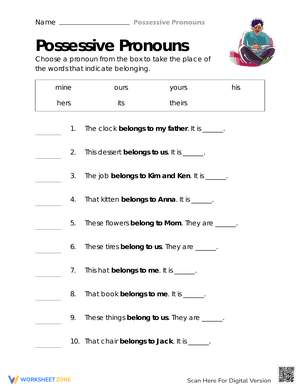
Possessive pronouns show up early in grammar instruction, but they keep causing errors well past first grade. Words like its, your, and their get swapped for contractions, and students often default to a possessive noun phrase instead of picking up a pronoun. A well-sequenced set of possessive pronouns worksheets gives you a direct way to name the pattern, isolate the tricky pairs, and check for transfer into student writing rather than just isolated drills.
Possessive Pronouns vs Possessive Nouns
Before students can use possessive pronouns with any confidence, they need to see how a pronoun replaces a possessive noun phrase. The dogs bone becomes its bone. Sarahs backpack becomes her backpack. Worksheets that pair a possessive noun sentence with its pronoun equivalent make this substitution visible instead of assumed. Many classrooms build this practice on top of earlier possessive noun work, so a short review item at the top of the worksheet helps students activate that prior learning before moving into pronoun-only practice.
This sequencing matters because students who have not internalized what a possessive noun phrase does will struggle to see why a pronoun is even needed. Worksheets that keep both forms side by side, rather than teaching pronouns in isolation, tend to produce more durable understanding.
Possessive Determiners vs Independent Possessive Pronouns
Not all possessive pronouns behave the same way in a sentence, and worksheet difficulty should reflect that. Possessive determiners such as my, your, his, her, its, our, and their always sit before a noun: my pencil, their classroom. Independent possessive pronouns such as mine, yours, his, hers, its, ours, and theirs stand alone and replace the whole noun phrase: that pencil is mine.
A useful leveling strategy is to start every unit with determiner-only fill-in-the-blank items, since they require less sentence restructuring, then move to sentence-transformation tasks that ask students to rewrite a determiner phrase as an independent pronoun. This two-stage worksheet sequence tends to reduce the errors that show up when students first attempt independent pronouns in their own writing.
Fixing the Its and Your Contraction Confusion
One of the most persistent errors in this unit is mixing up possessive pronouns with sound-alike contractions: its versus it's, your versus you're, their versus they're. Because these pairs sound identical, students often rely on spelling patterns they have memorized incorrectly rather than reasoning about function. Worksheets that force a choice between the two forms in context, rather than testing them separately, are more effective at catching this error pattern early.
Classroom Implementation
Use possessive pronoun worksheets as a short, repeatable routine rather than a single unit test. A five-minute warm-up with six to eight items, mixing determiners and independent pronouns, works well as a formative check before a longer grammar block. Keep an error log of which students consistently miss the its/it's pair versus which students miss independent pronouns like theirs or ours, since these represent different instructional needs.
For small groups, pull three or four worksheet items directly into a whiteboard activity where students say the sentence aloud before writing the pronoun. This catches errors that a purely written worksheet might miss, since some students can select the right written form without being able to explain why it fits the sentence.
Pair worksheet practice with a quick writing prompt once a week, asking students to write two or three sentences using at least one possessive pronoun. This step moves the skill from a fill-in-the-blank context into authentic use, which is where the its/it's error is most likely to reappear if the concept has not fully transferred.
Frequently Asked Questions
1. What grade level typically introduces possessive pronouns and where does it fall in the CCSS progression?
Possessive pronouns are introduced in grade 1 under CCSS.ELA-Literacy.L.1.1.d, which groups them with personal and indefinite pronouns as part of the same language standard.
2. What is the difference between a possessive pronoun and a possessive noun on a worksheet?
A possessive noun uses an apostrophe with a noun, such as Sarahs book, while a possessive pronoun replaces that phrase entirely, such as her book, without using an apostrophe.
3. How can teachers use possessive pronoun worksheets to fix common its and it's confusion?
Worksheets that require students to choose between the possessive pronoun and the contraction in the same sentence context, rather than practicing each form separately, are more effective at correcting this error.
4. Are possessive pronoun worksheets appropriate for ESL or intervention groups above grade 1?
Yes. Students in grades 2 through 4, including English language learners, often continue to need isolated possessive pronoun practice, especially when the error persists in their independent writing.
5. How should teachers pair possessive pronoun worksheets with writing practice for transfer beyond isolated drills?
Follow worksheet practice with a short weekly writing prompt that requires at least one possessive pronoun, which reveals whether the skill has transferred beyond a fill-in-the-blank format.















 Interactive Worksheet Maker
 Quiz Maker
 Word Search Maker
 Crossword Puzzle Maker
 Word Scramble Generator
 Sentence Scramble Generator
 Handwriting Worksheet Generator
 Name Tracing Generator
 Fill In The Blank Generator