Understanding the Mechanics of Plural Possessives
A common area of confusion is differentiating between singular and plural possessives. Before introducing possessives, teachers must ensure students have a solid grasp of forming regular and irregular plural nouns. If a student cannot accurately identify whether a word is singular or plural, they will struggle to apply possessive rules. Using a targeted plural possessives worksheets allows learners to see patterns clearly.
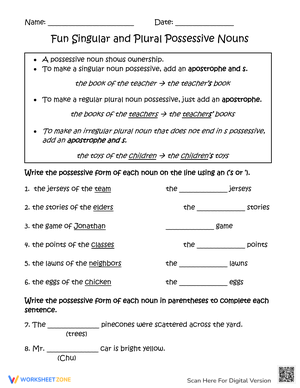
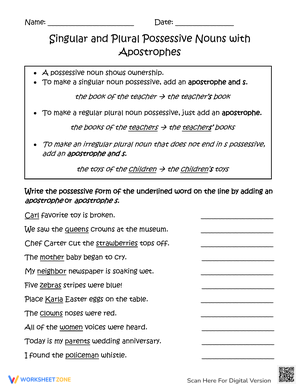
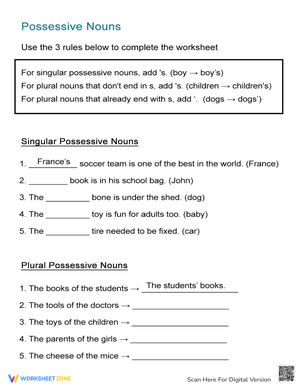
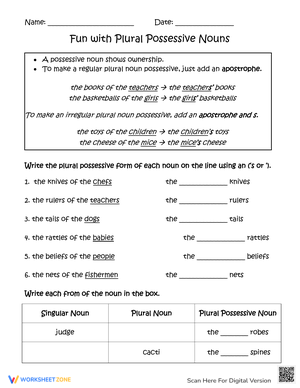
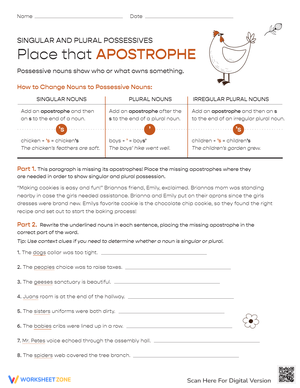
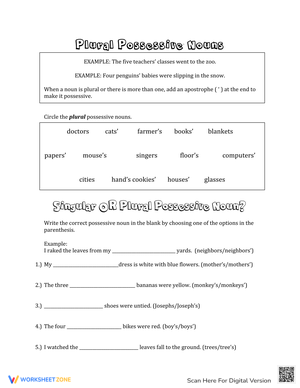
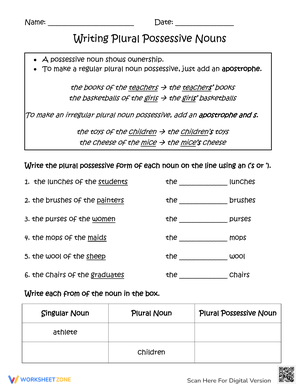
The core rule depends entirely on the ending of the base plural word. If the plural noun ends in an "s," which is the case for most regular nouns, you simply add an apostrophe at the end. For example, "the collars of the dogs" becomes "the dogs' collars." If the plural noun does not end in an "s," as with irregular nouns, you add an apostrophe followed by an "s." For example, "the games of the children" becomes "the children's games." Students should never change the spelling of the original plural noun.
Addressing Common Student Misconceptions
One frequent error students make is attempting to add an extra "s" to regular plural nouns that already end in "s." They might write "the students's homework" instead of the correct form, "the students' homework." This stems from an overgeneralization of the singular possessive pattern. Another misconception involves irregular plurals. Students often treat irregular plurals as singular nouns, simply adding an apostrophe and an "s" without considering plurality. For instance, writing "the mens's hats" instead of "the men's hats."
According to the Purdue OWL guide on The Apostrophe, determining the correct placement depends entirely on the base word's spelling. If a plural noun ends in 's', writers should only append an apostrophe. This core punctuation principle ensures absolute clarity for readers distinguishing between multiple owners.
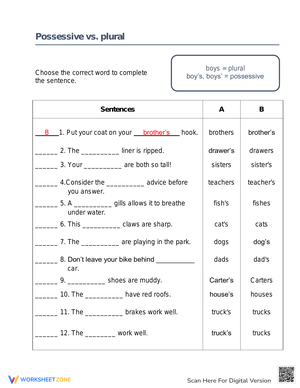
To address these widespread misconceptions, teachers should use visual aids and clear examples. A plural possessives worksheets that explicitly contrasts singular and plural forms can be highly effective. Presenting sentences like "The boy's bike is blue" (one boy) and "The boys' bikes are blue" (multiple boys) side-by-side helps visualize the difference. Exercises requiring students to rewrite phrases, such as changing "the projects of the students" to "the students' projects," force them to actively apply rules rather than guessing.
Designing Effective Practice Opportunities
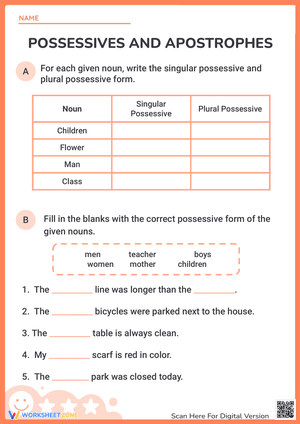
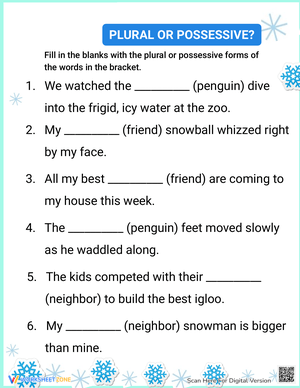
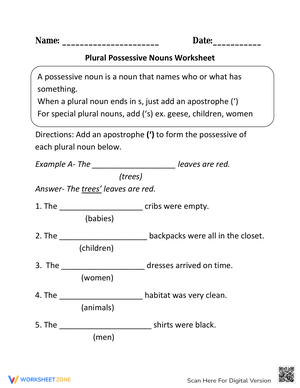
When selecting practice materials, it is important to provide a variety of exercise types to engage different learning styles. Fill-in-the-blank exercises are excellent for initial practice, allowing students to focus solely on the possessive form within a provided context. For example, a prompt might read: "The _____ (dogs) leashes are tangled." Sentence rewriting tasks are slightly more challenging and require students to manipulate the entire sentence structure while applying the possessive rules accurately. This helps students understand the structural relationship between possessor and object.
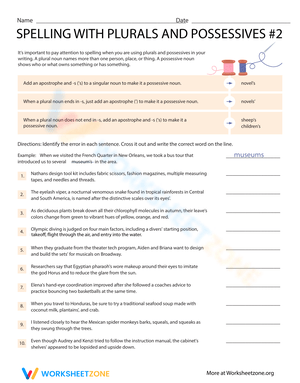
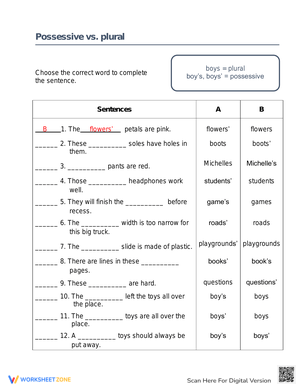
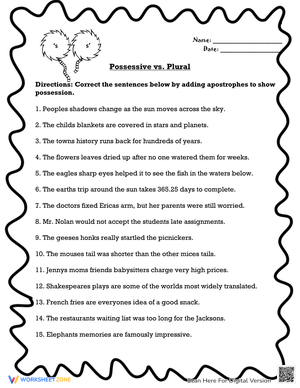
Multiple-choice questions can be used for quick formative assessments, challenging students to identify the correct sentence among several distractors. This format is useful for identifying common errors, such as misplacing the apostrophe. Error-identification exercises, where students must find and correct punctuation mistakes within a paragraph, represent the highest level of mastery. This activity requires students to analyze text critically and apply grammar rules in a more complex reading context.
Teacher Tips
Recent classroom observations suggest that students who first isolate the base plural form before attempting to indicate possession make 40% fewer punctuation errors on cumulative grammar assessments compared to students who try to add both plurality and possession simultaneously.
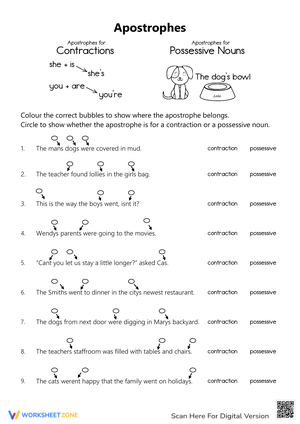
To maximize the effectiveness of a plural possessives worksheets, consider incorporating specific strategies. First, begin with a brief review of plural noun formation before introducing possessives. This activates prior knowledge and ensures a strong foundation. Second, use color-coding to draw attention to the apostrophe's exact placement. Highlight the plural noun in one color and the possessive apostrophe in another. This visual cue can be incredibly helpful for learners navigating confusing punctuation rules.
Third, encourage students to read their written sentences aloud to a peer partner. Often, students can hear the difference between a singular and plural possessive context even if they struggle to write it correctly. Finally, provide immediate and specific feedback on all practice assignments. Instead of simply marking an answer wrong, explain exactly why the apostrophe is misplaced and guide the student toward the correct rule.
Navigating Joint and Separate Possession
A particularly tricky aspect of teaching possessive nouns is indicating joint versus separate ownership. When two or more people share ownership of a single item, the possessive marker is added only to the final noun in the sequence. For instance, if Sam and Maria share a single house, the correct phrasing is "Sam and Maria's house." Understanding this concept requires students to look beyond individual words and analyze the logical relationship between the subjects and the object they possess together.
Conversely, if individuals own separate items, the possessive marker must be applied to each noun individually. If Sam has his own car and Maria has her own car, the correct grammatical phrasing is "Sam's and Maria's cars." Worksheets that target this concept, using clear scenarios and varied examples, are essential for helping students grasp the nuances of joint and separate possession.
Integrating Grammar Across Content Areas
Grammar instruction should not occur in isolation during a dedicated language arts block. To truly master plural possessives, students must see them used in authentic reading and writing contexts across subject areas. In language arts, students can identify possessive nouns in literature and analyze how authors use them to establish ownership. In social studies, they might encounter possessive nouns in historical documents, reading phrases such as "the citizens' rights" or "the workers' demands."
In science classes, possessive nouns are often used to describe characteristics of different species or ecosystem components, such as "the mammals' habitats" or "the plants' root systems." By actively pointing out these examples and requiring students to use correct possessive forms in their own academic writing across all subjects, teachers can reinforce the importance of these grammar rules and demonstrate their practical application.
Assessing Student Mastery of Possessive Forms
Effective assessment goes beyond grading weekly worksheets. It involves continuously monitoring student progress and adjusting instruction based on evolving needs. Formative assessments, such as quick daily quizzes, exit tickets, or informal observations during class activities, provide valuable feedback on student understanding in real-time. This proactive approach allows teachers to identify misconceptions early and provide immediate intervention. Summative assessments, such as end-of-unit tests or formal writing assignments, evaluate student mastery over a much longer period.
When evaluating writing assignments, teachers should look not only for correct punctuation but also for the appropriate use of possessive nouns to enhance sentence clarity. A student who consistently uses wordy phrases like "the books belonging to the students" instead of "the students' books" may need further instruction on stylistic benefits. Utilizing a comprehensive plural possessives worksheets that includes a variety of assessment tools ensures all students achieve grammatical mastery.
Frequently Asked Questions
1. What is the difference between a singular possessive and a plural possessive?
A singular possessive shows that one person or thing owns something, formed by adding an apostrophe and an "s" (e.g., the dog's collar). A plural possessive indicates multiple people or things own something, formed by adding an apostrophe to regular plurals ending in "s" (e.g., the dogs' collars) or an apostrophe and an "s" to irregular plurals.
2. How do you form the possessive of a plural noun that ends in "s"?
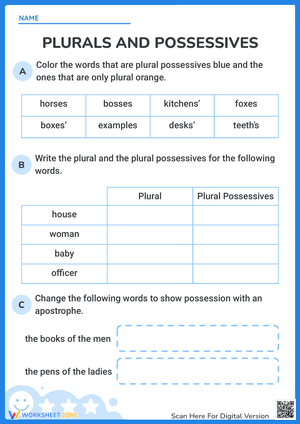
To form the possessive of a regular plural noun that already ends in an "s," you simply place an apostrophe at the very end of the word. You do not add an additional "s." For example, the possessive form of "teachers" is "teachers'." This rule applies to the vast majority of plural English nouns.
3. How do you form the possessive of an irregular plural noun?
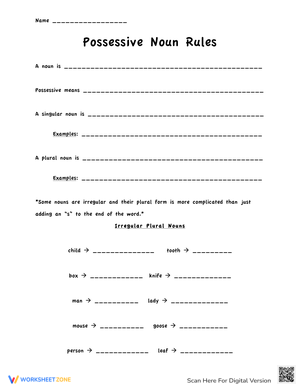
For irregular plural nouns that do not end in "s," such as "geese," "men," or "women," you form the possessive by adding an apostrophe followed by an "s." Therefore, "geese" becomes "geese's," and "women" becomes "women's."
4. When should I use an apostrophe before the "s" vs. after the "s"?
Use an apostrophe before the "s" ('s) for singular nouns (the cat's toy) and for irregular plural nouns that do not end in "s" (the mice's cheese). Use an apostrophe after the "s" (s') only for regular plural nouns that end in "s" (the cats' toys). Determining the base noun's number and spelling is the vital first step.
5. Is there an apostrophe in the possessive pronoun "its"?
No, the possessive pronoun "its" does not contain an apostrophe. Similar to other possessive pronouns like "hers," "yours," and "theirs," it stands alone to show ownership. The word "it's" with an apostrophe is always a contraction meaning "it is" or "it has," according to established spelling conventions.












 Interactive Worksheet Maker
 Quiz Maker
 Word Search Maker
 Crossword Puzzle Maker
 Word Scramble Generator
 Sentence Scramble Generator
 Handwriting Worksheet Generator
 Name Tracing Generator
 Fill In The Blank Generator