


























Views
Plays
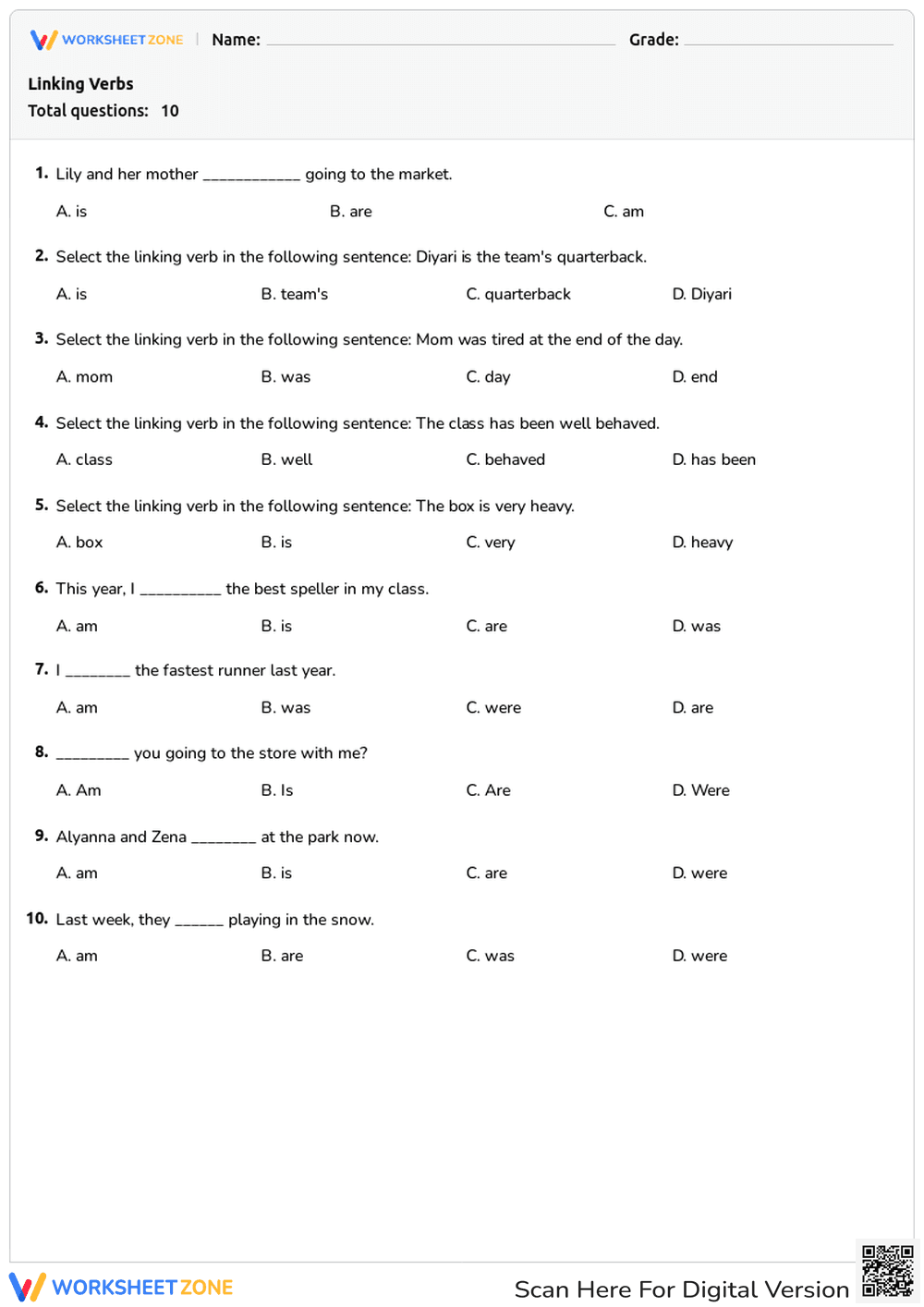

Linking Verbs Worksheet | Essential Grade 2-3 Grammar
Paste this activity's link or code into your existing LMS (Google Classroom, Canvas, Teams, Schoology, Moodle, etc.).
Students can open and work on the activity right away, with no student login required.
You'll still be able to track student progress and results from your teacher account.
Linking verbs connect the subject of a sentence to a word that describes or identifies it, serving as a bridge for meaning. This Grade 2-3 worksheet helps students master these essential connectors through 10 targeted multiple-choice questions. By identifying and applying verbs like "is," "was," and "has been," learners build the grammatical foundation necessary for clear, descriptive writing and accurate sentence construction.
At a Glance
- Grade: 2-3 · Subject: ELA Grammar
- Standard:
CCSS.ELA-LITERACY.L.3.1— Demonstrate command of standard English grammar and usage when writing or speaking- Skill Focus: Linking Verb Identification and Usage
- Format: 1 page · 10 problems · Answer key included · PDF
- Best For: Quick formative assessment or grammar review
- Time: 10–15 minutes
What's Inside: This single-page PDF contains 10 carefully crafted multiple-choice questions. The tasks are split between identifying the linking verb within a complete sentence and selecting the correct verb to complete a sentence frame. The worksheet covers various tenses and subject-verb agreement scenarios, including singular and plural subjects. A clear, easy-to-read layout ensures that young learners can focus entirely on the linguistic tasks without visual distraction.
The zero-prep design of this worksheet allows for immediate classroom implementation. Teachers can print the single-page PDF in less than 30 seconds, distribute it to the class for a 10-minute focused activity, and review the answers collectively to provide instant feedback. This streamlined workflow is ideal for morning work, transition periods, or as a reliable sub-plan component. Total teacher preparation time is under 2 minutes, ensuring that instructional focus remains on student engagement.
Standards Alignment: This resource is primarily aligned with `CCSS.ELA-LITERACY.L.3.1`, which requires students to demonstrate command of the conventions of standard English grammar and usage. It specifically addresses the use of verbs to convey various conditions and states of being. Both standard codes can be copied directly into lesson plans, IEP goals, or district curriculum mapping tools.
How to Use It: Use this worksheet as a formative assessment after a direct instruction lesson on parts of speech. It works effectively as a bell ringer to activate prior knowledge or as an exit ticket to check for understanding of subject-verb agreement. While students work, observe if they struggle more with identifying the verb or choosing the correct tense, as this provides a clear indicator for future small-group intervention. Expected completion time is 10 to 15 minutes.
Who It's For: This resource is designed for 2nd and 3rd-grade students who are beginning to explore complex sentence structures. It is also an excellent tool for English Language Learners (ELL) who need structured practice with auxiliary and linking verbs. Pair this worksheet with a visual anchor chart displaying common linking verbs to support students who require additional scaffolding.
Grammar instruction is most effective when isolated skills like linking verbs are practiced within the context of sentence structure, as supported by CCSS.ELA-LITERACY.L.3.1. This standard requires students to demonstrate a command of standard English grammar, specifically focusing on verb usage to ensure subject-verb agreement and logical sentence flow. Targeted practice worksheets provide the necessary guided instruction phase before students move to independent writing. By focusing on 10 specific instances of linking verb application, this resource allows teachers to identify common misconceptions regarding tense and plurality. Research from EdReports (2024) emphasizes that high-quality instructional materials must provide clear alignment to linguistic conventions to support literacy development. This worksheet serves as a focused tool for reinforcing the relationship between subjects and their descriptors, ensuring students can produce coherent sentences across various academic contexts.


