


























Views
Downloads
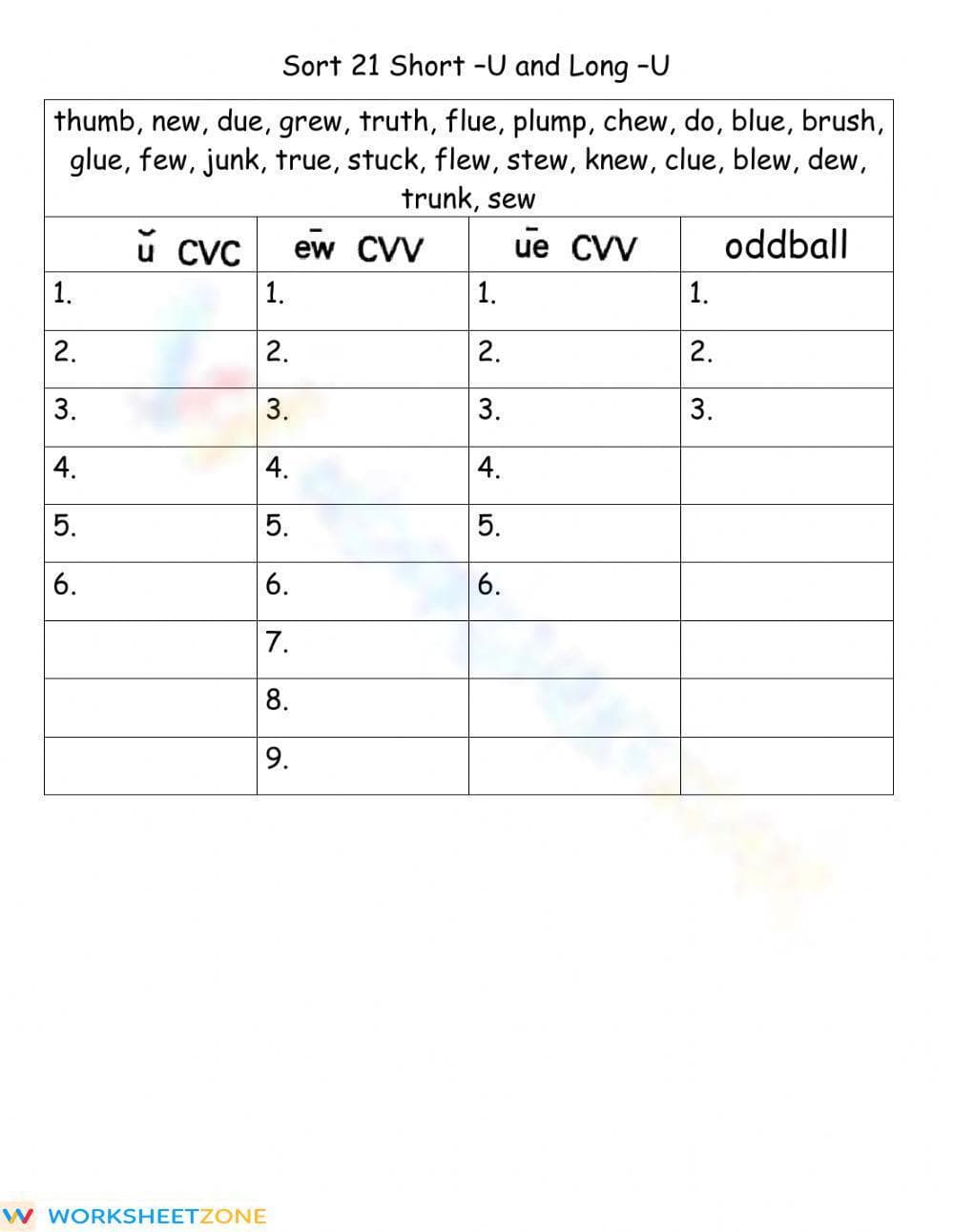

Printable Word Sort 21: Short & Long U Vowel Patterns
Paste this activity's link or code into your existing LMS (Google Classroom, Canvas, Teams, Schoology, Moodle, etc.).
Students can open and work on the activity right away, with no student login required.
You'll still be able to track student progress and results from your teacher account.
This printable Grade 2 phonics worksheet provides a structured word study activity focused on distinguishing between short and long U vowel patterns. By categorizing words into specific orthographic headers, students develop the decoding skills necessary for reading fluency and accurate spelling. This resource ensures learners master the "ew" and "ue" vowel teams through active engagement.
At a Glance
- Grade: 2 · Subject: English Language Arts
- Standard:
CCSS.ELA-LITERACY.RF.2.3.B— Know spelling-sound correspondences for additional common vowel teams- Skill Focus: Short vs. Long U (ew, ue) Vowel Patterns
- Format: 1 page · 24 words · Answer key included · PDF
- Best For: Literacy centers and independent word study
- Time: 15–20 minutes
This single-page PDF contains a comprehensive word sort featuring 24 words. The worksheet is organized into four distinct categories: Short U (CVC), Long U with the "ew" pattern, Long U with the "ue" pattern, and an "oddball" column for irregular spellings like "do" and "sew." The clear grid layout and balanced word list facilitate easy cutting and pasting or written transcription into student notebooks.
Implementing this word study resource requires minimal effort, making it an ideal choice for busy educators or substitute lesson plans. First, print the single-page PDF (30 seconds). Second, distribute the sheets to students for independent sorting or partner work (1 minute). Finally, review the completed columns using the included answer key to provide immediate feedback on phonological accuracy. Total teacher prep time is under 2 minutes.
The primary focus of this activity is CCSS.ELA-LITERACY.RF.2.3.B, which requires students to identify and apply knowledge of common vowel teams. By analyzing how different letter combinations produce the same long U sound, students strengthen their understanding of English orthography. This standard code can be copied directly into lesson plans, IEP goals, or district curriculum mapping tools to track student progress toward reading mastery.
Incorporate this worksheet during the "independent practice" phase of a phonics lesson. After introducing the long U vowel teams, assign the sort to verify student comprehension of the new patterns. For a formative assessment, observe which words students place in the "oddball" column; this reveals their ability to recognize when a common letter pattern does not follow the standard phonetic rule, such as the unique sound in "sew."
This resource is designed for Grade 2 students, though it is highly effective for Grade 1 enrichment or Grade 3 intervention. It is particularly beneficial for English Language Learners (ELL) who need explicit practice with vowel team pronunciation. Pair this worksheet with a short reading passage containing "ew" and "ue" words to reinforce the skill in a connected text context and bridge the gap between spelling and reading.
Effective word study instruction relies on the categorization of words to reveal underlying patterns in the English language. According to Fisher & Frey (2014), the gradual release of responsibility in literacy instruction is most effective when students engage in structured, independent tasks that require them to analyze spelling-sound correspondences. This worksheet targets the CCSS.ELA-LITERACY.RF.2.3.B standard by isolating the short and long U sounds, including "ew" and "ue" vowel teams. Research indicates that such focused orthographic sorting significantly improves both decoding speed and spelling retention across various learner profiles. By including "oddball" words like "sew" and "do," the activity also prompts critical thinking about phonetic exceptions, ensuring students do not over-rely on rigid rules but rather develop a nuanced, mastery-level understanding of English pronunciation and vocabulary.


