


























Views
Downloads
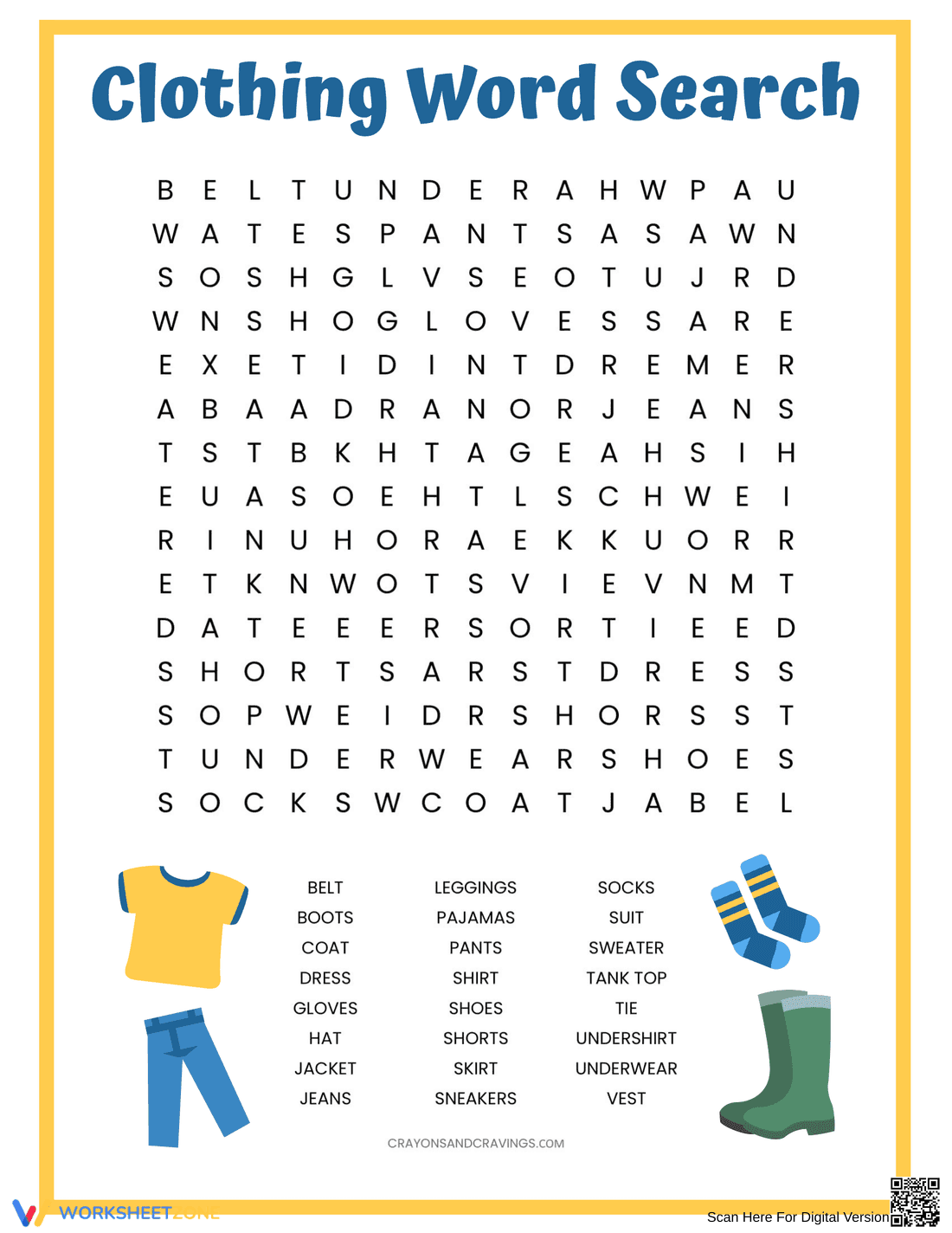

Clothing Word Search: Printable Grade 3 Vocabulary
Paste this activity's link or code into your existing LMS (Google Classroom, Canvas, Teams, Schoology, Moodle, etc.).
Students can open and work on the activity right away, with no student login required.
You'll still be able to track student progress and results from your teacher account.
This printable clothing word search helps third-grade students master spelling and identify common apparel terms. By searching for themed vocabulary, learners reinforce word recognition and cognitive scanning skills. This activity provides an engaging way to build language acquisition and contextual understanding of everyday items.
At a Glance
- Grade: 3 · Subject: ELA & Vocabulary
- Standard:
CCSS.ELA-LITERACY.L.3.6— Acquire and use grade-appropriate conversational and domain-specific words- Skill Focus: Spelling, word recognition, and clothing vocabulary
- Format: 1 page · 24 problems · Answer key included · PDF
- Best For: Morning work, early finishers, or sub plans
- Time: 15–20 minutes
This resource contains a single-page word search grid featuring 24 clothing-related terms. The word list includes common items like boots, coat, dress, jeans, and sweater, alongside specific terms like undershirt and vest. The layout features clear, uppercase lettering in a grid format, accompanied by colorful illustrations of clothing items to provide visual context. A complete answer key is provided to facilitate quick grading.
Implementing this activity requires minimal teacher preparation. First, print the single-page PDF document, which takes less than 1 minute. Second, distribute the sheets to students during transition times or morning routines, requiring about 30 seconds of classroom management. Finally, review the completed puzzles using the provided answer key, allowing students to self-correct their work in under 2 minutes. This efficient workflow makes the worksheet an ideal option for emergency sub plans or sudden schedule changes.
This worksheet aligns directly with the Common Core State Standard CCSS.ELA-LITERACY.L.3.6, which requires students to acquire and use grade-appropriate conversational, general academic, and domain-specific words. By identifying and spelling clothing terms, students expand their functional vocabulary. Both standard codes can be copied directly into lesson plans, IEP goals, or district curriculum mapping tools.
Use this puzzle as a warm-up activity before direct instruction in a language arts unit focusing on categorization. Alternatively, assign it as an independent practice task after introducing clothing vocabulary in an English as a Second Language (ESL) lesson. Teachers can conduct formative assessment by observing which students struggle to locate words, indicating a need for targeted visual scanning support. Students typically complete the search within 15 to 20 minutes.
This worksheet is designed for third-grade students, English language learners, and students requiring spelling intervention. To differentiate, teachers can highlight the first letter of each word on the grid for struggling readers, or ask advanced students to write sentences using five of the discovered words. Pair this activity with a thematic reading passage about clothing history or weather-appropriate attire.
This vocabulary worksheet supports the acquisition of domain-specific language aligned with standard CCSS.ELA-LITERACY.L.3.6. By engaging in word search puzzles, third-grade students practice visual scanning and orthographic mapping, which are essential components of word recognition. According to research by Fisher & Frey (2014) on vocabulary instruction, structured word play and puzzle-based activities reinforce spelling patterns and help transfer new terms into working memory. This resource provides a low-stakes environment for students to interact with thematic vocabulary, building the foundational language skills necessary for reading comprehension. The clear layout and structured word list ensure that students can independently practice spelling and word identification. Educators can integrate this tool into daily routines to support vocabulary retention and spelling accuracy across diverse student populations.


