


























Views
Plays


Word Choice and Root Words | Essential Grade 2 ELA
Paste this activity's link or code into your existing LMS (Google Classroom, Canvas, Teams, Schoology, Moodle, etc.).
Students can open and work on the activity right away, with no student login required.
You'll still be able to track student progress and results from your teacher account.
This Grade 2 ELA worksheet helps students refine their vocabulary by focusing on precise word choice and root word identification. By moving beyond basic synonyms, students learn to select words that carry specific effects and nuances, significantly improving the quality of their descriptive writing. This resource provides immediate practice in identifying how different words change the tone of a sentence.
At a Glance
At a Glance
- Grade: 2 · Subject: ELA
- Standard:
CCSS.ELA-LITERACY.L.2.5— Distinguish shades of meaning among closely related verbs and adjectives- Skill Focus: Descriptive word choice and root words
- Format: 2 pages · 10 problems · Answer key included · PDF
- Best For: Formative assessment or vocabulary quiz
- Time: 15–20 minutes
What's Inside
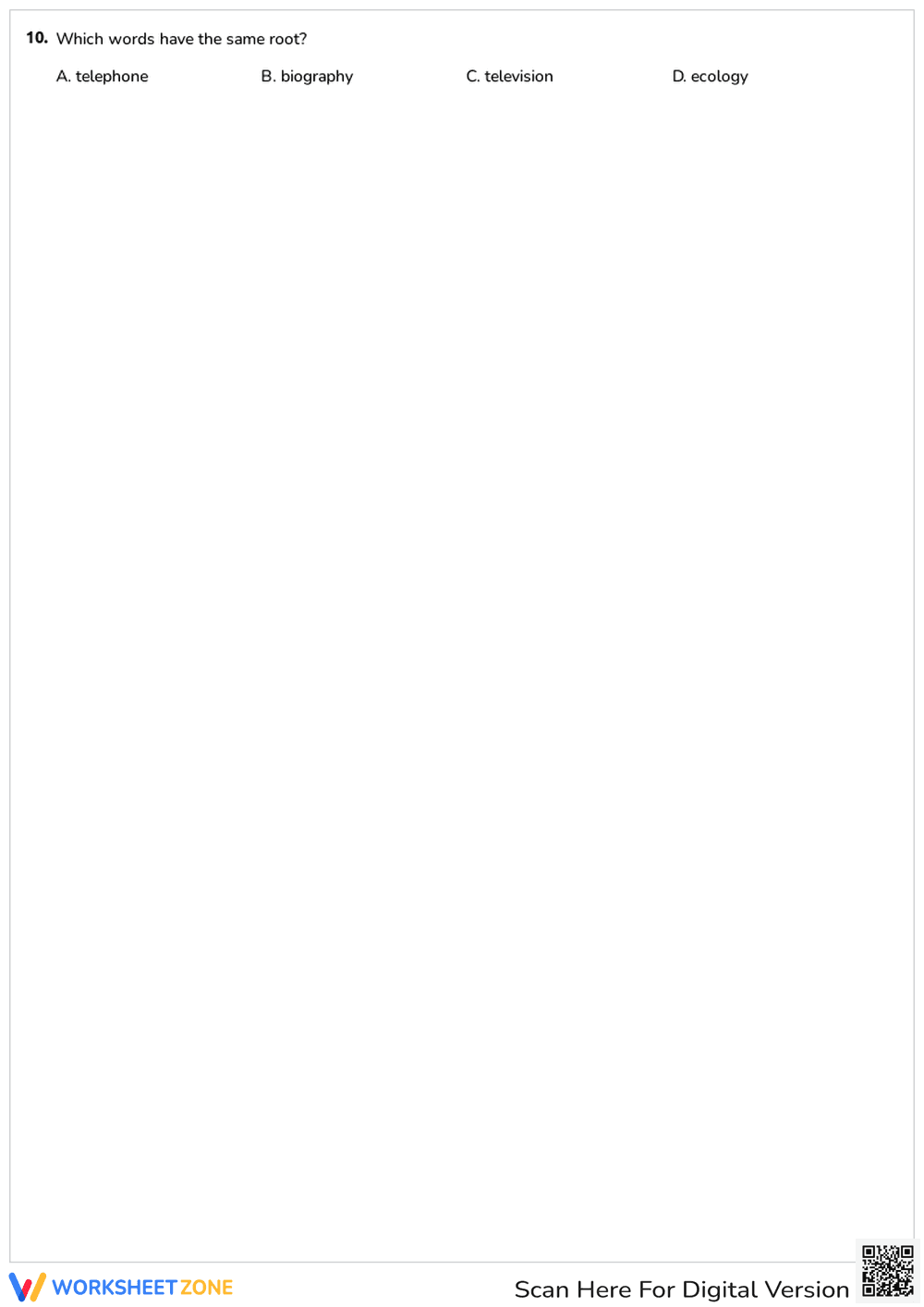
The worksheet contains 10 carefully crafted multiple-choice questions distributed across 2 pages. The first half of the assessment challenges students to identify sentences where specific words are used for effect, such as choosing "stroll" over "walk." The second half focuses on replacing common adjectives and verbs with more descriptive alternatives, alongside exercises on multiple-meaning words and basic Greek or Latin roots.
Zero-Prep Workflow
This resource is designed for a zero-prep classroom workflow. Print the 2-page PDF in seconds. Distribution takes approximately 1 minute, and because the format is a standardized multiple-choice quiz, review and grading can be completed in under 5 minutes using the included key. This makes it an ideal choice for morning work, a quick exit ticket, or an emergency sub plan.
Standards Alignment
The primary alignment for this resource is `CCSS.ELA-LITERACY.L.2.5`, which requires students to demonstrate understanding of word relationships and nuances in word meanings. It specifically addresses sub-standard L.2.5.B, which focuses on distinguishing shades of meaning among related verbs. Both standard codes can be copied directly into lesson plans, IEP goals, or district curriculum mapping tools.
How to Use It
Use this worksheet as a formative assessment after a lesson on synonyms and descriptive writing. It is best assigned during the independent practice phase of a gradual release model. Teachers should observe if students struggle with the multiple-meaning questions, which serves as a prompt to provide additional context-clue instruction. Completion typically takes 15 to 20 minutes.
Who It's For
This resource is tailored for Grade 2 students but serves as an excellent review for Grade 3 or an enrichment activity for advanced Grade 1 learners. It is particularly beneficial for English Language Learners (ELLs) who are building their academic vocabulary. Pair this worksheet with a descriptive writing prompt or a mentor text that showcases strong word choice.
This Grade 2 vocabulary resource focuses on the critical shift from basic word recognition to understanding semantic nuances and morphological structures. By requiring students to distinguish between general verbs like "walk" and descriptive alternatives like "stroll" or "trudge," the worksheet directly supports the development of precise expressive language. Research by Fisher & Frey (2014) emphasizes that intentional word choice instruction is a cornerstone of literacy development, as it allows students to convey complex meanings and emotional tones in their writing. Furthermore, the inclusion of root word identification aligns with morphological awareness strategies that predict long-term reading comprehension success. This 10-question assessment provides a clear snapshot of student mastery regarding CCSS.ELA-LITERACY.L.2.5, specifically the ability to distinguish shades of meaning among closely related verbs and adjectives. Educators can use these data points to identify specific gaps in vocabulary breadth or contextual application, ensuring that instructional interventions are targeted and effective for diverse learners.


