


























Views
Downloads
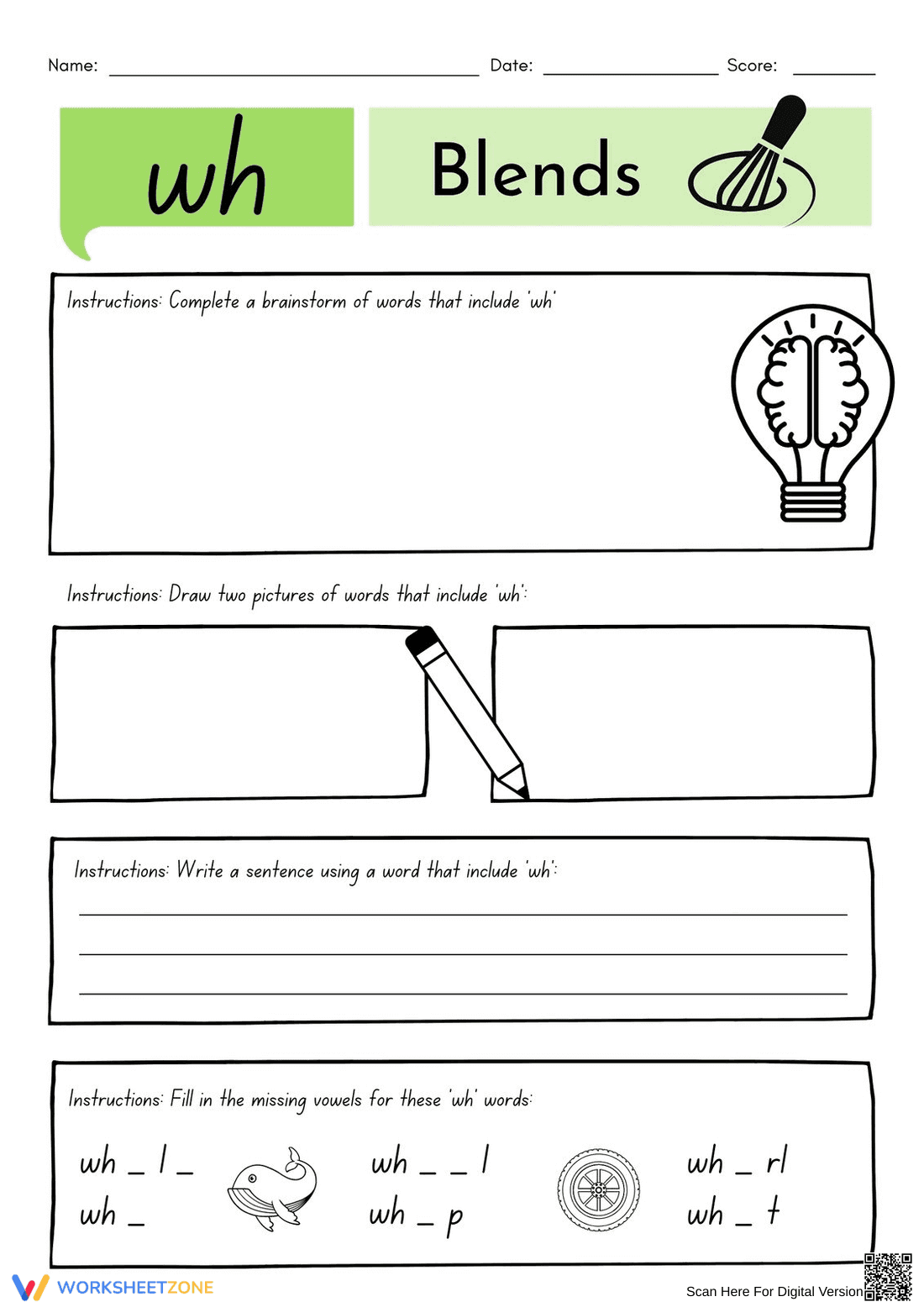

WH Digraphs & Blends Printable Worksheet | Grade 1
Paste this activity's link or code into your existing LMS (Google Classroom, Canvas, Teams, Schoology, Moodle, etc.).
Students can open and work on the activity right away, with no student login required.
You'll still be able to track student progress and results from your teacher account.
This Grade 1 phonics worksheet provides targeted practice with the "wh" consonant digraph. Students will brainstorm vocabulary, illustrate concepts, construct a complete sentence, and identify missing vowels to build foundational reading and spelling skills. The structured format ensures young learners can independently apply their phonetic knowledge.
At a Glance
- Grade: 1 · Subject: ELA
- Standard:
CCSS.ELA-LITERACY.RF.1.3.A— Know spelling-sound correspondences for common consonant digraphs.- Skill Focus: WH blends and digraphs
- Format: 1 page · 10 tasks · Answer key included · PDF
- Best For: Independent phonics practice
- Time: 15–20 minutes
This single-page resource features four task sections engaging multiple learning modalities. It begins with an open-ended brainstorming box for words starting with "wh." Next, two drawing panels allow visual representation of chosen vocabulary. A sentence-writing block encourages contextual application, while the final section contains six fill-in-the-blank exercises where students supply missing vowels to complete words like "whale" and "wheel." An answer key is provided.
Zero-Prep Workflow
Designed for immediate classroom implementation:
- Print (1 min): Download the PDF and print. The black-and-white design is ink-friendly.
- Distribute (1 min): Hand out during your literacy block. Instructions are straightforward for first graders.
- Review (3 min): Use the answer key to check the fill-in-the-blank section quickly.
Total prep time is under two minutes, making this perfect for sub plans.
Standards Alignment
This worksheet is directly aligned to CCSS.ELA-LITERACY.RF.1.3.A, requiring students to know the spelling-sound correspondences for common consonant digraphs. By isolating the "wh" sound and requiring both encoding (spelling) and expressive (writing/drawing) tasks, it reinforces phonetic mastery. Both standard codes can be copied directly into lesson plans, IEP goals, or district curriculum mapping tools.
How to Use It
Deploy this worksheet during independent literacy centers after direct instruction on digraphs. It serves as effective independent practice while the teacher pulls guided reading groups. Alternatively, use it as a formative assessment. Observe whether students independently generate "wh" words or rely on environmental print, providing valuable data for future instruction. Expected completion time is 15 to 20 minutes.
Who It's For
Designed for Grade 1 students mastering early phonics, this also serves as an intervention tool for Grade 2. The drawing tasks provide a helpful scaffold for English Language Learners (ELLs) connecting vocabulary to visual meaning. Pair this with a "wh" anchor chart or decodable passage for a comprehensive lesson.
Mastering consonant digraphs like "wh" is a critical milestone in early literacy development. According to Fisher & Frey (2014), providing students with multimodal opportunities to interact with new phonics patterns—such as drawing, writing, and spelling—significantly increases retention and automaticity. This resource directly supports CCSS.ELA-LITERACY.RF.1.3.A by asking students to know spelling-sound correspondences for common consonant digraphs. When young readers can confidently decode and encode these letter combinations, their reading fluency and reading comprehension scores improve dramatically. By combining open-ended brainstorming with structured fill-in-the-blank exercises, this worksheet ensures that students are not merely memorizing spelling lists, but actively constructing meaning around the "wh" sound. This balanced approach to phonics instruction builds the necessary cognitive pathways for long-term reading success, independent writing proficiency, and overall academic confidence in the primary grades.


