


























Views
Downloads
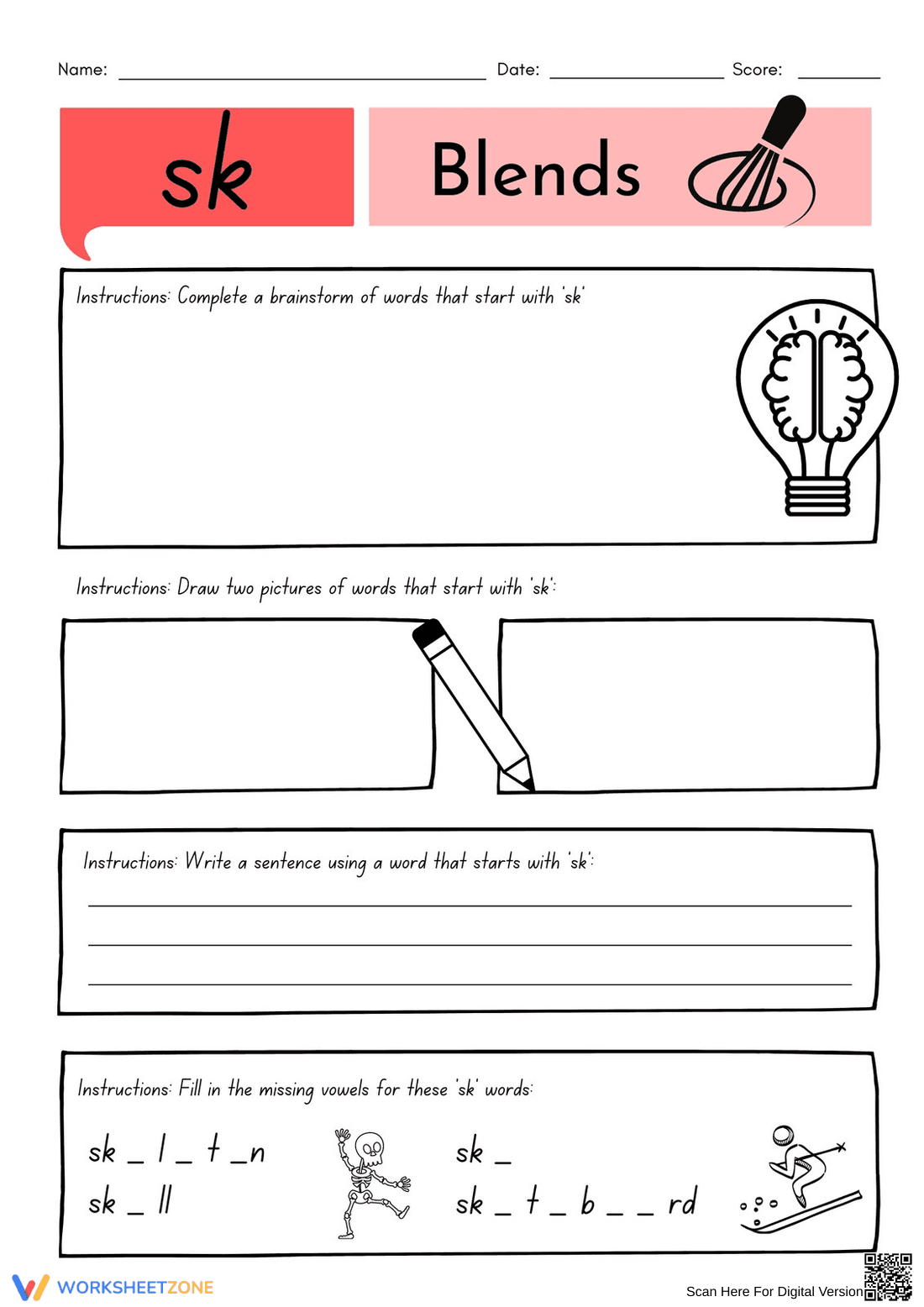

Grade 1 SK Blends — Printable No-Prep Worksheet
Paste this activity's link or code into your existing LMS (Google Classroom, Canvas, Teams, Schoology, Moodle, etc.).
Students can open and work on the activity right away, with no student login required.
You'll still be able to track student progress and results from your teacher account.
This Grade 1 phonics worksheet provides targeted practice with initial "sk" consonant blends, helping early readers connect spelling patterns to spoken sounds. Students actively brainstorm, illustrate, write, and decode words starting with "sk," building essential foundational reading skills through engaging, multi-modal activities.
At a Glance
- Grade: 1 · Subject: ELA
- Standard:
CCSS.ELA-LITERACY.RF.1.3— Know and apply grade-level phonics and word analysis skills in decoding words.- Skill Focus: Initial Consonant Blends (SK)
- Format: 1 page · 4 problems · Answer key included · PDF
- Best For: Independent phonics practice, morning work, and small group literacy centers
- Time: 10–15 minutes
Inside this single-page resource, educators will find four distinct task types designed to reinforce the "sk" blend. The worksheet begins with an open-ended brainstorming section, followed by a creative drawing task where students illustrate two "sk" words. Next, a sentence-writing prompt encourages application of the blend in context. Finally, a fill-in-the-blank decoding activity challenges students to supply missing vowels for words like skeleton and skateboard, supported by visual cues.
Designed for a zero-prep workflow, this resource is ideal for busy teachers.
- Print (1 minute): Download the PDF and print. The design is ink-friendly.
- Distribute (1 minute): Hand out during literacy block. Instructions are simple for early readers.
- Review (3 minutes): Check responses using the answer key or review as a class.
With total prep time under two minutes, it is perfect for sub plans.
This activity aligns directly with CCSS.ELA-LITERACY.RF.1.3, requiring students to know and apply grade-level phonics and word analysis skills in decoding words. It specifically targets the mastery of initial consonant blends, a critical step in early reading fluency. Both standard codes can be copied directly into lesson plans, IEP goals, or district curriculum mapping tools.
Teachers can utilize this worksheet during independent practice immediately following direct instruction on consonant blends. It also serves as an excellent literacy center activity where students can work collaboratively to brainstorm and decode. As a formative assessment observation tip, watch how students tackle the missing vowel section; this will reveal their grasp of both the "sk" blend and medial vowel sounds. Expected completion time ranges from 10 to 15 minutes.
This resource is primarily designed for first-grade students developing their foundational reading skills. It can be easily differentiated for below-level second graders needing phonics intervention, or advanced kindergarteners ready for consonant blends. For a complete lesson, pair this worksheet with a phonics anchor chart displaying common "sk" words and a decodable reading passage featuring the target blend.
Mastering initial consonant blends like "sk" is a fundamental component of early literacy development. According to a 2024 report by EdReports, explicit and systematic phonics instruction significantly improves decoding accuracy and reading comprehension in primary grades. This worksheet directly supports CCSS.ELA-LITERACY.RF.1.3 by requiring students to apply grade-level phonics and word analysis skills. By engaging in varied tasks—from brainstorming to sentence construction—students solidify their understanding of how individual phonemes blend together to form recognizable words. The structured practice provided here ensures that learners not only recognize the visual pattern of the blend but can also produce it orally and apply it in written contexts. Consistent exposure to targeted phonics exercises is proven to build the automaticity necessary for fluent reading, making this resource an essential tool for early childhood educators focused on evidence-based literacy instruction.


