


























Views
Downloads

Community Helpers Word Scramble | Essential Grade 2 ELA
Paste this activity's link or code into your existing LMS (Google Classroom, Canvas, Teams, Schoology, Moodle, etc.).
Students can open and work on the activity right away, with no student login required.
You'll still be able to track student progress and results from your teacher account.
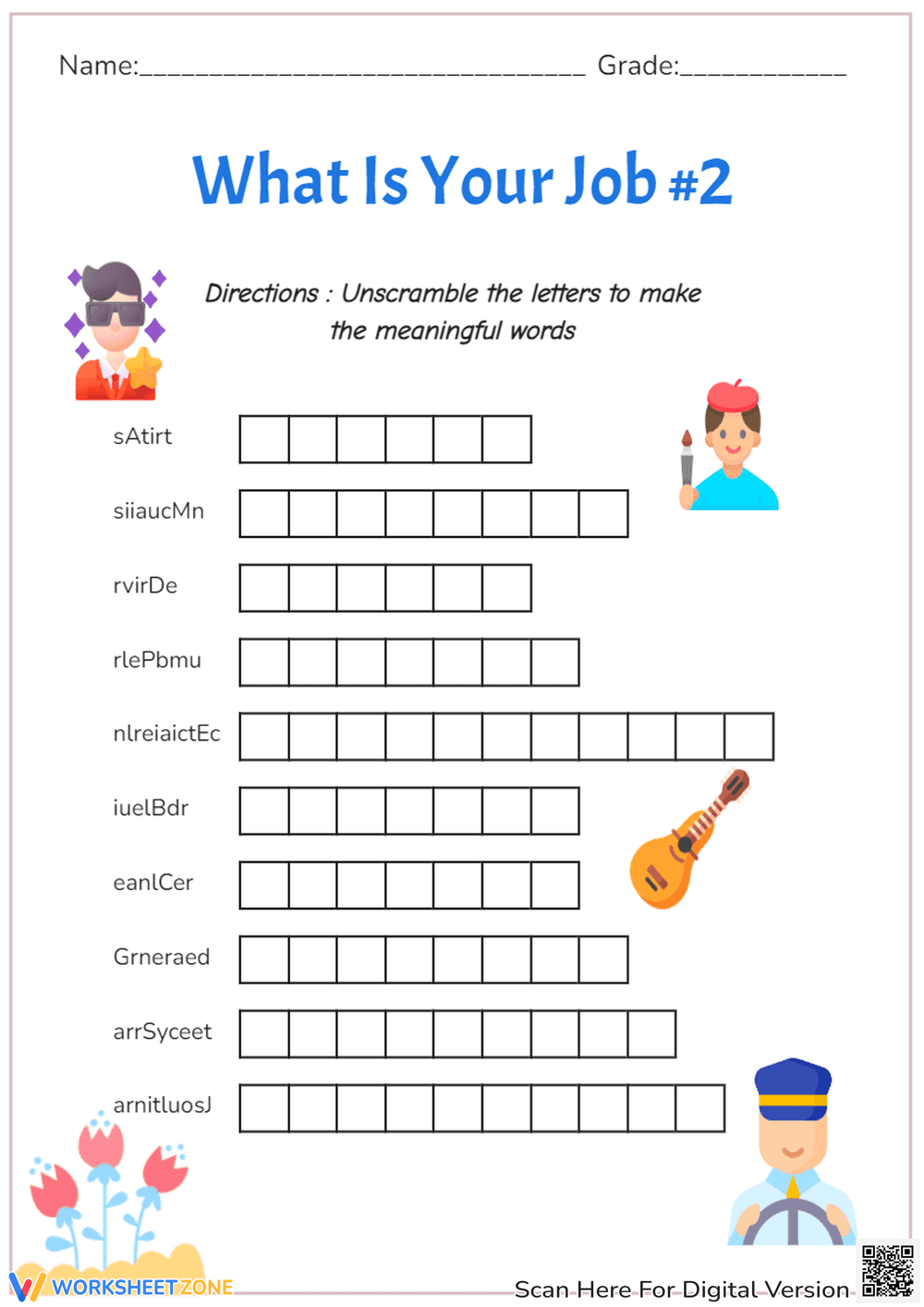
This Grade 2 community helpers worksheet strengthens spelling and vocabulary through an engaging word scramble format. Students analyze scrambled letter strings to identify common professions, reinforcing letter-sound relationships and word recognition. By decoding terms like Electrician and Journalist, learners build the linguistic confidence necessary for reading informational texts about society and careers.
At a Glance
- Grade: 2 · Subject: ELA
- Standard:
CCSS.ELA-LITERACY.L.2.2— Demonstrate command of the conventions of standard English capitalization, punctuation, and spelling.- Skill Focus: Spelling & Vocabulary
- Format: 1 page · 10 problems · Answer key included · PDF
- Best For: Independent practice or morning work
- Time: 15–20 minutes
Inside this resource, you will find a single-page activity featuring 10 distinct word scramble challenges. Each task provides a jumbled set of letters corresponding to a specific job title, accompanied by a letter-box grid to guide student spelling. The layout is clean and visually supported by colorful icons representing various professions, ensuring students remain engaged while working through the list.
The zero-prep workflow for this worksheet is designed for maximum efficiency. First, print the single-page PDF (30 seconds). Next, distribute the sheets to your students as they arrive or during a transition (1 minute). Finally, review the answers as a whole group using the included key to provide immediate feedback (5 minutes). This makes it an ideal choice for emergency sub plans or quick literacy warm-ups.
This worksheet aligns with CCSS.ELA-LITERACY.L.2.2, which requires students to demonstrate command of the conventions of standard English spelling. By unscrambling complex words, students practice phonemic awareness and orthographic mapping. This resource also supports vocabulary development used to describe connections between community roles. Both standard codes can be copied directly into lesson plans, IEP goals, or district curriculum mapping tools.
Use this worksheet as a formative assessment after a social studies unit on community helpers. It serves as an excellent exit ticket to gauge spelling proficiency. Alternatively, assign it during literacy centers to promote independent problem-solving. Teachers should observe if students use the provided letter boxes to self-correct their spelling. Expect completion within 15 to 20 minutes depending on student familiarity with the terms.
This resource is tailored for Grade 2 students but is highly effective for Grade 1 enrichment or Grade 3 review. It is particularly beneficial for English Language Learners (ELLs) who need visual cues to connect vocabulary to meaning. Pair this worksheet with a community helpers anchor chart or a non-fiction picture book about different careers to provide a comprehensive learning experience.
Research from Fisher & Frey (2014) emphasizes that word-level play, such as scrambles and puzzles, significantly enhances orthographic processing and long-term vocabulary retention. This worksheet targets CCSS.ELA-LITERACY.L.2.2 by requiring students to manipulate 10 specific job-related terms, moving them from passive recognition to active production. According to the RAND AIRS 2024 report, structured spelling practice that incorporates visual scaffolds—like the letter boxes used here—reduces cognitive load for developing readers, allowing them to focus on phoneme-grapheme mapping. By engaging with high-frequency community helper terms, students build the foundational literacy skills required for more complex informational reading. This resource provides a measurable way to track student progress in spelling conventions while reinforcing social studies concepts. It is a high-utility tool for any primary classroom seeking to bridge the gap between vocabulary acquisition and standard English conventions through evidence-based, low-stakes practice.


