


























Views
Downloads

Back to School Word Scramble | Grade 2 Essential
Paste this activity's link or code into your existing LMS (Google Classroom, Canvas, Teams, Schoology, Moodle, etc.).
Students can open and work on the activity right away, with no student login required.
You'll still be able to track student progress and results from your teacher account.
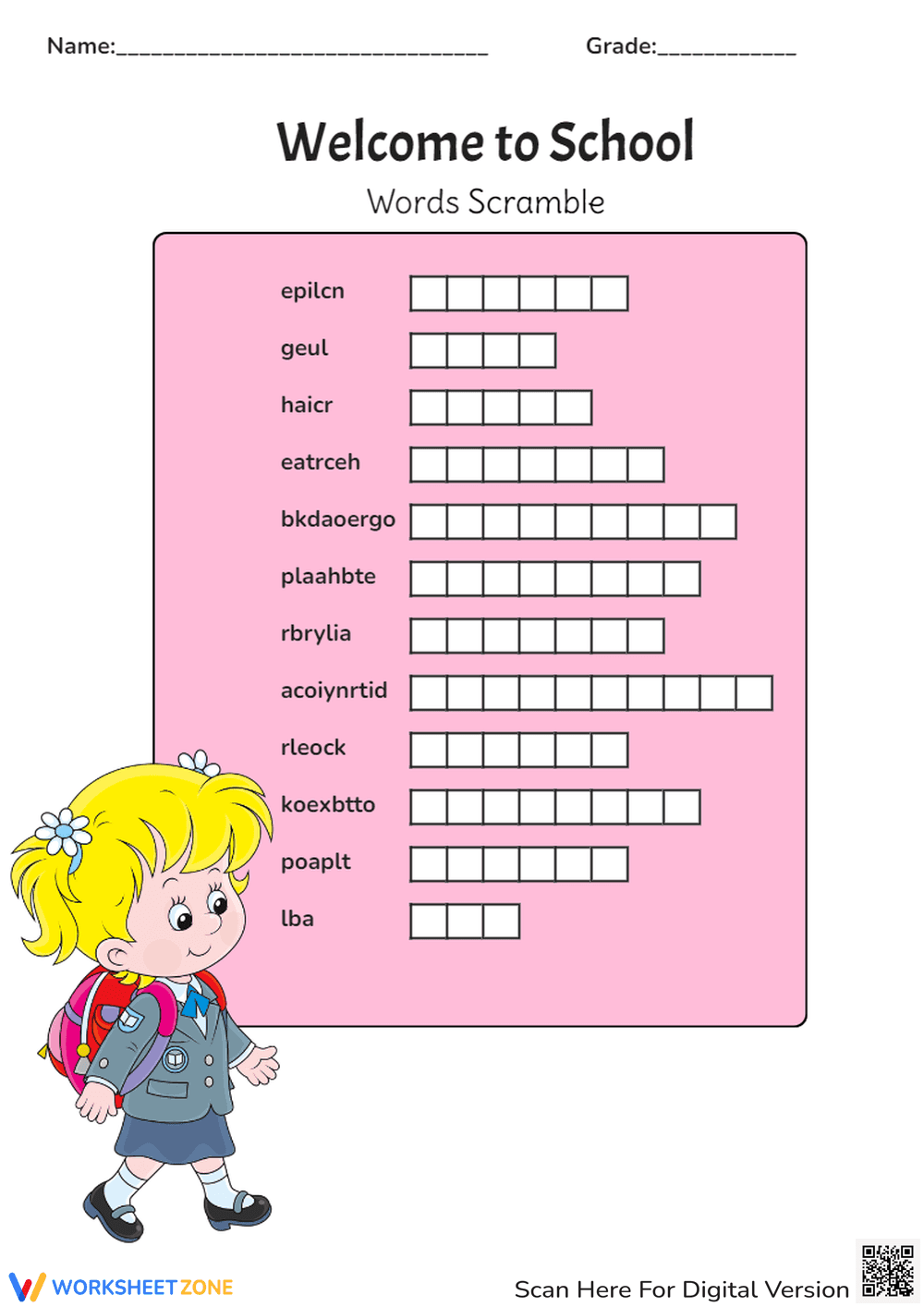
This Grade 2 word scramble worksheet helps students master school-themed vocabulary through engaging letter-rearrangement tasks. By decoding 12 essential classroom terms, learners strengthen their phonemic awareness and orthographic mapping skills. It serves as an ideal icebreaker for the first week of school, ensuring students feel confident while practicing fundamental spelling patterns in a low-stakes environment.
At a Glance
- Grade: 2 · Subject: ELA
- Standard:
CCSS.ELA-LITERACY.L.2.2— Demonstrate command of the conventions of standard English capitalization, punctuation, and spelling.- Skill Focus: Spelling and Vocabulary
- Format: 1 page · 12 problems · Answer key included · PDF
- Best For: Back-to-school icebreakers and morning work
- Time: 15–20 minutes
Inside this resource, you will find a single-page activity featuring 12 scrambled school-related words. Each word is accompanied by a clear letter-box grid that provides a visual scaffold for the correct word length. The layout is clean and student-friendly, featuring a cheerful illustration to maintain engagement. A comprehensive answer key is provided to facilitate quick grading or student self-correction.
The zero-prep workflow for this worksheet is designed for maximum efficiency. First, print the single-page PDF (30 seconds). Next, distribute the sheets to your students as they arrive for morning work or a transition period (1 minute). Finally, review the answers as a whole group to reinforce correct spelling and pronunciation (5 minutes). Total teacher preparation time is under two minutes, making it an excellent choice for sub plans.
This worksheet aligns with CCSS.ELA-LITERACY.L.2.2, focusing on the ability to generalize learned spelling patterns when writing words. It also supports vocabulary acquisition for younger learners transitioning into more complex letter combinations. Both standard codes can be copied directly into lesson plans, IEP goals, or district curriculum mapping tools.
Use this worksheet as a "bell-ringer" during the first week of the academic year to assess baseline spelling abilities. It also functions well as a formative assessment tool; observe which students struggle with longer words like "dictionary" or "chalkboard" to identify those needing additional phonics support. Completion typically takes 15 to 20 minutes depending on the student's grade level and familiarity with the terms.
This resource is designed for students in Grades 1 through 4, with a primary focus on Grade 2 developmental levels. It is particularly effective for English Language Learners (ELLs) who benefit from visual word-length cues. Pair this activity with a classroom scavenger hunt or a school-themed anchor chart to provide additional context for the vocabulary words and reinforce the learning objective.
Research from Fisher & Frey (2014) emphasizes that word-study activities, such as scrambles and puzzles, are vital for developing orthographic processing in early elementary students. By requiring students to manipulate letters to form known vocabulary, this worksheet reinforces the cognitive connection between phonemes and graphemes. The inclusion of 12 specific school-themed terms aligns with the CCSS.ELA-LITERACY.L.2.2 standard, which mandates that students demonstrate command of standard English spelling patterns. According to the RAND AIRS 2024 report, high-quality supplemental materials that focus on high-frequency vocabulary significantly improve reading fluency and writing accuracy in diverse classrooms. This worksheet provides a structured yet accessible way for students to engage with academic language during critical transition periods. By integrating these spelling tasks into the daily routine, educators can foster a more robust lexical foundation, ensuring that students are prepared for the increasing linguistic demands of higher grade levels.


