


























Views
Downloads

Calculating Area Worksheet: Grade 4 Essential Math Printable
Paste this activity's link or code into your existing LMS (Google Classroom, Canvas, Teams, Schoology, Moodle, etc.).
Students can open and work on the activity right away, with no student login required.
You'll still be able to track student progress and results from your teacher account.
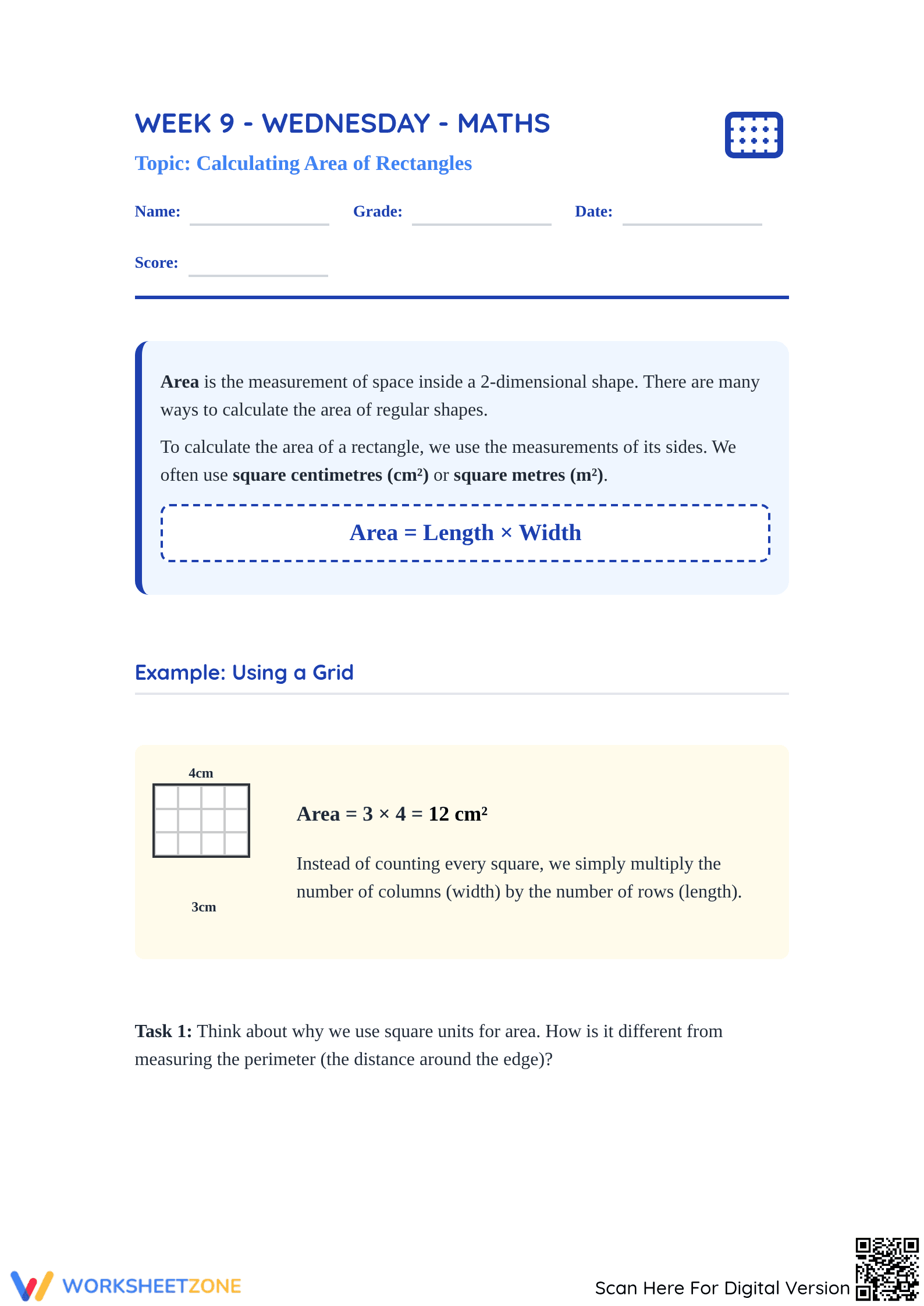
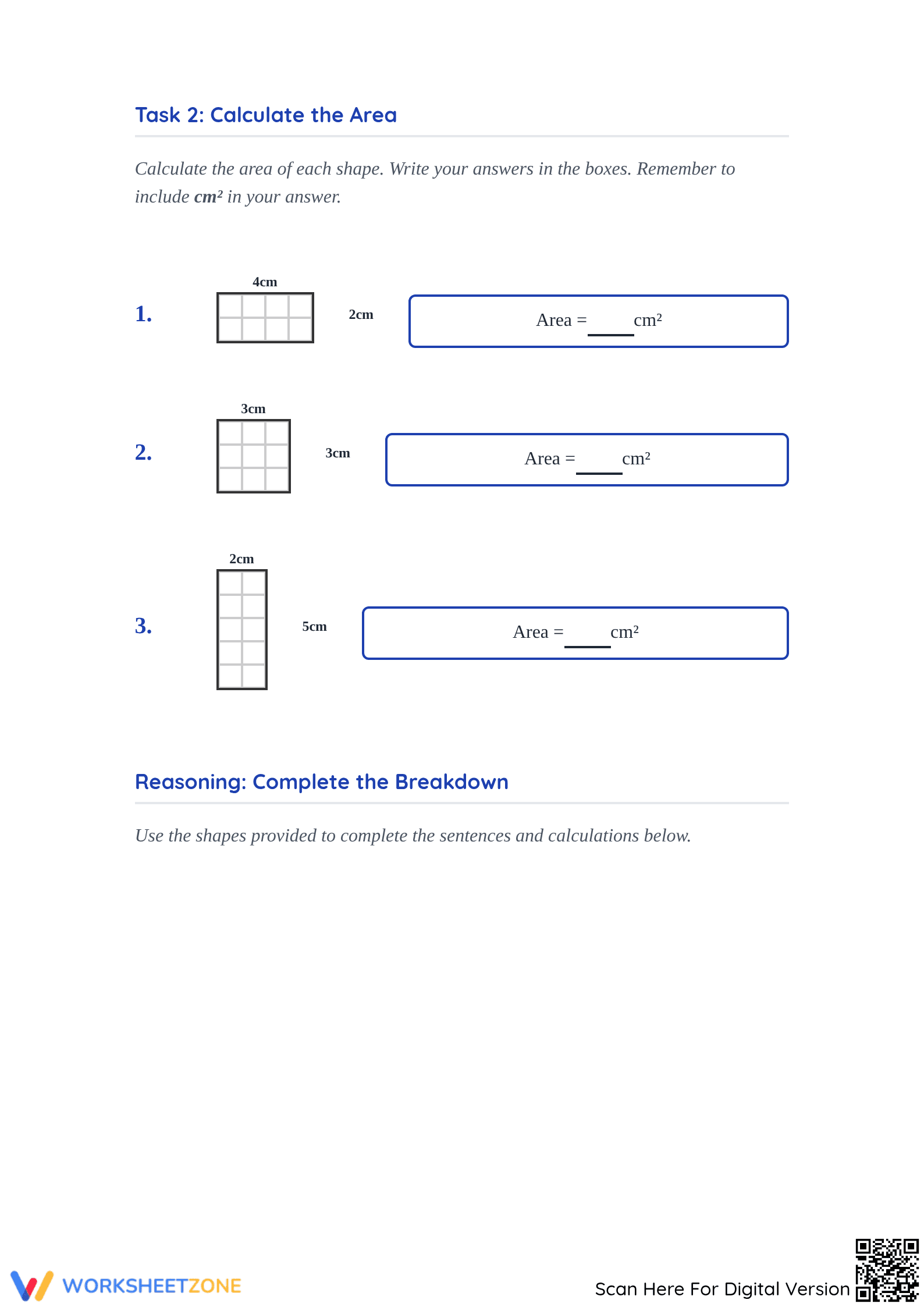
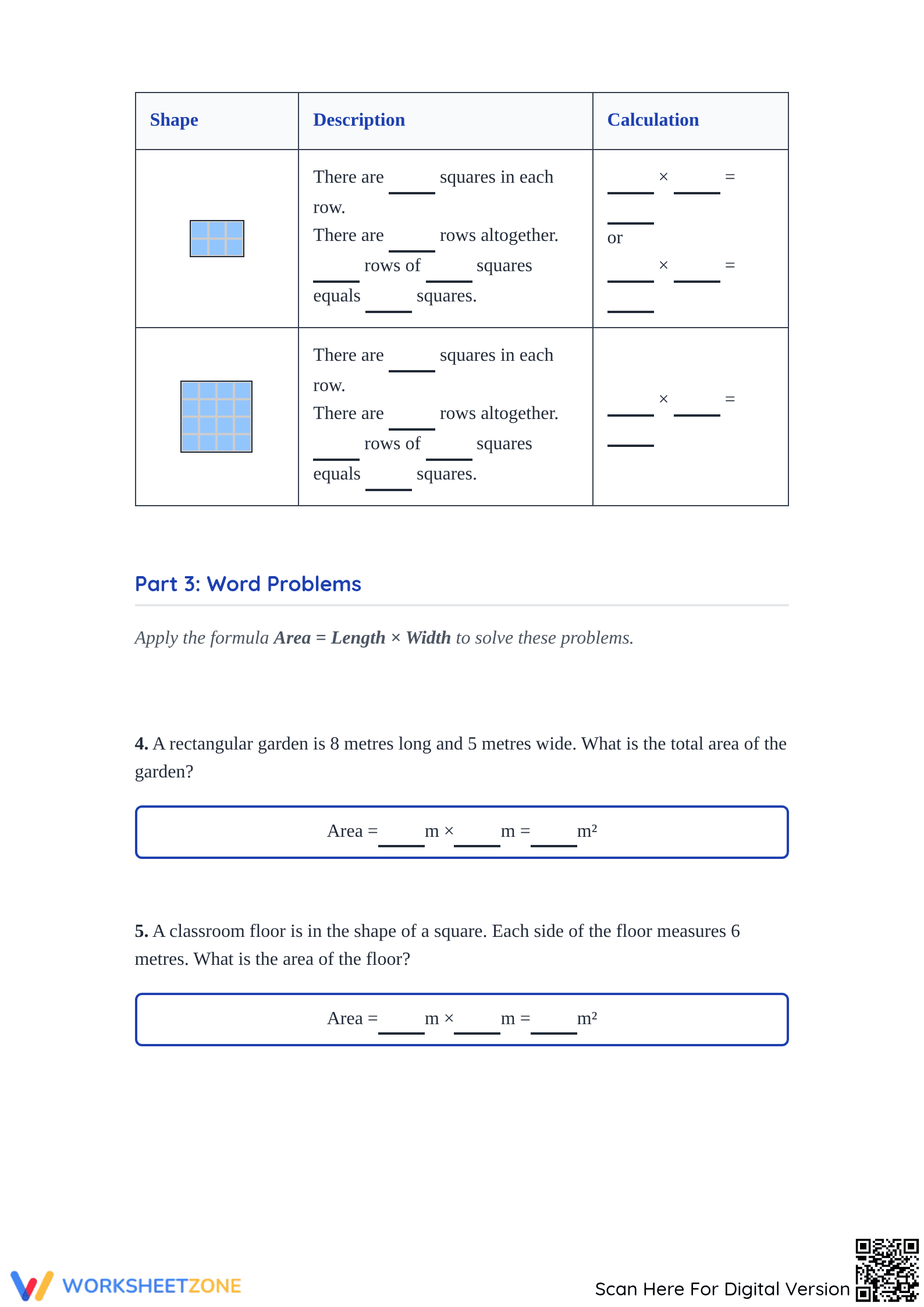
This comprehensive Grade 4 math worksheet guides students through the fundamental process of calculating the area of rectangles. By moving from conceptual understanding using grids to applying the standard formula, learners master the relationship between length, width, and square units. Students will solve real-world word problems and calculate missing dimensions with confidence.
At a Glance
- Grade: 4 · Subject: Math
- Standard:
CCSS.MATH.CONTENT.4.MD.A.3— Apply the area formula for rectangles in real-world and mathematical problems- Skill Focus: Calculating Area of Rectangles
- Format: 5 pages · 12 problems · Answer key included · PDF
- Best For: Mid-unit practice or sub plan resource
- Time: 30–45 minutes
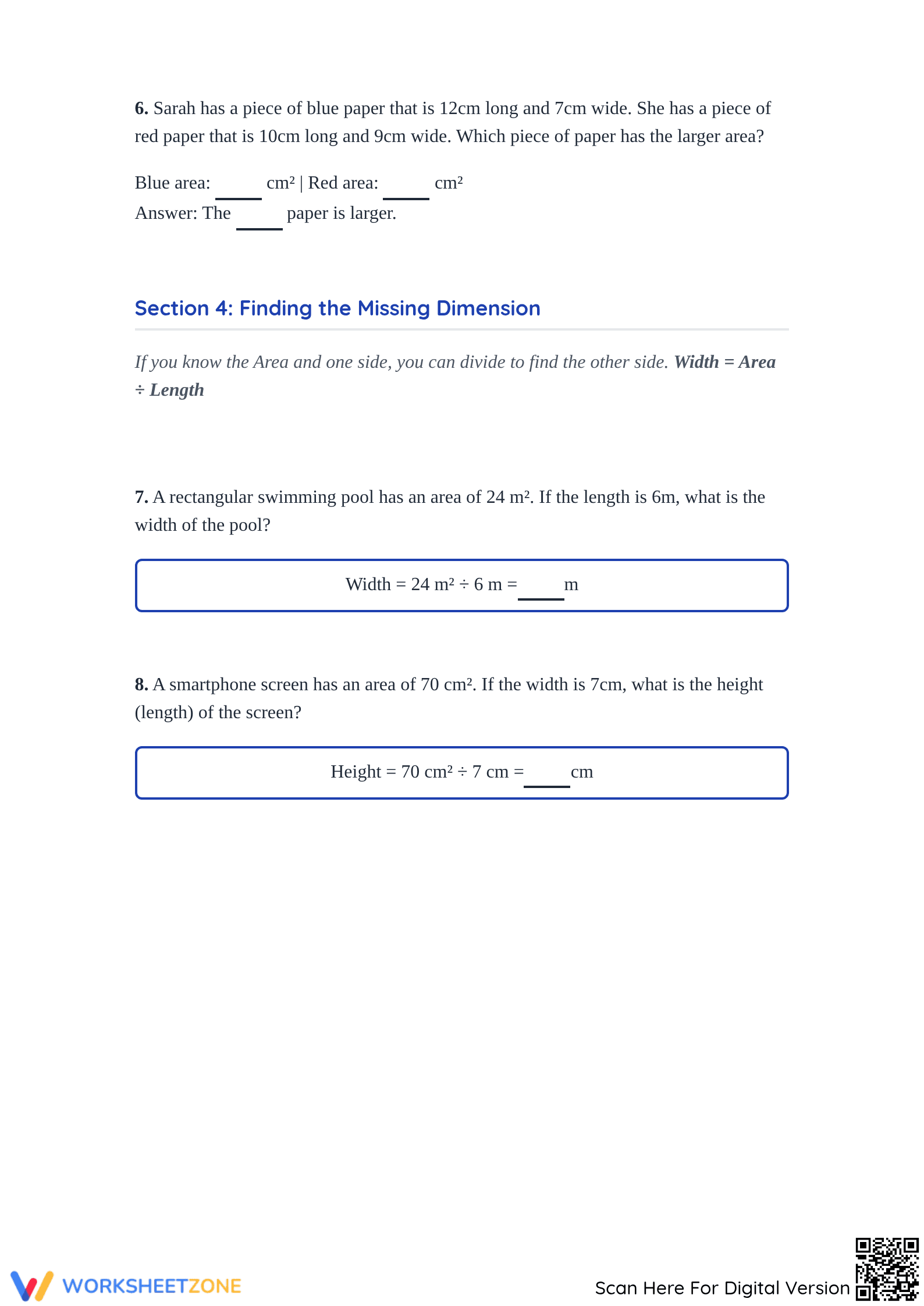
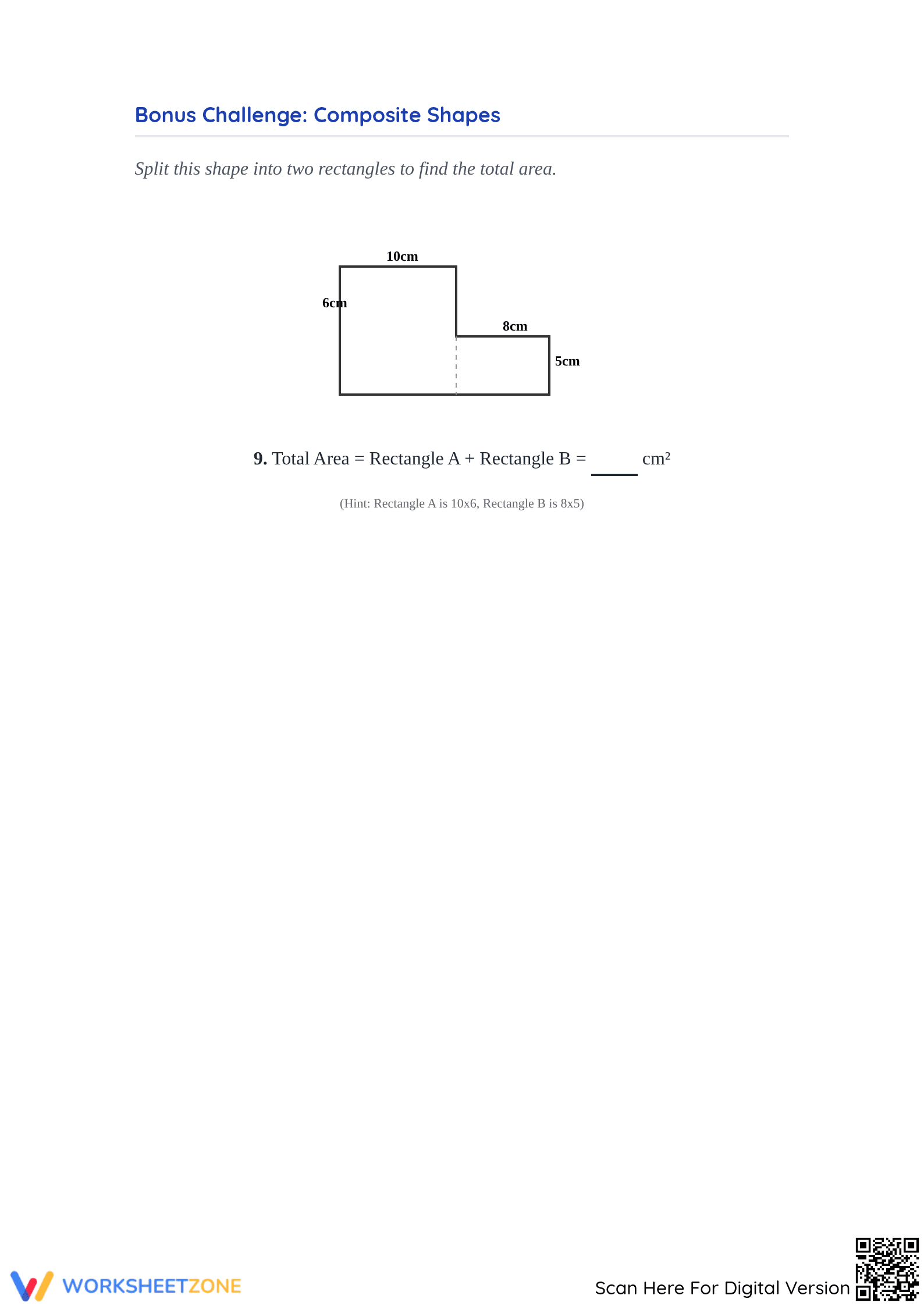
This 5-page packet features a structured progression of tasks. It starts with clear visual examples and conceptual questions about square units. The interior pages provide six direct calculation problems using grids and measurements, followed by four challenging word problems. The final sections introduce higher-order thinking with missing dimension calculations and a bonus challenge involving composite rectangular shapes. A complete answer key is provided for rapid grading and student self-correction.
Teachers can implement this resource in three simple steps: Print the 5-page PDF (30 seconds), distribute to students during the independent practice block (1 minute), and review the final results using the provided answer key (under 2 minutes). The self-explanatory layout and step-by-step examples make this an ideal "grab-and-go" sub plan or a low-stress homework assignment that requires no additional teacher setup or physical manipulatives.
The primary focus is CCSS.MATH.CONTENT.4.MD.A.3, which requires students to apply the area formula for rectangles in varied contexts. This worksheet explicitly addresses the standard by providing diverse problem types, including mathematical diagrams and descriptive real-world scenarios. Students also engage with CCSS.MATH.CONTENT.5.MD.A.1 as they navigate different units of measurement in reasoning tasks. Both standard codes can be copied directly into lesson plans, IEP goals, or district curriculum mapping tools.
Use this worksheet during the independent practice phase of a gradual release model. After modeling the Area = Length x Width formula, assign pages 1-3 for core mastery. Use the "Missing Dimension" section on page 4 as a formative assessment check; observe if students correctly identify division as the inverse operation needed. Expect students to complete the full packet within 40 minutes, depending on their familiarity with multiplication facts.
This resource is designed for Grade 4 students, but also serves as a robust review for Grade 5 and 6 learners. The inclusion of sentence frames in the reasoning section provides excellent scaffolding for English Language Learners (ELL) and students with IEPs. Pair this with a physical tiling activity or a digital area simulator for a multi-modal learning experience that reinforces the spatial nature of geometric measurement.
Aligned to CCSS.MATH.CONTENT.4.MD.A.3, this worksheet facilitates the transition from concrete tiling to abstract formula application, a critical milestone in elementary geometric reasoning. According to EdReports 2024, high-quality instructional materials must balance procedural fluency with conceptual understanding to ensure long-term retention of mathematical properties. By requiring students to explain the difference between area and perimeter in the initial task, this resource targets the underlying logic behind the calculation. Research from Fisher & Frey (2014) highlights that structured independent practice with increasing complexity—such as the transition from simple rectangles to composite shapes found here—is essential for moving students toward mastery. The inclusion of word problems and inverse missing dimension tasks ensures that students can apply their knowledge in varied contexts, meeting the rigorous demands of modern state assessments. This self-contained 5-page PDF provides the necessary breadth for a full instructional period while maintaining a high signal-to-noise ratio for learner focus and teacher efficiency.


