


























Views
Downloads
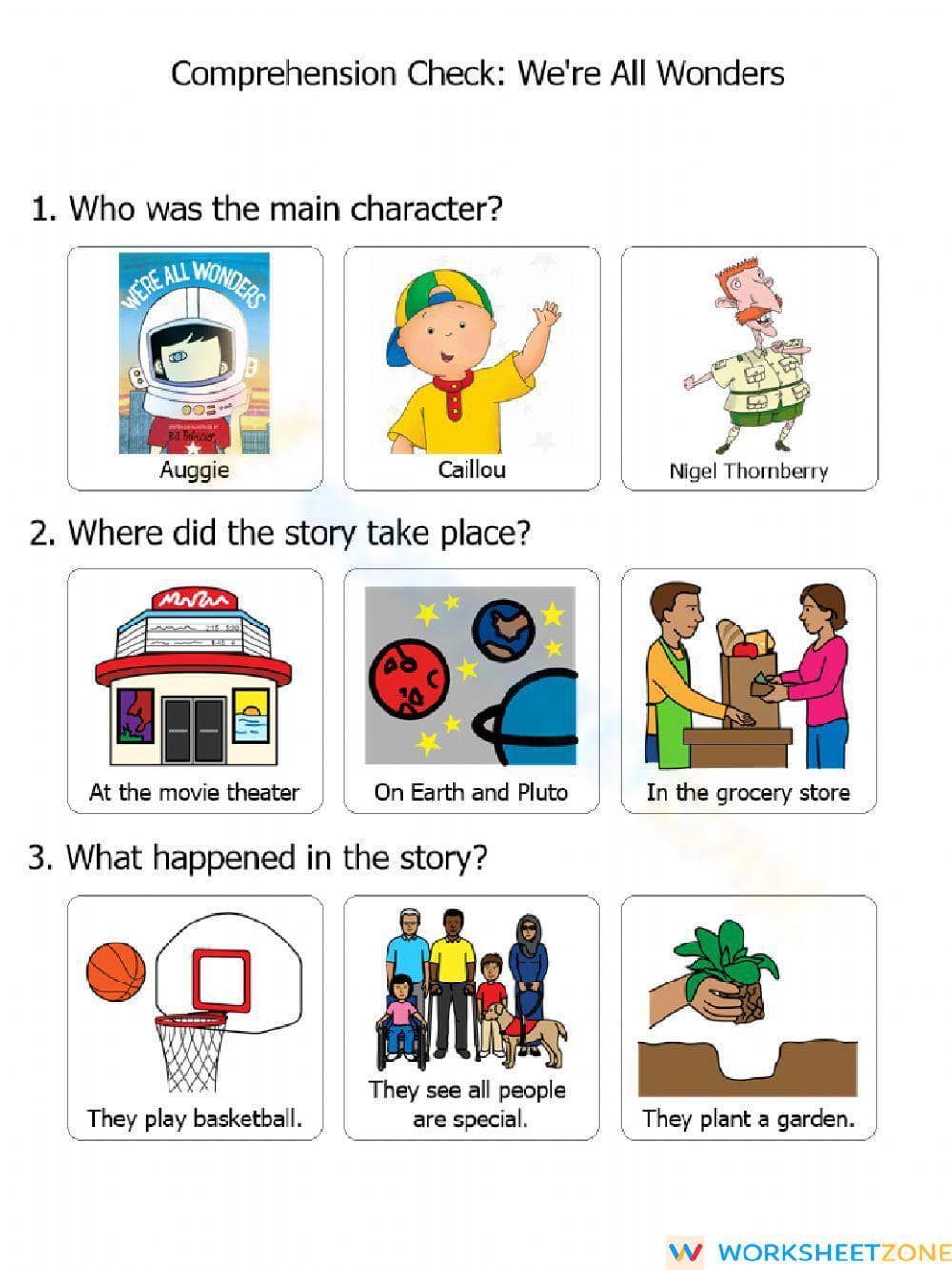

Printable We're All Wonders Reading Comprehension Worksheet
Paste this activity's link or code into your existing LMS (Google Classroom, Canvas, Teams, Schoology, Moodle, etc.).
Students can open and work on the activity right away, with no student login required.
You'll still be able to track student progress and results from your teacher account.
This We're All Wonders comprehension check empowers Grade 1 through Grade 3 students to demonstrate their understanding of character, setting, and plot. By identifying Auggie’s journey and the story's core message of kindness, learners solidify their reading comprehension skills. This resource ensures students can recall key details immediately after a read-aloud or independent session.
At a Glance
- Grade: Grade 1-3 · Subject: English Language Arts
- Standard:
CCSS.ELA-LITERACY.RL.1.1— Ask and answer questions about key details in a literary text- Skill Focus: Identifying Character, Setting, and Plot
- Format: 1 page · 3 problems · Answer key included · PDF
- Best For: Post-reading assessment and comprehension check
- Time: 5–10 minutes
What's Inside
This single-page PDF features three high-impact multiple-choice questions supported by clear visual aids for younger learners. Students identify the main character, the story's setting between Earth and Pluto, and the primary plot resolution regarding the value of every person. The worksheet includes a structured answer key for rapid grading and provides enough space for student names and dates.
Zero-Prep Workflow
This resource is designed for a three-step immediate implementation. First, print the single-page PDF (30 seconds). Second, distribute the worksheets to students following a reading of We're All Wonders (1 minute). Third, review the visual answers as a class or individually to check for understanding (2 minutes). Total teacher preparation time is well under two minutes, making it ideal for busy mornings.
Standards Alignment
This worksheet is primarily aligned to CCSS.ELA-LITERACY.RL.1.1, which requires students to ask and answer questions about key details in a text. By focusing on the "who," "where," and "what" of the story, it also supports RL.2.1 and RL.3.1. Both standard codes can be copied directly into lesson plans, IEP goals, or district curriculum mapping tools.
How to Use It
Use this as a "exit ticket" immediately following a direct instruction read-aloud to gauge student engagement and memory retention. Alternatively, assign it during independent literacy centers for Grade 2 and 3 students who have read the book themselves. A formative assessment tip is to observe if students rely on the illustrations or the text labels to choose their answers.
Who It's For
This comprehension check is perfect for early elementary students in Grades 1-3, including English Language Learners who benefit from the visual scaffolding. It naturally pairs with a character education lesson on empathy or a classroom anchor chart focused on "Wh- Questions." The simple layout ensures that the task remains focused on comprehension rather than decoding.
Effective reading instruction requires consistent checks for understanding that allow students to connect character actions with thematic outcomes. This worksheet facilitates that connection by isolating three critical narrative elements—character, setting, and event—aligned to CCSS.ELA-LITERACY.RL.1.1. According to Fisher & Frey (2014), the use of scaffolded questions and visual supports is vital for developing the literal comprehension skills necessary for later inferential thinking. By identifying Auggie's unique perspective and the "Earth and Pluto" setting, students demonstrate their ability to navigate complex narrative structures in a simplified format. This assessment provides 3 clear data points for teachers to track mastery of foundational literacy standards. The visual options minimize cognitive load, ensuring that students can focus on the specific skill of detail recall. This structured approach is proven to support long-term literacy gains and can be integrated into any balanced literacy curriculum without additional preparation.


