


























Views
Downloads
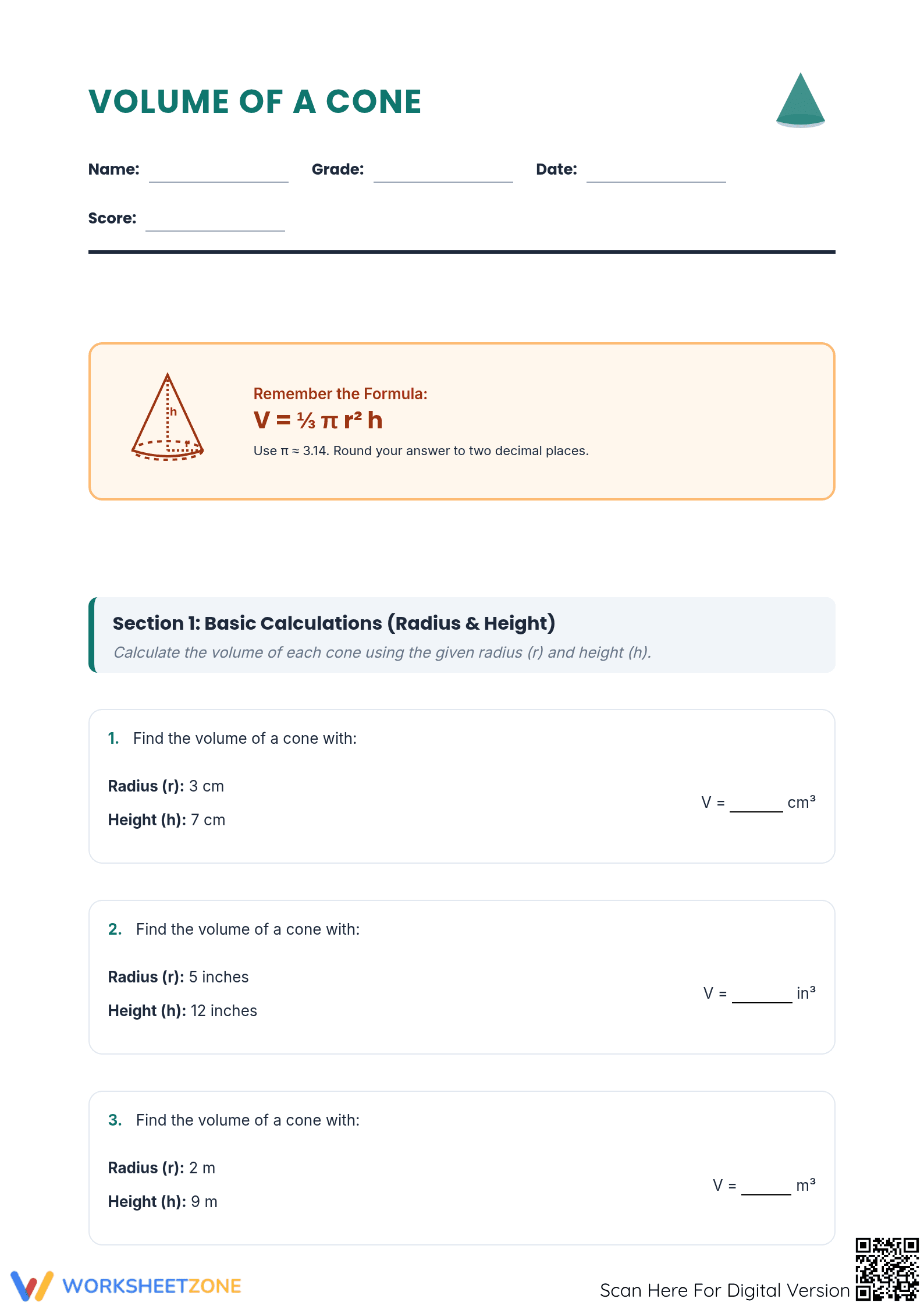


Printable Volume of a Cone Worksheet | Grade 8 Math
Paste this activity's link or code into your existing LMS (Google Classroom, Canvas, Teams, Schoology, Moodle, etc.).
Students can open and work on the activity right away, with no student login required.
You'll still be able to track student progress and results from your teacher account.
Mastering three-dimensional geometry requires consistent practice with formulas and spatial reasoning. This Grade 8 worksheet provides a structured sequence for calculating the volume of a cone, moving from basic calculations to real-world applications. Students will build computational fluency while applying the standard formula to various mathematical and practical scenarios involving both radius and diameter.
At a Glance
- Grade: 8 · Subject: Math (Geometry)
- Standard:
CCSS.MATH.CONTENT.8.G.C.9— Use formulas to calculate the volumes of cones and solve real-world problems- Skill Focus: Volume of Cones (Radius, Diameter, Word Problems)
- Format: 4 pages · 16 problems · Answer key included · PDF
- Best For: Independent practice, homework, or formative assessment
- Time: 35–50 minutes
What's Inside
This 4-page PDF packet contains 16 problems organized by difficulty. Page 1 focuses on calculations using radius and height. Page 2 introduces challenge problems where students must determine radius from diameter. The final pages provide real-world applications and a challenge task requiring students to solve for a missing dimension, ensuring a complete path to geometric mastery.
Zero-Prep Workflow
- Print (30 seconds): Open the 4-page PDF and print copies for your class. The high-contrast layout ensures clear visibility.
- Distribute (1 minute): Hand out the packets as a follow-up to direct instruction. No teacher setup is required.
- Review (5 minutes): Use the included answer key to grade submissions or project the solutions for immediate student self-correction.
Standards Alignment
The primary focus is CCSS.MATH.CONTENT.8.G.C.9, requiring students to know and use volume formulas for cones. The worksheet provides iterative practice with the formula V = 1/3πr²h and addresses supporting standards for rounding and unit conversion. These standard codes can be copied directly into lesson plans or curriculum mapping tools.
How to Use It
This packet is ideal for the "Independent Practice" phase. After modeling the formula, assign Section 1 to check for understanding before progressing to word problems. For a formative assessment tip, observe students during Section 2 to ensure they correctly divide the diameter by two, a frequent point of error.
Who It's For
Designed for Grade 8, this resource also suits high school geometry review. The tiered sections provide natural differentiation based on student readiness. It pairs well with an interactive whiteboard lesson on 3D shapes or hands-on activities involving physical models of cones and cylinders.
According to EdReports (2024), high-quality math instructional materials must balance procedural fluency with conceptual understanding and application. This worksheet achieves that balance by providing 16 targeted tasks that move from simple formula application to complex problem-solving. Research from the NAEP highlights that students who consistently engage with multiple representations of geometric problems, such as the mix of visual diagrams and text-based word problems found here, show significantly higher retention rates. By requiring students to interpret diameter measurements and solve for missing variables in Section 3, this resource aligns with the rigor demanded by CCSS.MATH.CONTENT.8.G.C.9. This 4-page packet serves as a reliable tool for classroom teachers seeking to solidify student mastery of cone volume through structured, standards-aligned practice that is both efficient for the educator and effective for the learner.


