


























Views
Plays

French Feelings Worksheet | Essential Grade 1-2 Ready
Paste this activity's link or code into your existing LMS (Google Classroom, Canvas, Teams, Schoology, Moodle, etc.).
Students can open and work on the activity right away, with no student login required.
You'll still be able to track student progress and results from your teacher account.
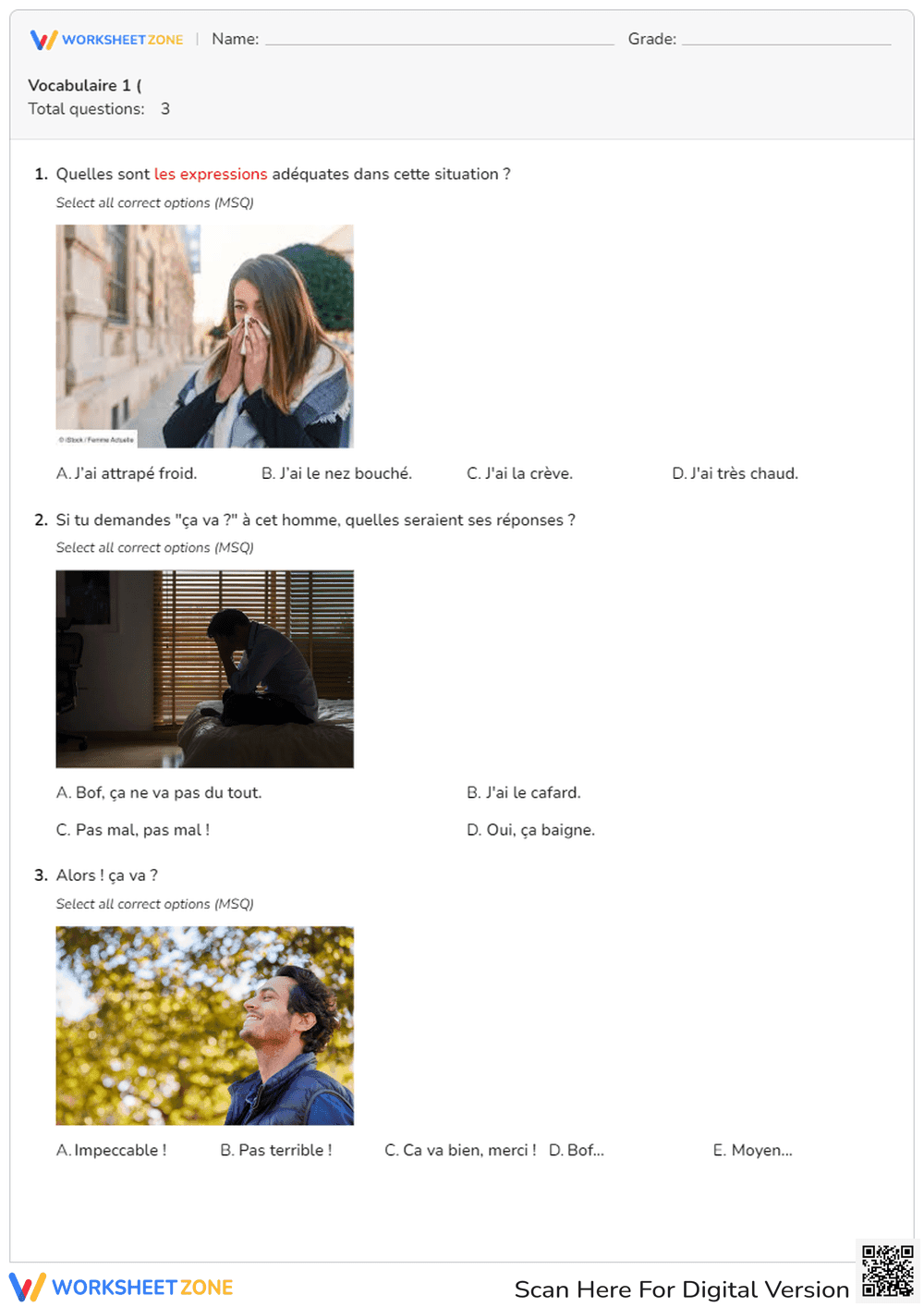
This French vocabulary worksheet helps novice learners identify and express physical and emotional states. By connecting visual cues to specific idiomatic expressions like "J'ai attrapé froid" or "J'ai le cafard," students build the foundational communication skills necessary for basic interpersonal interactions in a second language before moving to complex dialogue.
At a Glance
- Grade: 1-2 · Subject: French
- Standard:
ACTFL.W-L.1.1— Identify common words and phrases for feelings and health- Skill Focus: French greetings and health vocabulary
- Format: 1 page · 3 problems · Answer key included · PDF
- Best For: Quick formative assessment or warm-up
- Time: 5–10 minutes
The PDF contains one high-quality page featuring three distinct multiple-choice questions (MSQ). Each question is paired with a clear, realistic photograph to provide context for the vocabulary. Students must select all correct options that match the visual scenario, covering topics from common illnesses to emotional well-being and informal greetings.
This resource is designed for immediate classroom implementation with a zero-prep workflow. Teachers can print the single-page PDF in less than 30 seconds. Distribution takes approximately 1 minute, and because the worksheet uses a clear multiple-choice format, review and grading can be completed in under 2 minutes. It is an ideal sub-plan or bell-ringer activity for busy educators.
Aligned to ACTFL.W-L.1.1, students demonstrate understanding of simple, everyday greetings and expressions of well-being. This aligns with the Novice Low to Novice Mid proficiency levels where learners recognize high-frequency words and phrases. This standard code can be copied directly into lesson plans, IEP goals, or district curriculum mapping tools.
Use this as a "Do Now" activity at the start of a French lesson to activate prior knowledge. Alternatively, use it as an exit ticket to gauge student mastery of the "Comment ça va?" unit. Completion typically takes 5 to 10 minutes depending on the learner's familiarity with the idioms. Teachers should observe if students can distinguish between physical health and emotional mood.
Designed for Grade 1 and Grade 2 students or any introductory French learner, this worksheet provides necessary scaffolding through imagery. It pairs perfectly with an anchor chart displaying common French emotions and physical states or a direct instruction lesson on the verb "avoir" in idiomatic expressions.
According to Fisher & Frey (2014), the use of visual non-linguistic representations significantly enhances vocabulary acquisition for second language learners by providing immediate context for abstract concepts. This worksheet applies this research by pairing high-resolution images with idiomatic French expressions like "J'ai le nez bouché" and "Ça baigne." By requiring students to select multiple correct responses, the task moves beyond simple rote memorization toward a more nuanced understanding of linguistic variety. Aligned to the ACTFL.W-L.1.1 standard, this resource ensures that students are meeting national benchmarks for novice communication. The structured format allows for quick data collection, making it a reliable tool for tracking progress in early world language programs. Educators can confidently integrate this into their curriculum to support the development of interpretive communication skills in a time-efficient manner.


