




























Views
Downloads

Printable Writing Checklist | Grade 1 ELA

Paste this activity's link or code into your existing LMS (Google Classroom, Canvas, Teams, Schoology, Moodle, etc.).
Students can open and work on the activity right away, with no student login required.
You'll still be able to track student progress and results from your teacher account.
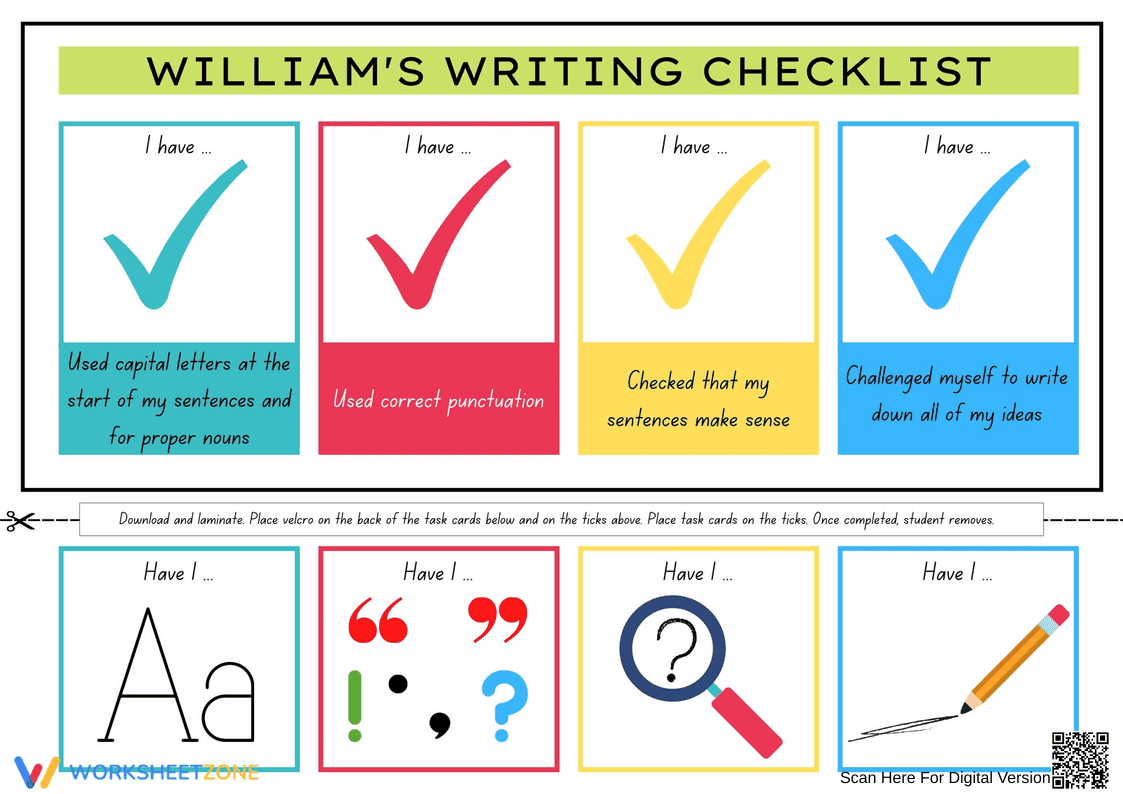
This interactive writing checklist helps early elementary students self-monitor their writing mechanics and idea generation. By using visual cues and hands-on task cards, young writers actively check for capitalization, punctuation, and sentence clarity, fostering independence and confidence during independent writing blocks.
At a Glance
- Grade: 1 · Subject: ELA
- Standard:
CCSS.ELA-LITERACY.L.1.2— Use standard English capitalization and punctuation.- Skill Focus: Writing conventions and self-monitoring
- Format: 1 page · 4 tasks · No answer key · PDF
- Best For: Independent writing stations
- Time: 5–10 minutes
This single-page resource features a four-part visual schedule designed to be laminated and used with velcro. It includes a base checklist with clear "I have..." statements and four corresponding interactive task cards. The visual prompts remind students to check for capital letters, correct punctuation, sentence sense, and idea completion. The hands-on format allows students to physically move the task cards as they complete each self-assessment step.
Skill Progression
- Guided practice: Introduce the checklist during whole-group instruction, modeling how to check a shared writing piece for capitals and punctuation using the 4 visual cards.
- Supported practice: Students use the laminated checklist during small-group writing, with teacher prompting to move the velcro pieces as they verify each convention.
- Independent practice: Writers keep the tool at their desks, independently self-monitoring their drafts before submitting final work.
This gradual-release approach ensures students internalize the I Do, We Do, You Do model of writing revision.
Standards Alignment
Aligned to CCSS.ELA-LITERACY.L.1.2, this tool supports students as they demonstrate command of the conventions of standard English capitalization, punctuation, and spelling when writing. It also reinforces early sentence-level comprehension and self-correction strategies. Both standard codes can be copied directly into lesson plans, IEP goals, or district curriculum mapping tools.
How to Use It
Introduce this visual schedule before independent writing time to set clear expectations for mechanics. During the writing process, teachers can use it as a quick formative assessment tool by observing which students independently move their velcro task cards and which require reminders to check their punctuation. Expect students to spend 5 to 10 minutes reviewing their work with this checklist at the end of a writing session.
Who It's For
This resource is ideal for first-grade students, special education classrooms, and English Language Learners who benefit from visual supports and tactile engagement. The clear icons provide excellent differentiation for pre-readers or students struggling with executive functioning during multi-step writing tasks. Pair this checklist with a foundational anchor chart on punctuation for maximum impact.
Integrating visual schedules and self-monitoring tools directly impacts student achievement in early literacy. Aligned with CCSS.ELA-LITERACY.L.1.2, this resource requires students to use standard English capitalization and punctuation actively. According to Fisher & Frey (2014), providing students with clear, visual criteria for success and opportunities for self-assessment significantly increases their independence and the overall quality of their writing. When young learners can physically manipulate task cards to confirm they have checked their sentences, they transition from passive participants to active evaluators of their own work. This tactile engagement reduces cognitive overload, allowing students to focus on one specific writing convention at a time. By embedding these structured self-monitoring practices into daily routines, educators build foundational habits that support long-term writing proficiency and executive functioning skills across all academic subjects.


