


























Views
Downloads
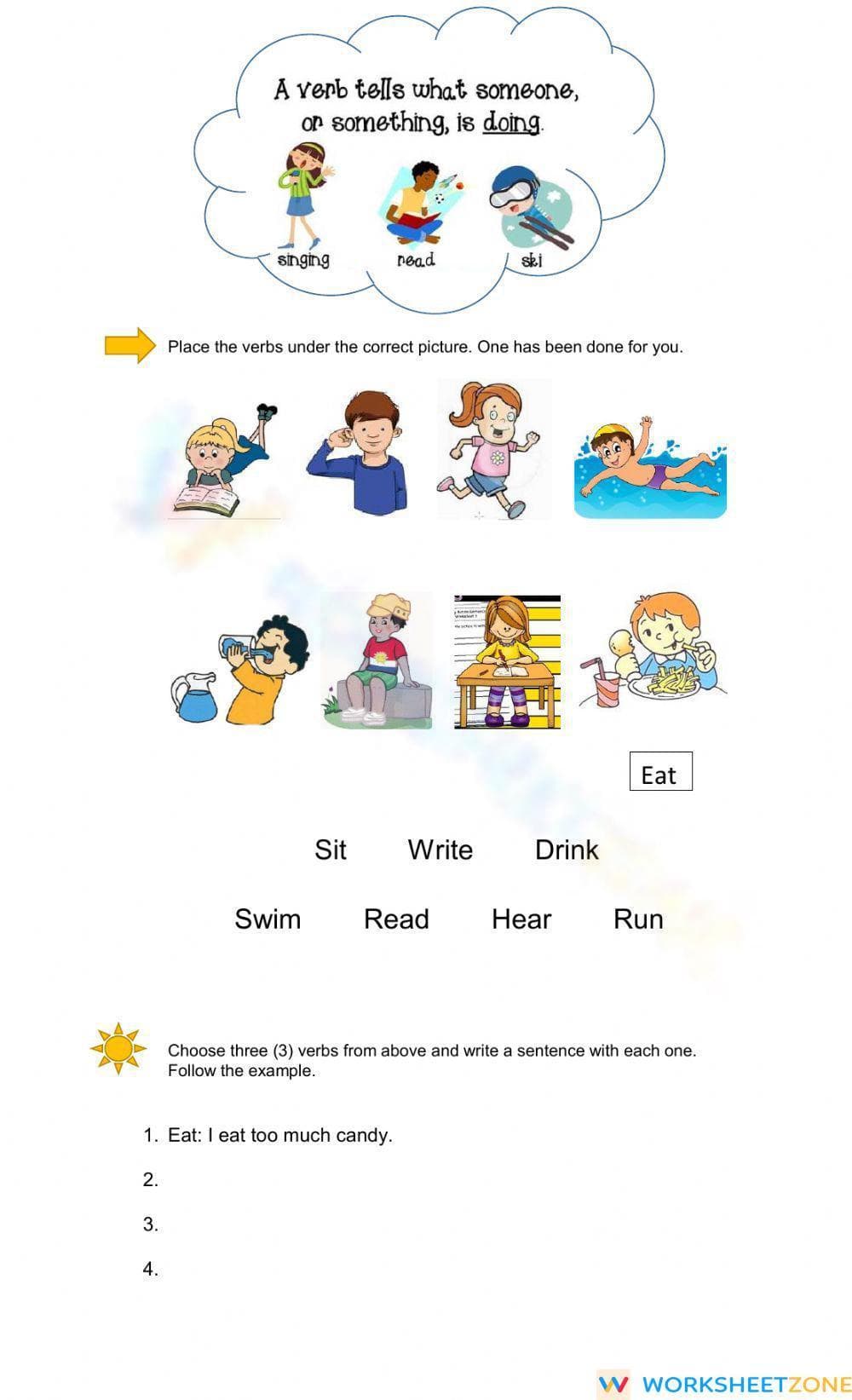

Essential Verbs Worksheet | Grade 1-3 ELA Printable
Paste this activity's link or code into your existing LMS (Google Classroom, Canvas, Teams, Schoology, Moodle, etc.).
Students can open and work on the activity right away, with no student login required.
You'll still be able to track student progress and results from your teacher account.
This printable Grade 1-3 action verbs worksheet provides a focused environment for students to master primary lexical concepts. By identifying physical actions in illustrations and applying them in original sentences, learners transition from recognition to active usage. This resource ensures students can distinguish between subjects and their actions, a fundamental building block for narrative writing and complex sentence construction.
At a Glance
- Grade: 1-3 · Subject: ELA
- Standard:
CCSS.ELA-LITERACY.L.1.1.E— Use frequently occurring verbs to describe actions and states of being- Skill Focus: Identifying and using action verbs
- Format: 1 page · 11 tasks · Answer key included · PDF
- Best For: Grammar centers and independent practice
- Time: 15–20 minutes
What's Inside
The worksheet features a clear, student-friendly definition of a verb inside a visual cloud at the top. Below, students find eight colorful illustrations depicting common activities such as swimming, drinking, and writing. A word bank provides the necessary vocabulary, reducing the cognitive load for early readers. The second section challenges students to synthesize their learning by writing three original sentences, ensuring they understand the syntax of action-oriented language.
Zero-Prep Workflow
This resource is designed for immediate classroom integration with a total teacher preparation time of under 2 minutes. First, print the single-page PDF (30 seconds) and distribute it to your grammar or ELA centers (30 seconds). Students can then work through the visual matching and sentence-building tasks independently for approximately 15 minutes. Finally, use the included answer key for a rapid individual or whole-class check (1 minute), making it an ideal choice for emergency sub plans or bell-ringers.
Standards Alignment
The primary focus is `CCSS.ELA-LITERACY.L.1.1.E`, which requires students to "Use frequently occurring verbs." By connecting visual representations of actions to their written forms, students build the vocabulary needed to satisfy early language standards. This worksheet also supports `CCSS.ELA-LITERACY.L.2.1` by reinforcing correct grammar usage in written sentences. Both standard codes can be copied directly into lesson plans, IEP goals, or district curriculum mapping tools.
How to Use It
For best results, assign this worksheet during the "Independent Practice" phase of a lesson on parts of speech. It serves as a perfect formative assessment to see which students can accurately map labels to actions. Alternatively, use it as a scaffolded writing prompt for English Language Learners (ELLs), as the visual cues provide a necessary bridge for vocabulary acquisition. Educators should observe whether students can successfully conjugate the verbs in their original sentences.
Who It's For
This resource is tailored for Grade 1 through Grade 3 students who are developing their core grammar foundations. It is particularly effective for visual learners who benefit from the connection between imagery and text. For students requiring extra support, the provided word bank serves as a scaffold, while advanced students can be challenged to write longer, more descriptive sentences using the same verbs.
The effective use of visual-to-text mapping in grammar instruction is supported by research from Fisher & Frey (2014) on the gradual release of responsibility. This Grade 1-3 worksheet applies these principles by providing a clear definition and examples before asking for independent sentence generation. Studies in the RAND AIRS 2024 report indicate that structured practice with frequently occurring verbs, as defined by `CCSS.ELA-LITERACY.L.1.1.E`, is critical for early literacy development and syntactic maturity. By using a word bank to lower the barrier to entry, this resource allows students to focus on the semantic relationship between pictures and labels, leading to higher retention rates. This targeted approach to lexical word classes ensures that students build a robust vocabulary of action words that serve as the engine for more complex sentence structures in later grades.


