


























Views
Downloads
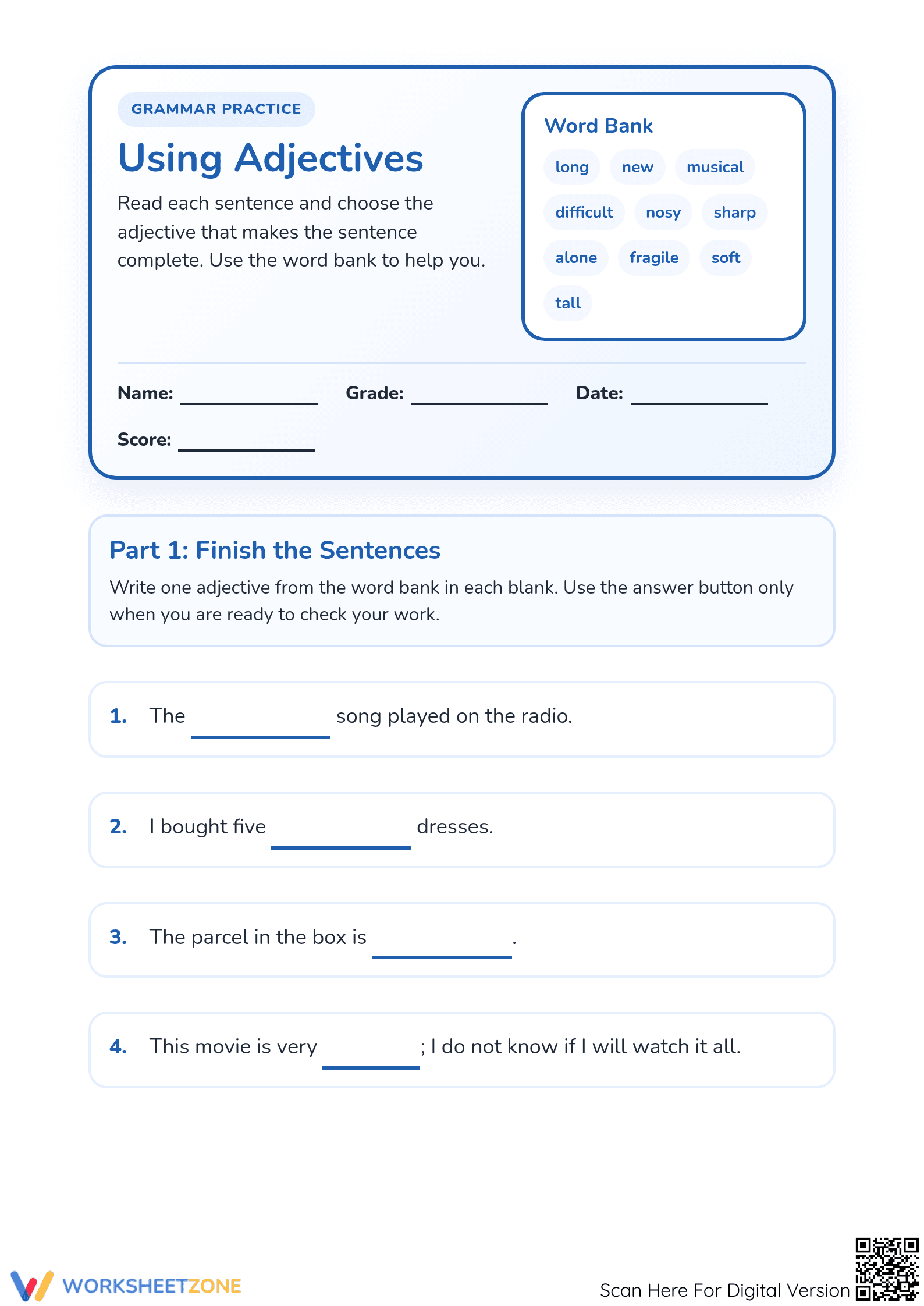


Grade 1 Using Adjectives — Printable No-Prep Worksheet
Paste this activity's link or code into your existing LMS (Google Classroom, Canvas, Teams, Schoology, Moodle, etc.).
Students can open and work on the activity right away, with no student login required.
You'll still be able to track student progress and results from your teacher account.
This Grade 1 adjectives worksheet helps students identify and apply descriptive words to complete meaningful sentences. By selecting the correct word from a provided bank, learners strengthen their vocabulary and understanding of how adjectives modify nouns. It provides a clear path toward descriptive writing mastery and improved reading comprehension through context clues.
At a Glance
- Grade: 1 · Subject: ELA
- Standard:
CCSS.ELA-LITERACY.L.1.1.F— Use frequently occurring adjectives to describe people, places, and things- Skill Focus: Descriptive Adjectives
- Format: 3 pages · 14 problems · Answer key included · PDF
- Best For: Independent practice or morning work
- Time: 15–20 minutes
What's Inside
This 3-page PDF features 14 targeted sentence-completion exercises designed for early readers. Part 1 includes 10 sentences with a primary word bank containing diverse descriptors like musical, fragile, and nosy. Part 2 offers 4 additional practice items with a secondary word bank to reinforce learning. A comprehensive answer key is included to facilitate rapid grading or student self-correction.
Zero-Prep Workflow
- Print: Select the 3-page PDF and print enough copies for your class in under 30 seconds.
- Distribute: Hand out the worksheets as a warm-up, grammar center activity, or homework assignment.
- Review: Use the included answer key to check for understanding or project it for a whole-class review session.
This resource is an ideal solution for emergency sub plans or last-minute grammar reinforcement when teacher prep time is limited.
Standards Alignment
This resource aligns directly with `CCSS.ELA-LITERACY.L.1.1.F`, which requires students to use frequently occurring adjectives. It also supports L.1.5.A by helping students sort words into categories and understand shades of meaning. Both standard codes can be copied directly into lesson plans, IEP goals, or district curriculum mapping tools to ensure instructional compliance.
How to Use It
Use this worksheet during the independent practice phase of a gradual release lesson on descriptive language. It works effectively after a shared reading session where the teacher highlights adjectives in a mentor text. For formative assessment, observe if students can justify why "fragile" fits a "parcel" better than "musical" based on sentence context. Completion typically takes 15 to 20 minutes.
Who It's For
This activity is designed for first-grade students developing foundational grammar skills. It is also highly suitable for second-grade review or English Language Learners (ELL) who require scaffolded vocabulary support. Pair this worksheet with a descriptive picture book or a classroom anchor chart listing sensory words to provide additional visual support for struggling writers.
According to research by Fisher & Frey (2014), the use of scaffolded word banks in grammar instruction significantly improves a student's ability to integrate new lexical classes into their functional writing. This worksheet targets CCSS.ELA-LITERACY.L.1.1.F by providing 14 specific opportunities for students to apply frequently occurring adjectives in context. By moving from a general word bank to a specialized practice section, the resource ensures that learners do not simply guess but instead evaluate the semantic fit of each descriptive word. This structured approach aligns with NAEP recommendations for increasing vocabulary depth in early elementary grades. The inclusion of a clear answer key facilitates immediate feedback, a critical component for mastery in Grade 1 ELA. Educators can rely on this tool for evidence-based practice that bridges the gap between isolated word recognition and contextual application in daily communication.


