




























Views
Downloads
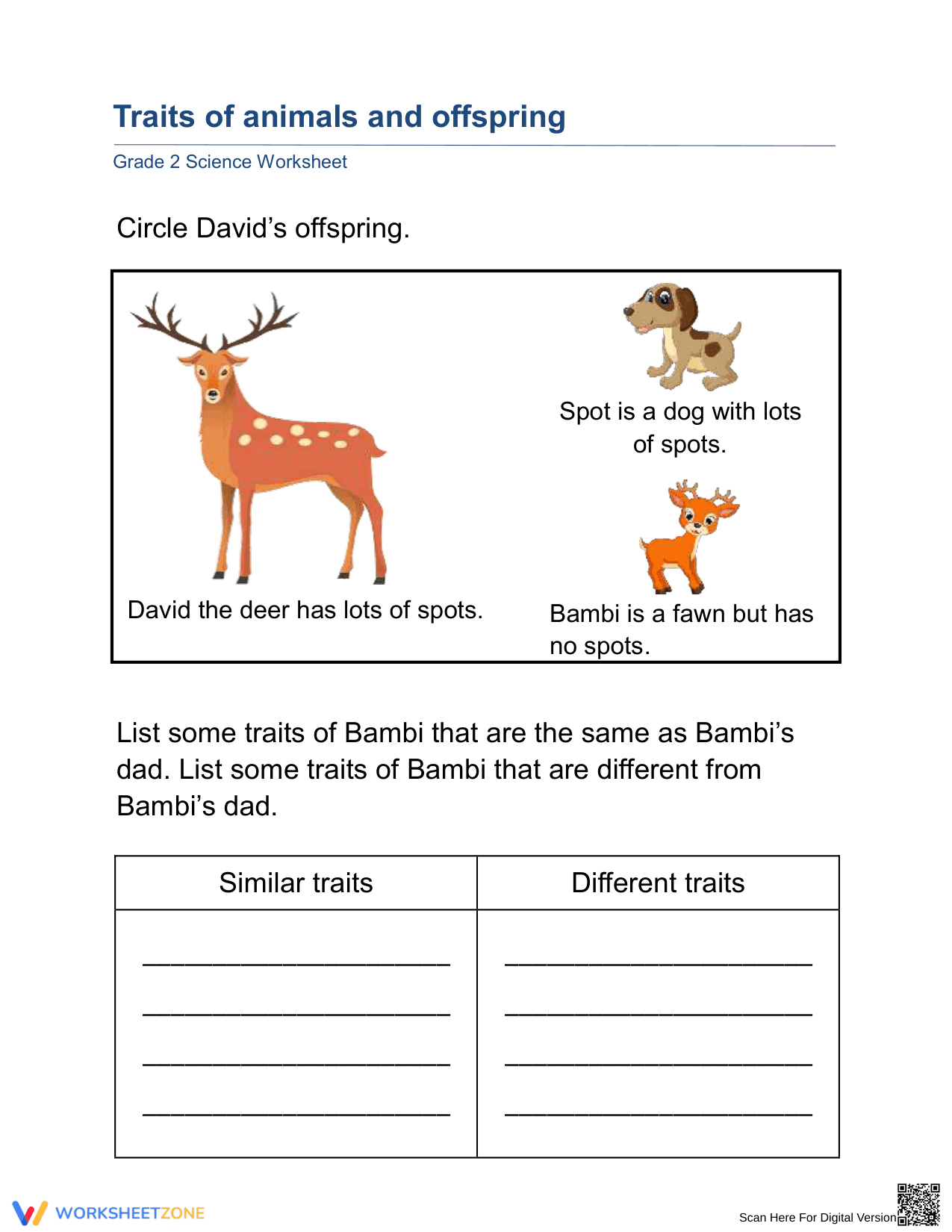
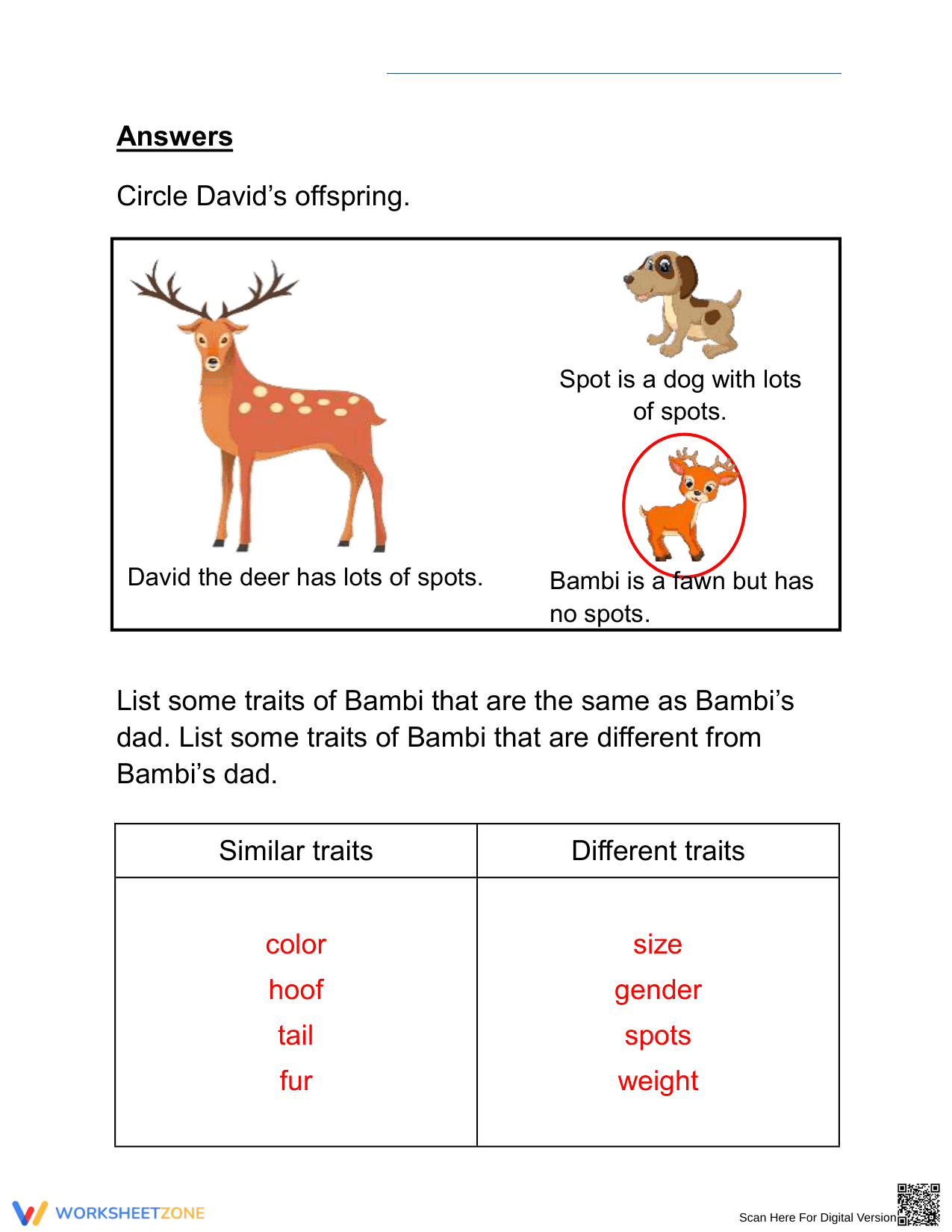

Essential Grade 2 Animal Traits and Offspring Worksheet

Paste this activity's link or code into your existing LMS (Google Classroom, Canvas, Teams, Schoology, Moodle, etc.).
Students can open and work on the activity right away, with no student login required.
You'll still be able to track student progress and results from your teacher account.
This Grade 2 life science worksheet helps students master heredity by identifying and comparing inherited traits between animal parents and offspring. Students observe physical characteristics to understand how young animals resemble their parents while noting subtle variations, practicing evidence-based scientific observation.
At a Glance
- Grade: 2 · Subject: Science
- Standard:
1-LS3-1— Make observations to show young animals are like, but not exactly like, parents- Skill Focus: Identifying and comparing inherited physical traits
- Format: 1 page · 2 tasks · Answer key included · PDF
- Best For: Introduction to life cycles and heredity
- Time: 15–20 minutes
This concisely structured one-page worksheet features two distinct scientific tasks. The first is a visual identification challenge where students distinguish offspring based on physical markers like spots and species. The second task uses a comparison table, prompting students to list similarities and differences between a parent deer and its fawn, encouraging detailed observation and descriptive writing.
The zero-prep workflow is designed for maximum efficiency. First, print the single-page PDF (30 seconds). Second, distribute to students for independent or guided practice (15 minutes). Third, review using the included answer key for immediate feedback (2 minutes). This streamlined approach makes it an ideal resource for emergency sub plans or quick formative checks.
Aligned with Next Generation Science Standard 1-LS3-1, this worksheet focuses on the animal kingdom to provide necessary evidence for students to meet the performance expectation: "Make observations to construct an evidence-based account that young plants and animals are like, but not exactly like, their parents." This standard code can be copied directly into lesson plans, IEP goals, or district curriculum mapping tools.
Assign this after direct instruction on animal families or life cycles as a mid-lesson check. Observe if students identify traits beyond color, such as ear shape or leg structure, for formative assessment. Most students complete the activity within 15 to 20 minutes, providing immediate data on mastery of inherited traits.
Primarily for Grade 2, this resource is effective for Grade 1 enrichment or Grade 3 review. It supports diverse learners with visual cues and structured comparison frames. It pairs well with read-alouds or digital slideshows about animal families to build background knowledge before independent work.
According to the RAND AIRS 2024 report on elementary science instruction, high-quality instructional materials that utilize visual scaffolds and structured comparisons significantly improve student retention of biological concepts. This worksheet applies those findings by requiring students to move from simple identification to analytical comparison. By focusing on observable physical traits, the resource ensures that 100% of student effort is directed toward the core requirements of the 1-LS3-1 standard. The inclusion of a clear answer key allows for consistent grading across different classroom settings, supporting data-driven instruction. Research indicates that these types of focused, single-page assessments are most effective when used as a bridge between direct instruction and independent inquiry. This resource provides a reliable method for documenting student progress toward mastery of heredity and variation of traits in the early elementary years.


