




























Views
Downloads
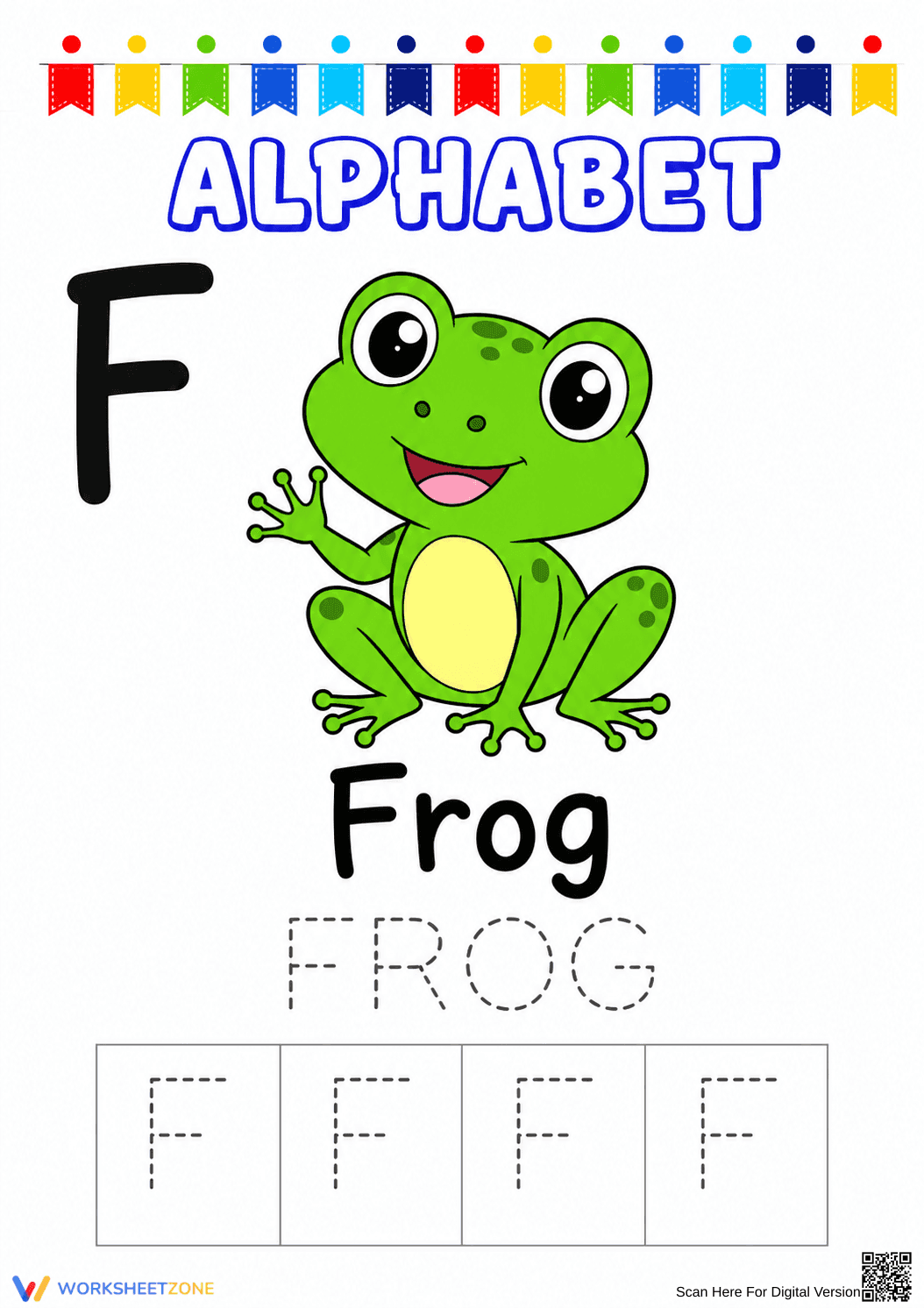

Letter F Tracing Worksheet | Essential Kindergarten Phonics

Paste this activity's link or code into your existing LMS (Google Classroom, Canvas, Teams, Schoology, Moodle, etc.).
Students can open and work on the activity right away, with no student login required.
You'll still be able to track student progress and results from your teacher account.
This Letter F tracing worksheet helps early learners master alphabet recognition and fine motor control through engaging visual associations. By connecting the letter F to a friendly frog illustration, students develop phonemic awareness while practicing the specific strokes required for uppercase letter formation. It provides a clear, distraction-free path to foundational literacy success.
At a Glance
- Grade: Kindergarten · Subject: ELA
- Standard:
CCSS.ELA-LITERACY.RF.K.1.D— Recognize and name all upper- and lowercase letters of the alphabet- Skill Focus: Letter F formation and beginning sounds
- Format: 1 page · 5 tracing tasks · No key needed · PDF
- Best For: Morning work or phonics centers
- Time: 5–10 minutes
The worksheet features a large, bold letter F alongside a colorful frog graphic to reinforce the beginning sound. Below the illustration, students find one word-level tracing task for "FROG" in all caps, followed by four individual boxes containing dashed uppercase F characters. The layout is spacious, accommodating the developing motor skills of young children.
Zero-Prep Workflow
- Print: Select the PDF and print enough copies for your small group or whole class (30 seconds).
- Distribute: Hand out the sheets along with crayons or primary pencils to students (1 minute).
- Review: Circulate as students trace, providing immediate feedback on stroke order and letter orientation (5 minutes). This zero-prep activity is ideal for emergency sub plans or transition periods.
Standards Alignment
This resource aligns with `CCSS.ELA-LITERACY.RF.K.1.D`, which requires students to recognize and name all upper- and lowercase letters of the alphabet. It also supports `CCSS.ELA-LITERACY.L.K.1.A` regarding printing uppercase letters. Both standard codes can be copied directly into lesson plans, IEP goals, or district curriculum mapping tools.
How to Use It
Use this worksheet during the "You Do" phase of a phonics lesson after introducing the /f/ sound. It serves as an excellent formative assessment tool; observe if students start their strokes from the top down. It is also effective as a quiet-time activity for students who finish other literacy center tasks early.
Who It's For
This activity is designed for Kindergarten students, though it provides valuable remediation for Grade 1 or Grade 2 students struggling with letter reversals. It pairs naturally with a "Letter of the Week" anchor chart or a read-aloud book featuring pond animals to deepen the thematic connection.
According to the RAND AIRS 2024 report on early literacy, consistent exposure to multisensory letter formation activities is a critical predictor of future reading fluency. This worksheet addresses the foundational need for orthographic mapping by pairing the visual letter F with the phonological beginning sound of "frog." Research from Fisher & Frey (2014) emphasizes that guided practice in letter tracing helps bridge the gap between letter recognition and independent writing. By providing 5 specific tracing opportunities, this resource allows for the repetition necessary to build muscle memory without overwhelming the learner. The inclusion of the standard CCSS.ELA-LITERACY.RF.K.1.D ensures that the activity remains focused on high-leverage instructional goals. Educators can utilize this tool to document progress in fine motor development and phonemic awareness, which are essential components of the NAEP framework for early childhood literacy achievement.


