


























Views
Downloads

Pre-Writing Tracing Worksheet | Printable Pre-K Science
Paste this activity's link or code into your existing LMS (Google Classroom, Canvas, Teams, Schoology, Moodle, etc.).
Students can open and work on the activity right away, with no student login required.
You'll still be able to track student progress and results from your teacher account.
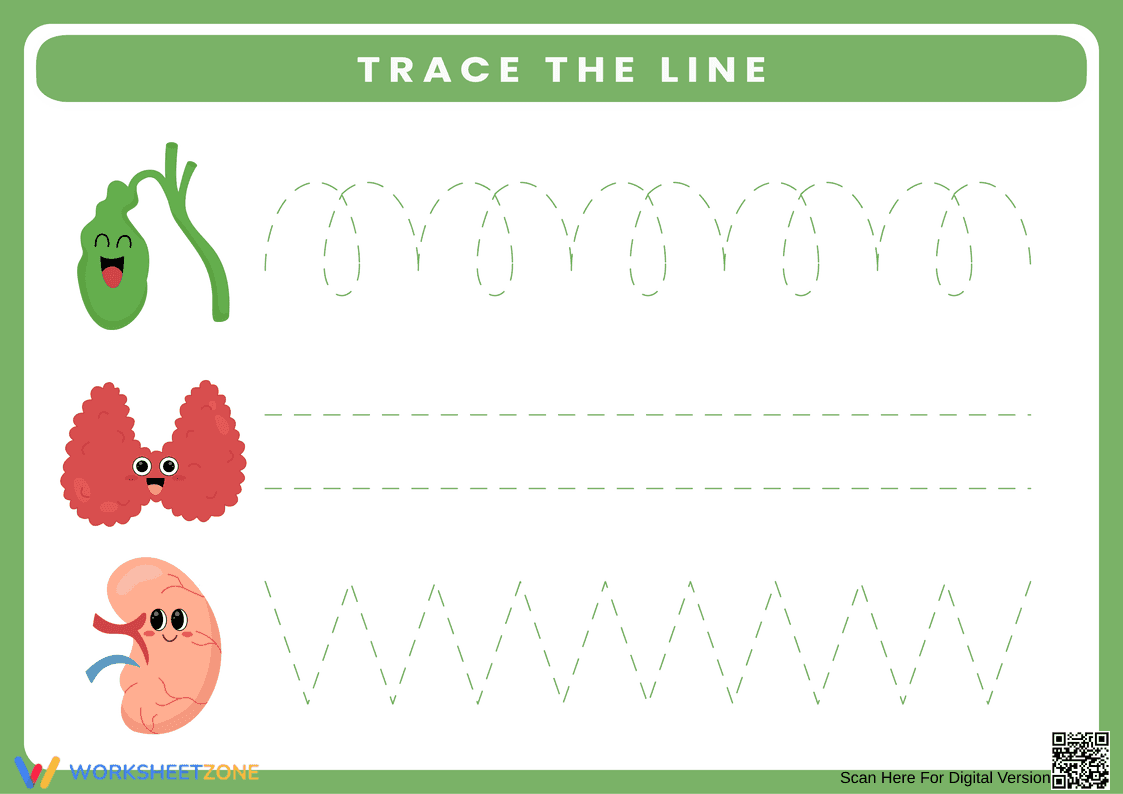
This foundational pre-writing worksheet helps early learners develop essential fine motor control by tracing distinct line patterns. Featuring engaging illustrations of human body organs, the activity strengthens hand-eye coordination and pencil grip, preparing preschool and kindergarten students for future letter formation and handwriting success.
At a Glance
- Grade: Pre-K · Subject: Science & Handwriting
- Standard:
CCSS.ELA-LITERACY.L.K.1.A— Form foundational pre-writing strokes- Skill Focus: Line tracing and fine motor control
- Format: 1 page · 3 problems · No answer key needed · PDF
- Best For: Morning work or centers
- Time: 5–10 minutes
Inside this single-page resource, educators will find three distinct tracing exercises paired with friendly illustrations of a gallbladder, thyroid, and kidney. The tracing paths include a continuous loop, a straight dashed line, and a sharp zig-zag pattern. These varied strokes require students to adjust pencil movements, providing targeted practice for fine motor articulation. The layout is clean, ensuring young learners remain focused.
This resource is designed for immediate classroom implementation with a streamlined zero-prep workflow.
- Print (30 seconds): Download the PDF and print copies.
- Distribute (1 minute): Hand out worksheets with pencils or crayons. No complex instructions required.
- Review (1 minute): Check progress by observing their ability to stay on the lines.
Total teacher preparation time is under two minutes, making this an excellent option for sub plans or morning bins.
This activity aligns with foundational early childhood standards, specifically supporting skills leading up to CCSS.ELA-LITERACY.L.K.1.A: Print many upper- and lowercase letters. By mastering loops, straight lines, and zig-zags, students build the muscle memory required for formal letter construction. It also introduces basic biological concepts, supporting early science inquiry. Both standard codes can be copied directly into lesson plans, IEP goals, or district curriculum mapping tools.
Teachers can utilize this worksheet during morning arrival as a quiet, focused activity that settles students into the daily routine. It also serves perfectly as an independent station during literacy or fine motor centers. While students work, teachers can conduct formative assessments by observing pencil grip and the fluidity of their tracing strokes. Expect most early learners to complete the three tracing paths within five to ten minutes.
This resource is primarily designed for preschool and kindergarten students developing pre-writing abilities. It is beneficial for occupational therapy or special education classrooms where students require targeted fine motor interventions. For differentiation, teachers can provide thicker markers for students needing grip support, or ask advanced learners to trace lines using multiple colors. Pair this activity with a read-aloud about the human body.
Developing strong fine motor skills through activities like line tracing is a critical precursor to academic success. This worksheet targets foundational pre-writing strokes, directly supporting the physical mechanics required for CCSS.ELA-LITERACY.L.K.1.A, where students learn to form letters accurately. According to Fisher & Frey (2014), early interventions that focus on targeted, repetitive motor tasks significantly improve long-term handwriting legibility and reduce cognitive load during early literacy instruction. When students do not have to struggle with pencil control, they can dedicate more working memory to phonics and reading comprehension. By integrating engaging visual elements like human organs with essential tracing practice, this resource provides a developmentally appropriate challenge. Consistent practice with varied line patterns ensures young learners build the necessary hand strength and coordination for future writing tasks.


