


























Views
Downloads
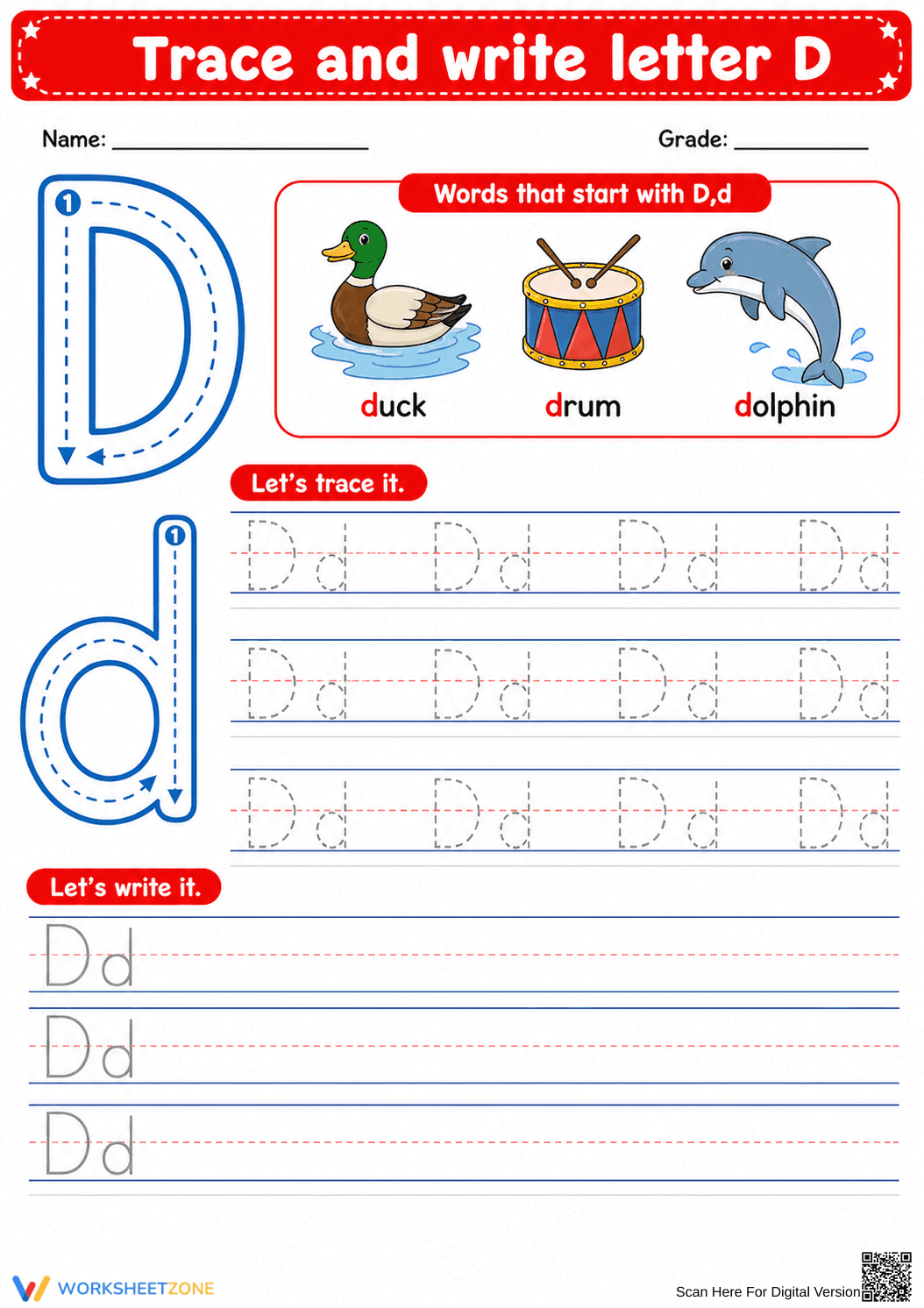

Printable Letter D Tracing Worksheet | Grade K ELA
Paste this activity's link or code into your existing LMS (Google Classroom, Canvas, Teams, Schoology, Moodle, etc.).
Students can open and work on the activity right away, with no student login required.
You'll still be able to track student progress and results from your teacher account.
This printable letter D worksheet helps early learners master uppercase and lowercase letter formation while reinforcing beginning sounds. Students practice tracing and writing the letter D independently, building essential fine motor skills and phonics recognition to support foundational reading and writing development in the primary classroom.
At a Glance
- Grade: K · Subject: ELA
- Standard:
CCSS.ELA-LITERACY.L.K.1.A— Print upper- and lowercase letters- Skill Focus: Letter D formation and beginning sounds
- Format: 1 page · 15 problems · No answer key · PDF
- Best For: Morning work or literacy centers
- Time: 10–15 minutes
Inside this single-page resource, educators will find a structured progression for letter mastery. The page begins with large directional arrows for uppercase and lowercase D, followed by a visual vocabulary section (duck, drum, dolphin) to anchor the beginning sound. The core includes three lines of dotted tracing practice and three blank lines for independent writing, providing a complete cycle of guided to independent practice.
This resource offers a zero-prep workflow:
- Print (1 minute): Simply download the PDF and print the required number of copies.
- Distribute (1 minute): Hand out to students during morning routines or place them in literacy center folders. No additional materials or teacher setup are required.
- Review (1 minute): Quickly scan student work to check for proper stroke direction and line placement.
Total teacher preparation time is under two minutes, making this an excellent, reliable option for emergency sub plans or quick transitions.
This worksheet is directly aligned to CCSS.ELA-LITERACY.L.K.1.A, requiring students to print many upper- and lowercase letters. It also supports foundational phonics skills by connecting the written symbol to its spoken sound through visual cues. Both standard codes can be copied directly into lesson plans, IEP goals, or district curriculum mapping tools.
Deploy this worksheet during morning work or as an independent station during literacy centers. Before assigning the independent writing section, teachers can model the stroke order on the board. As a formative assessment tip, observe students while they trace the large letters at the top; watch for correct starting points and continuous pencil movement rather than lifting the pencil unnecessarily. Most students will complete this activity within 10 to 15 minutes.
This resource is primarily designed for Kindergarten students developing their handwriting and phonics skills. It also serves as an effective intervention tool for first or second graders who need targeted remediation in letter formation or fine motor control. For differentiation, provide pencil grips or textured surfaces underneath the paper for students needing tactile feedback. Pair this worksheet with a read-aloud focusing on the "D" sound or a classroom anchor chart displaying D-words.
Developing automaticity in letter formation is a critical precursor to fluent writing and reading comprehension. When students practice printing upper- and lowercase letters, as outlined in CCSS.ELA-LITERACY.L.K.1.A, they reduce the cognitive load required for basic transcription, freeing up mental resources for higher-order text generation. According to Fisher & Frey (2014), explicit instruction combined with structured practice in foundational skills significantly improves long-term retention in early literacy. This worksheet provides that essential repetition through a gradual release model, moving from heavily guided tracing with directional arrows to independent writing on standard lined paper. By integrating visual vocabulary cues with the physical act of writing, the activity reinforces the neurological connection between the visual symbol and its corresponding phoneme, ensuring a comprehensive approach to early alphabet mastery.


