


























Views
Downloads

Grade 2 Synonyms — Printable No-Prep Worksheet
Paste this activity's link or code into your existing LMS (Google Classroom, Canvas, Teams, Schoology, Moodle, etc.).
Students can open and work on the activity right away, with no student login required.
You'll still be able to track student progress and results from your teacher account.
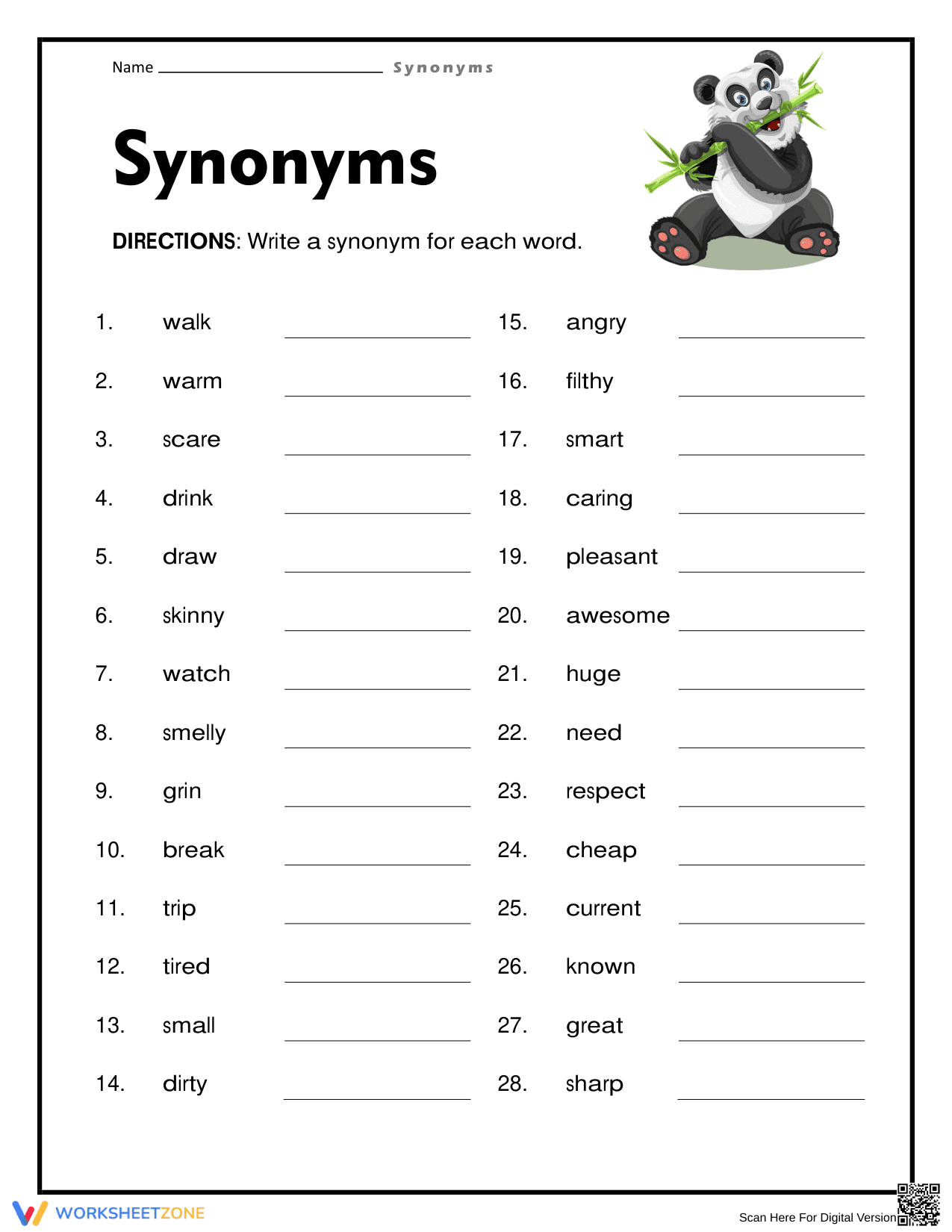
This Synonyms worksheet helps Grade 2 students expand their descriptive vocabulary and improve writing precision by identifying words with similar meanings. By practicing with 28 diverse vocabulary words, learners develop a deeper understanding of linguistic nuances, allowing them to communicate with greater clarity and variety in their everyday academic tasks.
At a Glance
- Grade: 2 · Subject: ELA
- Standard:
CCSS.ELA-LITERACY.L.2.5.B— Distinguish shades of meaning among closely related verbs and adjectives- Skill Focus: Identifying and writing synonyms
- Format: 1 page · 28 problems · Answer key included · PDF
- Best For: Vocabulary building and independent practice
- Time: 15–20 minutes
What's Inside
The worksheet features a focused layout containing 28 high-frequency words paired with blank lines for student responses. The list includes common verbs like "walk" and "grin," plus descriptive adjectives like "filthy" and "awesome." This one-page PDF is designed for immediate use, featuring a whimsical panda illustration to engage students. A comprehensive answer key is included to facilitate quick grading or student self-correction.
Zero-Prep Workflow
Implementation requires minimal effort, making it ideal for busy classrooms or emergency sub plans. First, print the required number of copies (under 1 minute). Next, distribute the sheets and remind students that synonyms are words with nearly identical meanings (under 1 minute). Finally, review the answers as a group or use the answer key for individual assessment (5 minutes). Total teacher preparation time is effectively under two minutes.
Standards Alignment
This resource aligns to CCSS.ELA-LITERACY.L.2.5.B, which requires students to "distinguish shades of meaning among closely related verbs and adjectives." By generating their own synonyms rather than using multiple-choice, the activity promotes higher-level recall and strengthens mental word relationships. This standard code can be copied directly into lesson plans, IEP goals, or district curriculum mapping tools.
How to Use It
Use this as an independent practice activity following a direct instruction lesson on word relationships. It also serves as an excellent warm-up "bell-ringer" to activate prior knowledge. During the activity, observe if students struggle with specific categories, such as emotional adjectives versus movement verbs. Expected completion time is 15 to 20 minutes. Include the completed worksheet in student portfolios to track vocabulary growth over time.
Who It's For
This is designed for Grade 2 but works well for Grade 1 enrichment or Grade 3 remediation. It is particularly beneficial for English Language Learners (ELL) expanding their synonym banks. To differentiate, provide a "word bank" on the whiteboard for students needing extra scaffolding. This resource pairs naturally with a classroom anchor chart or a reading passage where students find and replace repetitive words.
The systematic practice of identifying synonyms is a foundational component of effective vocabulary acquisition, a key predictor of long-term reading comprehension success. According to the RAND AIRS 2024 report on literacy development, students who engage in regular word-relationship exercises demonstrate higher fluency in both creative and expository writing tasks. This worksheet addresses CCSS.ELA-LITERACY.L.2.5.B by challenging learners to access their internal lexicon and retrieve precise linguistic matches for 28 distinct terms. By moving toward active recall, the activity reinforces the semantic networks that allow children to navigate complex texts with greater ease. Educators can utilize this assessment-ready tool to gather data on student mastery of word nuances, ensuring that every learner develops the essential linguistic tools required for academic achievement. This evidence-based approach to vocabulary instruction supports a comprehensive literacy framework focused on building robust communication skills through targeted practice.


