




























Views
Downloads
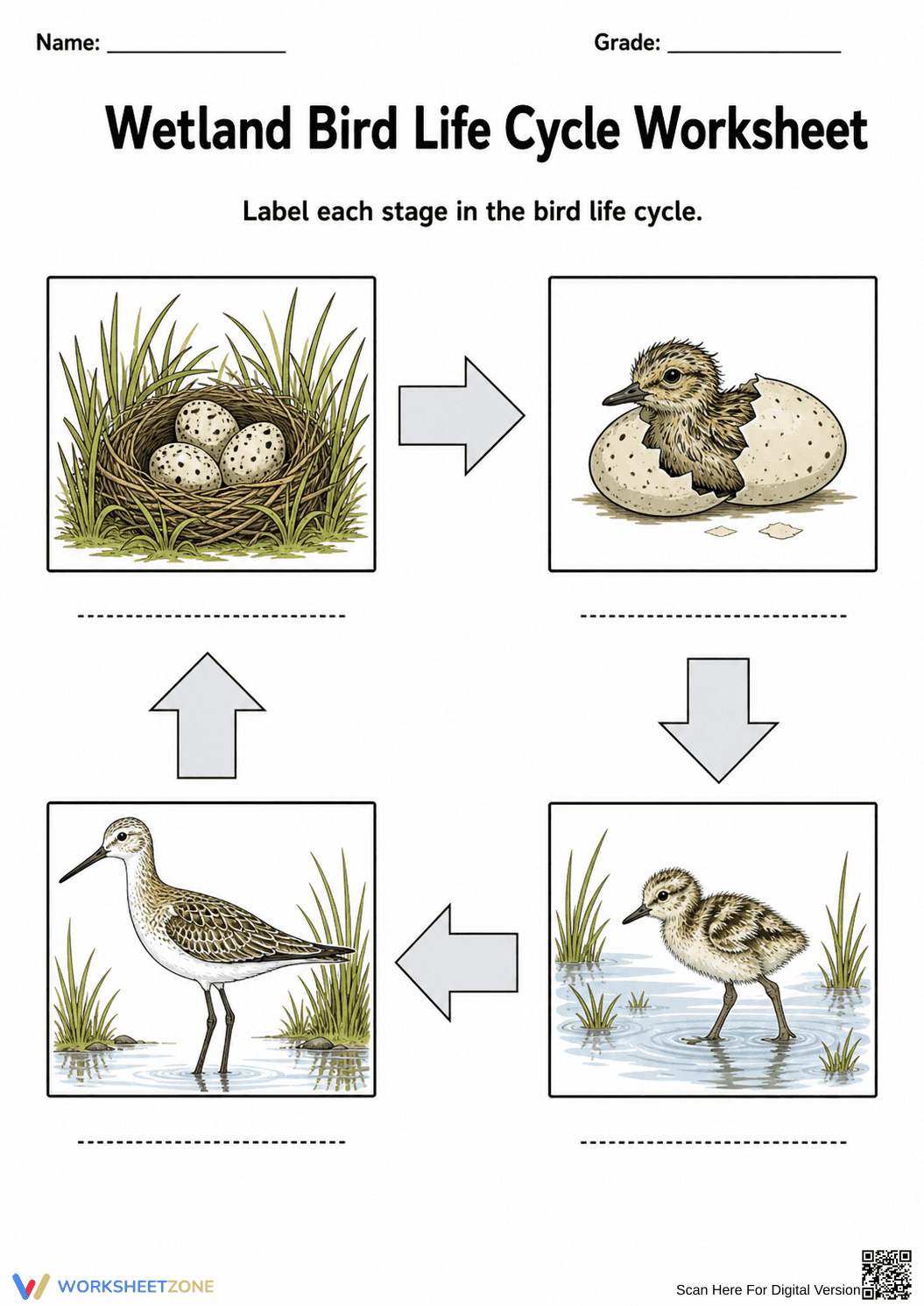

Grade 3 Bird Life Cycle — Printable No-Prep Worksheet

Paste this activity's link or code into your existing LMS (Google Classroom, Canvas, Teams, Schoology, Moodle, etc.).
Students can open and work on the activity right away, with no student login required.
You'll still be able to track student progress and results from your teacher account.
This Grade 3 science worksheet helps students identify and sequence the developmental stages of a wetland bird. By labeling four distinct phases of growth, learners build a foundational understanding of biological cycles. This resource provides a clear visual model for students to observe how organisms change over time.
At a Glance
- Grade: 3 · Subject: Science
- Standard:
3-LS1-1— Develop models to describe organism life cycles- Skill Focus: Sequencing bird life cycle stages
- Format: 1 page · 4 problems · Answer key included · PDF
- Best For: Independent practice or formative assessment
- Time: 10–15 minutes
This single-page PDF features a high-quality diagram illustrating the life cycle of a wetland bird. It includes four specific labeling tasks where students identify the egg, hatchling, juvenile, and adult stages. The layout uses clear directional arrows to emphasize the cyclical nature of life, accompanied by a comprehensive answer key for quick grading and immediate feedback.
The workflow for this activity is designed for maximum efficiency. First, print the single-page PDF in approximately 30 seconds. Next, distribute the sheets to students as a warm-up or exit ticket. Finally, review the correct labels as a whole group using the provided answer key. Total teacher preparation time is under 2 minutes, making it an ideal sub plan or last-minute addition to a science unit.
This resource aligns with 3-LS1-1: Develop models to describe that organisms have unique and diverse life cycles but all have in common birth, growth, reproduction, and death. It supports the crosscutting concept of Patterns by showing how life repeats in predictable stages. Both standard codes can be copied directly into lesson plans, IEP goals, or district curriculum mapping tools.
Use this worksheet during the Explain phase of a 5E lesson on animal adaptations or habitats. It serves as an excellent formative assessment to check for understanding after a lesson on avian biology. Expect students to complete the labeling in 10 to 15 minutes. Observe if students can correctly identify the transition from the egg to the hatchling stage as a key growth marker.
This activity is designed for third-grade students but is also appropriate for second-grade enrichment or first-grade guided practice. It is particularly effective for visual learners and English Language Learners who benefit from the clear pictorial representations. Pair this with a non-fiction passage about shorebirds or a wetland habitat anchor chart for a complete lesson experience.
The use of visual models to teach biological concepts like the 3-LS1-1 standard is supported by research from Fisher & Frey (2014), which emphasizes the importance of scaffolding complex scientific processes through graphic organizers and diagrams. By isolating the four stages of a wetland bird's life cycle, this worksheet reduces cognitive load while reinforcing the core concept that all organisms undergo birth, growth, and reproduction. According to the Fisher & Frey framework, providing students with a structured sequence allows them to internalize the cyclical nature of life before moving toward more complex ecological interactions. This 1-page resource provides the necessary visual evidence for students to construct their own mental models of avian development. The inclusion of an answer key ensures that the feedback loop is immediate, a critical component for mastery in primary science education. This worksheet is a reliable tool for meeting NGSS requirements.


