


























Views
Downloads

Grade 2 Fables & Morals — Printable No-Prep Worksheet
Paste this activity's link or code into your existing LMS (Google Classroom, Canvas, Teams, Schoology, Moodle, etc.).
Students can open and work on the activity right away, with no student login required.
You'll still be able to track student progress and results from your teacher account.
This reading comprehension resource provides students with a classic fable to help them identify central messages and morals. By reading "The Goose That Laid the Golden Eggs," young learners practice recounting stories and understanding how character actions lead to specific consequences, building foundational literary analysis skills.
At a Glance
- Grade: 2 · Subject: ELA
- Standard:
CCSS.ELA-LITERACY.RL.2.2— Recount fables and determine their central message or moral- Skill Focus: Reading comprehension and morals
- Format: 1 page · 1 reading passage · No answer key needed · PDF
- Best For: Independent reading practice
- Time: 15–20 minutes
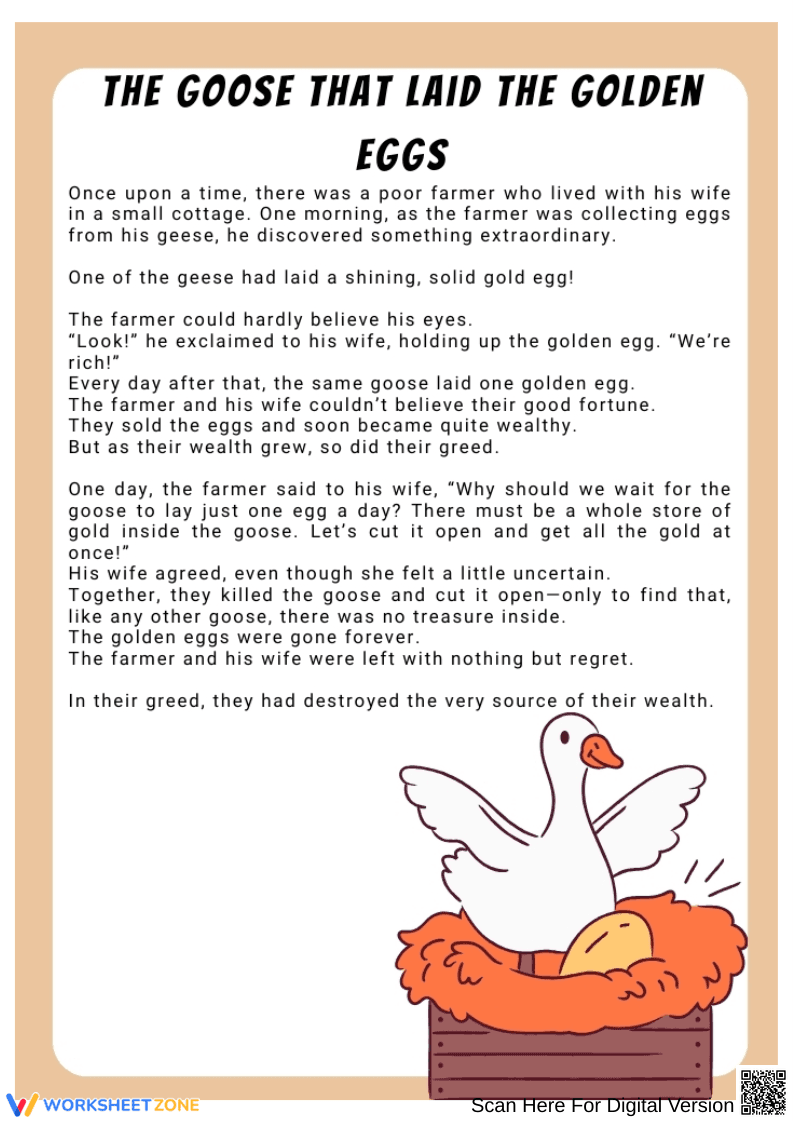
Inside this resource, educators will find a single-page, beautifully formatted reading passage of the classic Aesop's fable. The text is sized appropriately for early elementary readers and includes an engaging illustration to support visual context. The story is structured to clearly highlight the progression of the farmer's greed, making it highly accessible for students to extract the underlying lesson about patience and gratitude.
This resource is designed for immediate classroom implementation with a streamlined workflow:
- Print (1 minute): Simply download the PDF and print a class set. The single-page layout minimizes paper waste.
- Distribute (1 minute): Hand out the passage during literacy centers or whole-group reading blocks.
- Review (5 minutes): Read the text together or have students read independently, then discuss the moral as a class.
Total teacher prep time is under two minutes, making this an excellent, reliable option for emergency sub plans or quick literacy block transitions.
This passage is directly aligned to CCSS.ELA-LITERACY.RL.2.2: Recount stories, including fables and folktales from diverse cultures, and determine their central message, lesson, or moral. It also supports general reading fluency and vocabulary acquisition in context. Both standard codes can be copied directly into lesson plans, IEP goals, or district curriculum mapping tools.
Teachers can utilize this fable during whole-group instruction to model how to find a story's moral. Read the text aloud, pausing to ask students what the farmer might do next. Alternatively, assign it as independent reading during literacy centers. As a formative assessment observation tip, ask students to highlight the specific sentence where the farmer makes his greedy decision. Expected completion time ranges from 15 to 20 minutes depending on the reading level of the group.
This text is primarily designed for first through third-grade students developing their narrative comprehension skills. It works exceptionally well for on-grade-level second graders, while providing strong enrichment for advanced first graders or necessary review for third graders needing extra support with theme identification. Pair this passage with a graphic organizer or an anchor chart detailing common themes in literature to maximize student understanding.
Integrating classic literature into early elementary classrooms remains a highly effective strategy for developing complex comprehension skills. According to Fisher & Frey (2014), utilizing structured texts with clear narrative arcs significantly improves a student's ability to extract underlying themes and central messages. This specific resource targets CCSS.ELA-LITERACY.RL.2.2, requiring students to recount fables and determine their central message or moral. By engaging with "The Goose That Laid the Golden Eggs," learners encounter a concrete example of cause and effect driven by character motivation. Explicit instruction using fables provides a necessary scaffold for young readers transitioning from literal to inferential thinking. Regular practice with these types of moral-driven narratives ensures students build the critical analytical frameworks required for advanced literary analysis in later grades.


