




























Views
Downloads

Printable Digestion Process Worksheet | Grade 7 Science

Paste this activity's link or code into your existing LMS (Google Classroom, Canvas, Teams, Schoology, Moodle, etc.).
Students can open and work on the activity right away, with no student login required.
You'll still be able to track student progress and results from your teacher account.
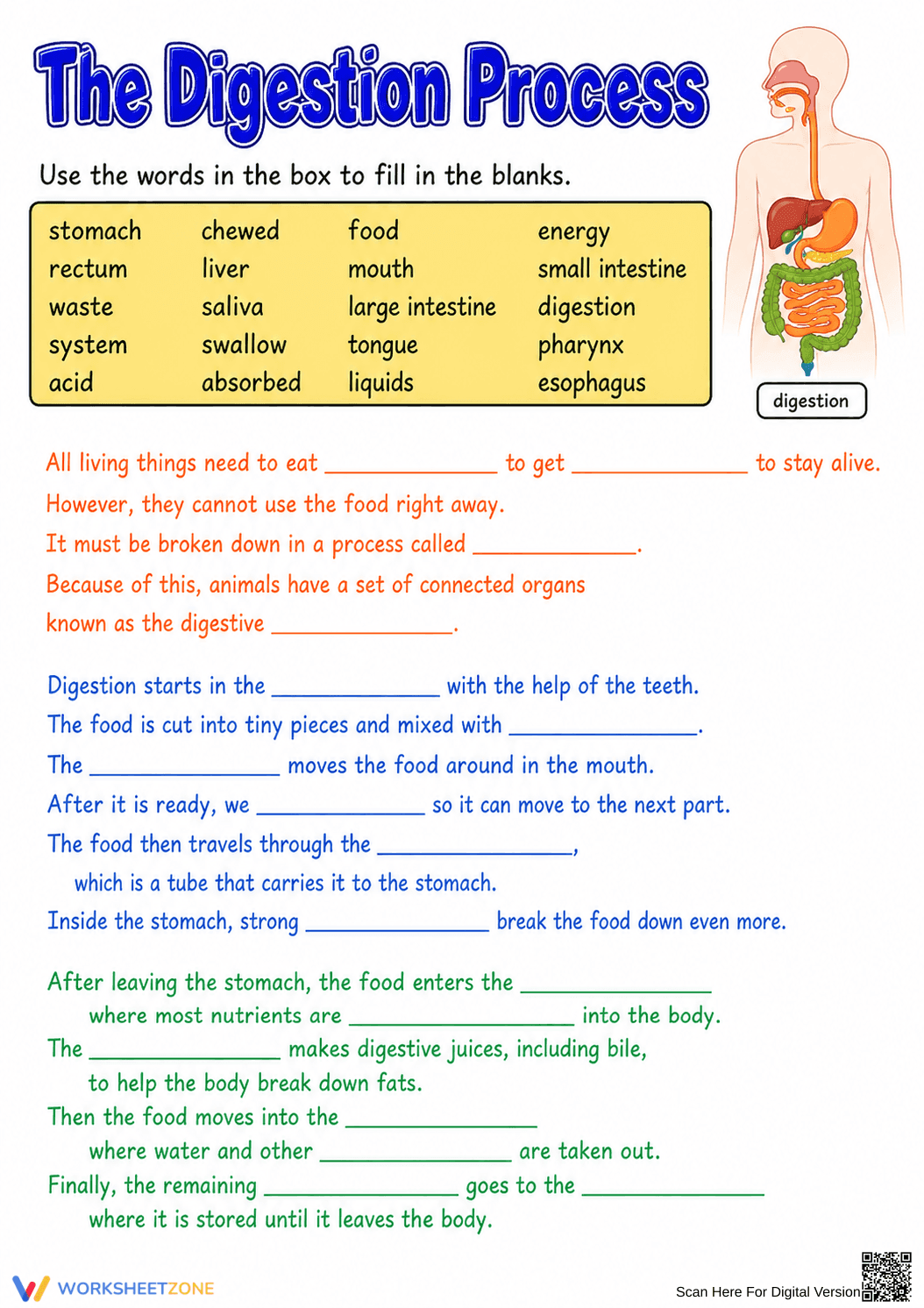
This digestive system worksheet provides an overview of how the human body processes nutrients and eliminates waste. Students identify key organs and physiological stages by completing a narrative sequence following food from mouth to rectum. Learners will demonstrate a clear understanding of the path food takes and the specific functions of each organ.
At a Glance
- Grade: 7 · Subject: Science
- Standard:
MS-LS1-3— Use evidence to explain how body systems interact to support life- Skill Focus: Digestive system anatomy and physiology
- Format: 1 page · 15 problems · Answer key included · PDF
- Best For: Independent practice or quick formative assessment
- Time: 15–20 minutes
The single-page layout is designed for clarity in a busy classroom. It includes a robust word bank containing 20 essential terms, such as esophagus, small intestine, saliva, and acid. The main task consists of 15 fill-in-the-blank sentences forming a cohesive story of digestion. A detailed anatomical diagram of the human torso provides a visual reference to help students locate organs, reinforcing the connection between structure and function.
Optimized for a zero-prep workflow, this resource saves valuable instructional time. Simply print the PDF and distribute it as a bell-ringer or transition activity. Review answers as a whole group using the included key to address misconceptions immediately. With minimal preparation time, it is an ideal choice for emergency sub plans or last-minute review sessions where high-quality content is needed instantly.
This worksheet aligns with MS-LS1-3, requiring students to understand how the body is a system of interacting subsystems. By tracing the flow of matter through the digestive tract, students see how specialized organs work together to maintain homeostasis. Standard codes can be copied directly into lesson plans or IEP goals.
Use this worksheet as a formative assessment after an introductory lecture. As students work, circulate to observe if they can distinguish between the roles of the small and large intestines, providing an immediate pulse check on comprehension. Alternatively, assign it as homework to solidify vocabulary before a unit test. Expected completion time is 15 to 20 minutes.
Designed for middle school science students, this resource serves as a primary learning tool or foundational refresher. It pairs naturally with an interactive torso model or an anchor chart detailing chemical versus mechanical digestion. The word bank provides necessary support for English Language Learners and students with IEPs, ensuring all learners can access the core curriculum.
Cloze-style activities with word banks are a recognized strategy for reinforcing domain-specific vocabulary. Providing structured linguistic supports allows students to focus on the conceptual relationships between anatomical structures rather than struggling with spelling. This worksheet targets the MS-LS1-3 standard by requiring students to sequence the interactions of the digestive subsystem. High-quality, focused practice materials significantly improve retention of complex biological processes. By integrating visual diagrams with narrative text, this resource addresses multiple learning modalities, ensuring students can articulate how the body breaks down food to extract energy. This evidence-based approach supports long-term mastery of human body systems and prepares students for advanced biological studies.


