


























Views
Downloads

Grade 3-5 Valentine Addition Mystery — Printable Worksheet
Paste this activity's link or code into your existing LMS (Google Classroom, Canvas, Teams, Schoology, Moodle, etc.).
Students can open and work on the activity right away, with no student login required.
You'll still be able to track student progress and results from your teacher account.
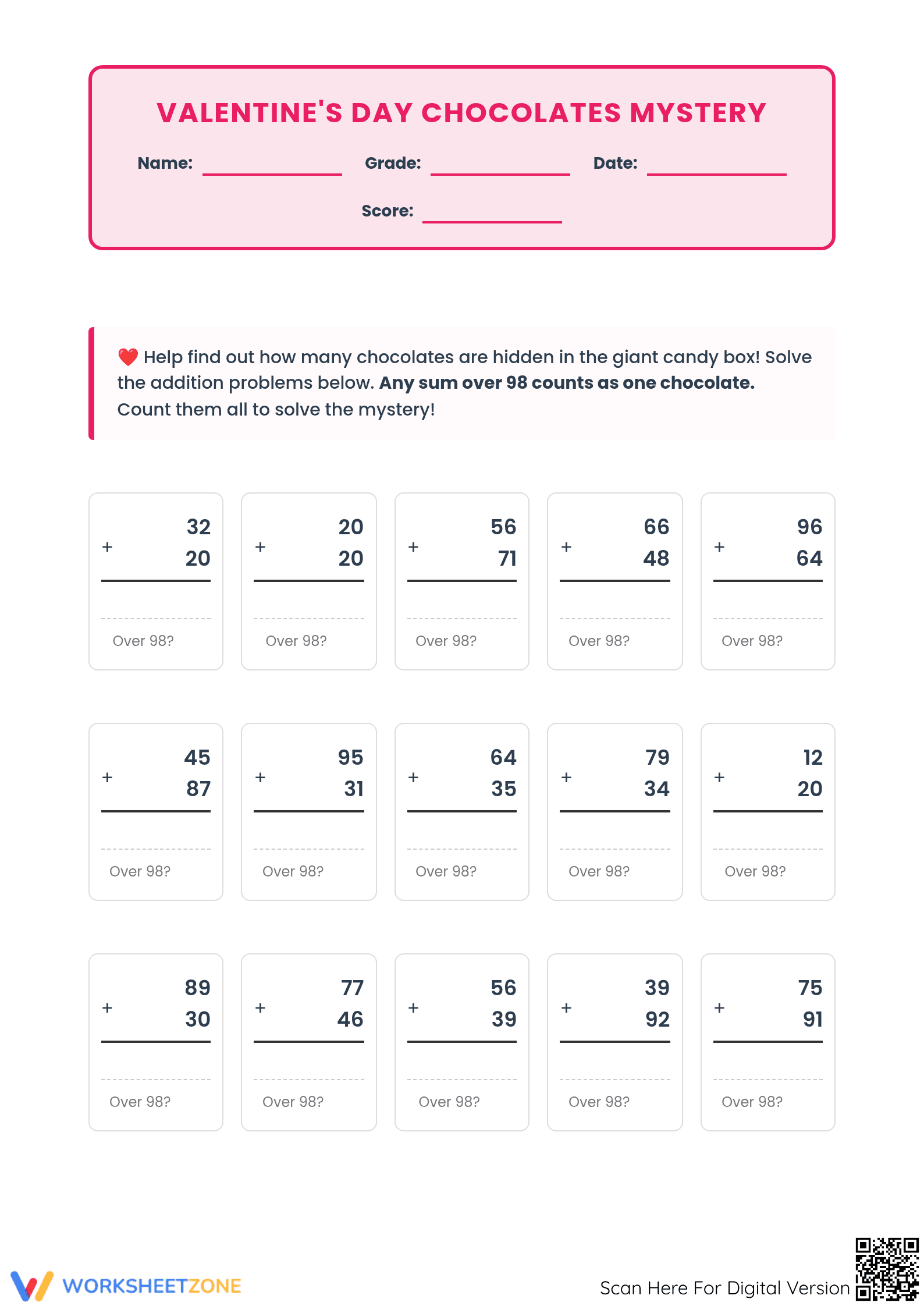
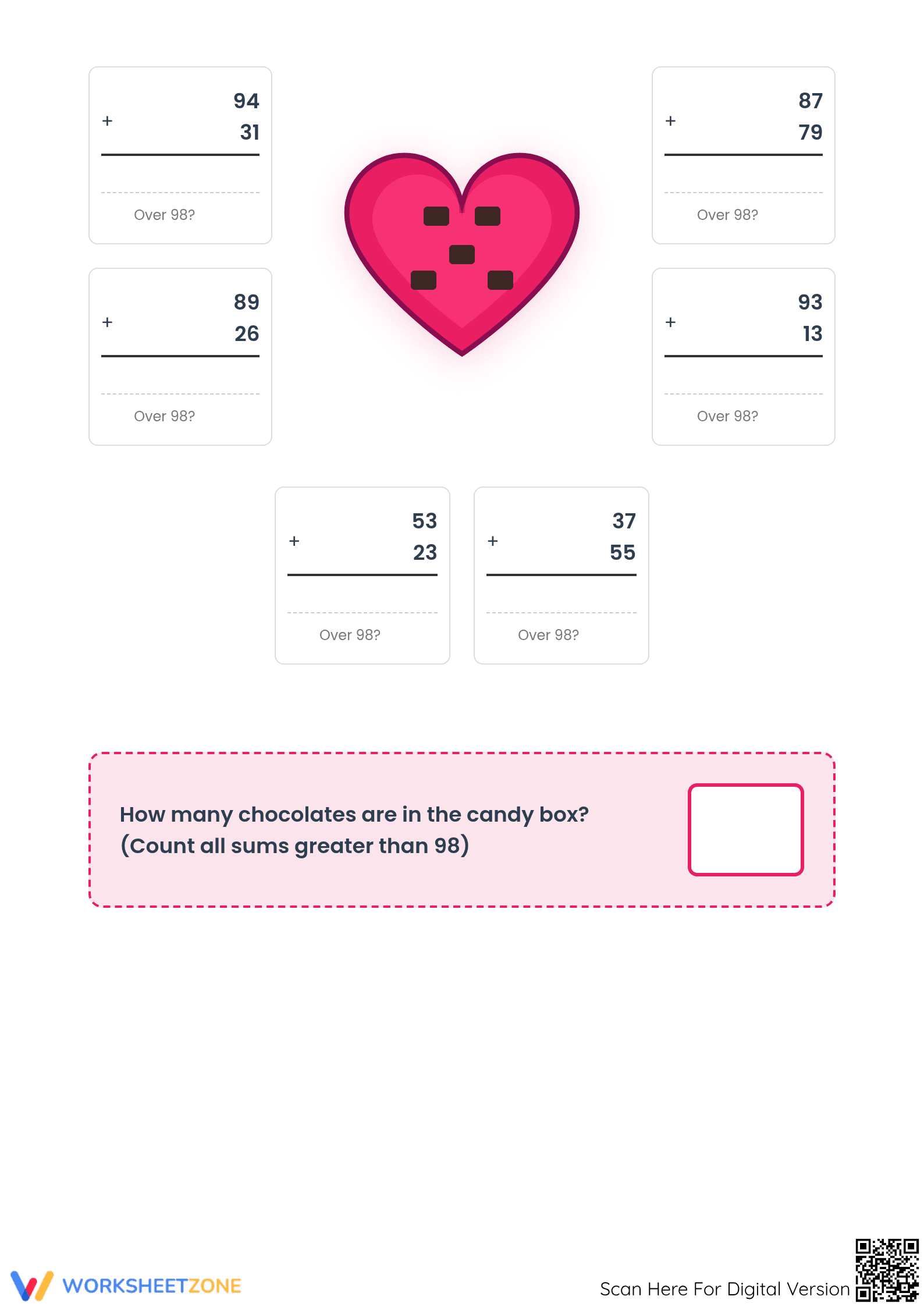
Engage students this Valentine's Day with a mathematical mystery that turns 2-digit addition practice into an exciting challenge. By solving multi-step addition problems and comparing sums to a target value, learners develop computational fluency while uncovering the secret of the chocolate candy box. This seasonal activity ensures high engagement without sacrificing rigorous academic standards.
At a Glance
- Grade: 3–5 · Subject: Math
- Standard:
CCSS.MATH.CONTENT.3.NBT.A.2— Fluently add within 1000 using strategies based on place value- Skill Focus: 2-Digit Addition · Regrouping
- Format: 2 pages · 21 problems · Answer key included · PDF
- Best For: Seasonal practice and computational fluency
- Time: 20–30 minutes
This two-page PDF resource features 21 vertically oriented 2-digit addition problems. Each task box includes an "Over 98?" check-box, requiring students to evaluate their calculated sum against a specific benchmark. Page one contains fifteen foundational problems, while page two offers six additional tasks and a final mystery solving box to calculate the total chocolate count.
Zero-Prep Workflow
The Chocolates Mystery is designed for immediate classroom deployment with a target prep time of under 2 minutes. Simply print the dual-page worksheet and distribute it to students. Learners follow the self-explanatory mystery instructions to identify which sums exceed 98. Use the included answer key for a rapid five-minute whole-class review or individual self-grading.
Standards Alignment
The primary focus is `CCSS.MATH.CONTENT.3.NBT.A.2`, which requires students to fluently add and subtract within 1000 using strategies and algorithms based on place value. This worksheet supports the development of mental math and algorithmic accuracy. Both standard codes can be copied directly into lesson plans, IEP goals, or district curriculum mapping tools.
How to Use It
Use this worksheet as a bell-ringer activity on Valentine's Day to settle the class with a focused, seasonal task. Alternatively, assign it as a formative assessment during a math center rotation. Observe students as they calculate sums to identify common regrouping errors or place-value misconceptions. The expected completion time for most intermediate learners is 25 minutes.
Who It's For
This resource is ideal for Grade 3, 4, and 5 students who are mastering 2-digit addition with regrouping. It provides necessary scaffolding for struggling learners while maintaining interest for advanced students through the mystery element. Pair this with a place-value anchor chart or a short lesson on comparing three-digit numbers for a comprehensive instructional block.
Mathematical fluency is foundational to higher-order problem solving in late elementary and middle school grades. This Valentine's Day Chocolates Mystery aligns with `CCSS.MATH.CONTENT.3.NBT.A.2` by providing targeted practice in 2-digit addition, a critical prerequisite for mastering multi-digit arithmetic. According to the RAND AIRS 2024 report, integrating gamified elements like mysteries or secrets into routine practice significantly increases student persistence and reduces math anxiety during seasonal transitions. By requiring students to compare their sums to 98, the worksheet also reinforces number sense and estimation skills. This structured practice supports the gradual release of responsibility model, moving students from guided calculation to independent verification of results. Educators can utilize the clear data points provided by the 21 tasks to measure individual progress toward computational mastery. The inclusion of an answer key ensures this resource remains a high-value, low-effort tool for busy classroom teachers.


