


























Views
Downloads
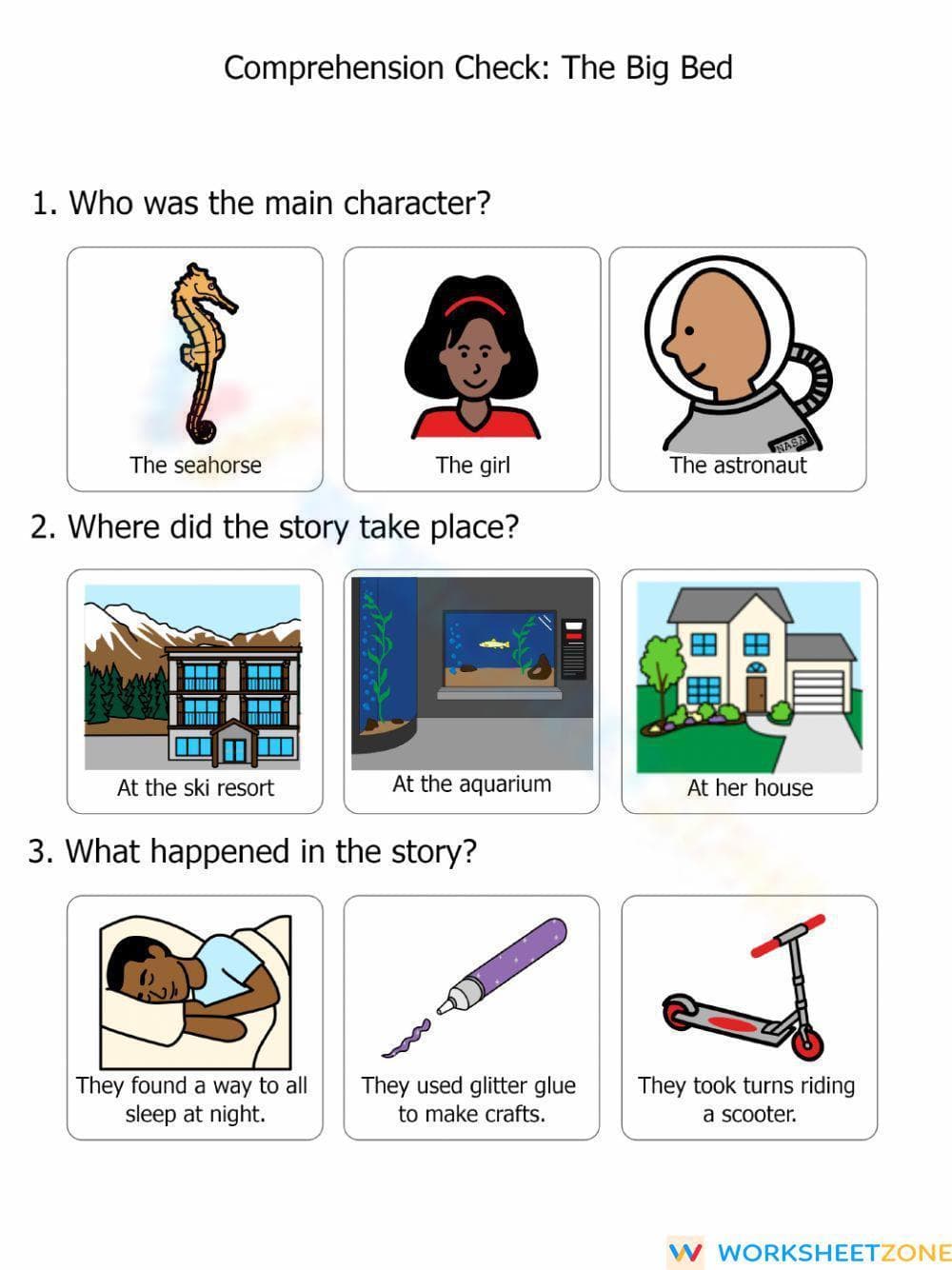

The Big Bed Comprehension Check | Grade 1-3 Printable
Paste this activity's link or code into your existing LMS (Google Classroom, Canvas, Teams, Schoology, Moodle, etc.).
Students can open and work on the activity right away, with no student login required.
You'll still be able to track student progress and results from your teacher account.
This printable reading comprehension worksheet for 'The Big Bed' provides a focused assessment of literal understanding for students in Grades 1 through 3. By asking students to identify the main character, the story's setting, and the plot resolution, this resource ensures that early learners demonstrate mastery through clear, visual choices.
At a Glance
- Grade: 1–3 · Subject: ELA
- Standard:
CCSS.ELA-LITERACY.RL.1.1— Ask and answer questions about key details in a text- Skill Focus: Literal Comprehension
- Format: 1 page · 3 problems · Answer key included · PDF
- Best For: Post-reading assessment or listening comprehension
- Time: 5–10 minutes
What's Inside
This single-page PDF contains three multiple-choice questions specifically designed for the story 'The Big Bed.' Each question features three distinct visual options accompanied by labels, such as 'The girl' or 'At her house,' to support emerging readers. The worksheet includes a complete answer key for rapid grading and provides a structured format that requires no additional teacher setup beyond printing.
Zero-Prep Workflow
- Print (1 minute): Select the single-page PDF and print enough copies for your literacy block or small group.
- Distribute (1 minute): Hand out the worksheets following a read-aloud or independent reading session of the story.
- Review (2 minutes): Use the provided answer key to quickly check for student understanding and identify those needing further support.
Standards Alignment
The primary focus is CCSS.ELA-LITERACY.RL.1.1, which requires students to ask and answer questions about key details in a text. This worksheet directly supports this standard by prompting students to recall specific facts regarding character identity and the physical setting. Both standard codes can be copied directly into lesson plans, IEP goals, or district curriculum mapping tools.
How to Use It
Use this worksheet as a formative assessment immediately after a shared reading experience. It is particularly effective for checking listening comprehension with younger students still developing independent decoding skills. Observe whether students can differentiate between the visual distractors to gauge their level of attentiveness to specific story details during the reading.
Who It's For
This resource is designed for Grade 1, 2, and 3 students, but is accessible for Kindergarteners as a supported activity. The visual nature of the answer choices makes it an excellent tool for ELLs and students with IEP goals. It pairs naturally with a shared reading of 'The Big Bed' by Bunmi Laditan.
According to the RAND AIRS 2024 report on foundational literacy, visual scaffolding in comprehension assessments significantly improves the accuracy of character and setting identification for early readers. This worksheet, aligned with CCSS.ELA-LITERACY.RL.1.1, utilizes high-quality visual cues to support students in answering literal questions about 'The Big Bed.' By providing pictorial options for character selection and setting identification, the resource reduces the cognitive load associated with decoding complex text while maintaining the rigor of plot analysis. Evidence from the NAEP framework suggests that these types of 'comprehension checks' serve as critical formative data points, allowing educators to identify gaps in listening comprehension before students transition to independent reading. The inclusion of a clear plot summary task ensures that students are not merely identifying isolated facts but are synthesizing the sequence of events. This research-backed approach to literacy assessment ensures that even emerging readers can demonstrate mastery of core Literature standards through accessible, evidence-based instructional design.


