


























Views
Downloads


Aligned Astronaut Reading Worksheet | Grade 1-3 English
Paste this activity's link or code into your existing LMS (Google Classroom, Canvas, Teams, Schoology, Moodle, etc.).
Students can open and work on the activity right away, with no student login required.
You'll still be able to track student progress and results from your teacher account.
This Grade 1-3 reading comprehension worksheet helps young learners build essential literacy skills through an engaging story about Astronaut Tom. Students practice identifying key details and expanding their space-themed vocabulary while engaging with a high-interest topic. By connecting text to meaning, this resource ensures students develop the foundational skills necessary for independent reading success and informational text mastery.
At a Glance
- Grade: 1-3 · Subject: English
- Standard:
CCSS.ELA-LITERACY.RI.1.1— Ask and answer questions about key details in a text- Skill Focus: Literal comprehension and vocabulary acquisition
- Format: 2 pages · 7 tasks · Answer key included · PDF
- Best For: Independent practice or literacy center activity
- Time: 15–20 minutes
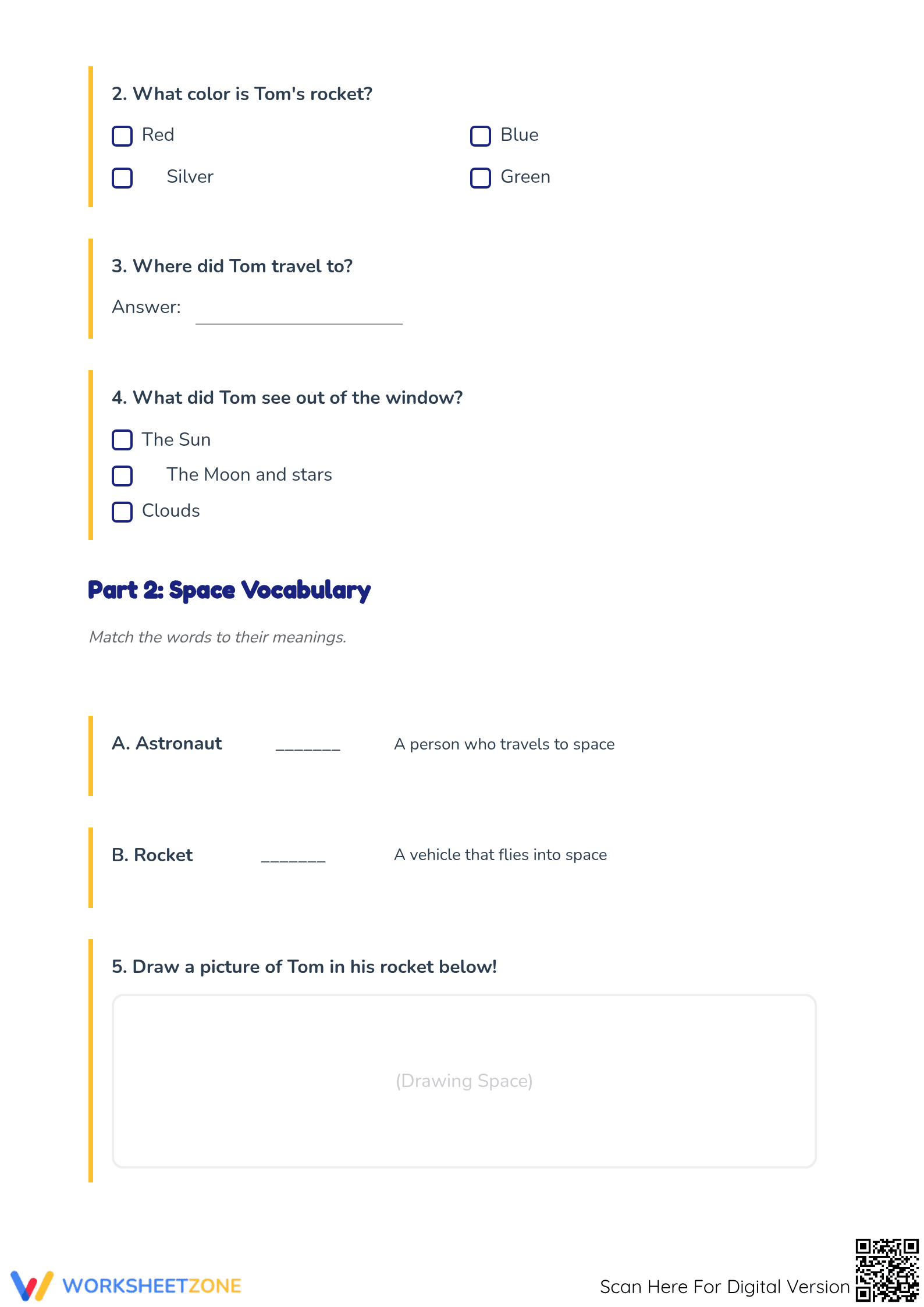
Inside this two-page resource, you will find a structured narrative about an astronaut's journey to outer space. The first page features a clear, accessible reading passage followed by an initial comprehension check. The second page expands the learning with multiple-choice questions, a space-themed vocabulary matching section, and a creative drawing prompt that allows students to visualize the text they just read. A full answer key is included for quick grading.
Zero-Prep Workflow
This resource is designed for maximum efficiency in the modern classroom. First, print the two-page PDF (approx. 30 seconds). Second, distribute the copies to your students for immediate engagement (approx. 1 minute). Finally, use the included answer key to review student work or facilitate a quick peer-grading session (approx. 5 minutes). This streamlined process requires less than two minutes of total teacher preparation, making it an ideal choice for substitute plans or morning work.
Standards Alignment
The primary focus of this worksheet is CCSS.ELA-LITERACY.RI.1.1: "Ask and answer questions about key details in a text." It also supports CCSS.ELA-LITERACY.L.1.6 by introducing domain-specific vocabulary such as "astronaut" and "rocket." These standard codes can be copied directly into lesson plans, IEP goals, or district curriculum mapping tools to ensure every instructional minute is aligned with grade-level expectations and rigorous academic targets.
How to Use It
Use this worksheet during the independent practice portion of a literacy lesson to assess student ability to retrieve information from a text. It also serves as an excellent formative assessment tool; observe how students approach the vocabulary matching to gauge their word-solving strategies. For best results, assign this activity after a whole-group read-aloud about space to build background knowledge. Most students will successfully complete the 7 tasks within a 15-to-20-minute window.
Who It's For
This resource is perfect for first and second-grade students who are beginning to transition from learning to read to reading to learn. It provides enough scaffolding for emerging readers while offering a creative outlet for more advanced learners. This worksheet pairs naturally with a classroom anchor chart about "Who, What, Where, and Why" questions or a short informational video about NASA and space travel.
Research by Fisher & Frey (2014) emphasizes the importance of close reading and answering text-dependent questions as a catalyst for deep comprehension. This astronaut-themed worksheet applies these principles by requiring students to revisit the text for specific evidence regarding Astronaut Tom's experience. By mastering the CCSS.ELA-LITERACY.RI.1.1 standard through high-interest topics, students build the cognitive stamina required for more complex informational texts. The inclusion of vocabulary matching and visual representation ensures a multi-modal approach to literacy, which NAEP data suggests is critical for closing achievement gaps in early elementary grades. Educators can rely on this printable resource as a stable, evidence-based tool for daily instruction or targeted intervention.


