




























Thanksgiving Recipe Fractions: Double and Halve a Recipe | Grade 5
Paste this activity's link or code into your existing LMS (Google Classroom, Canvas, Teams, Schoology, Moodle, etc.).
Students can open and work on the activity right away, with no student login required.
You'll still be able to track student progress and results from your teacher account.
This Grade 5 Thanksgiving math worksheet provides practical fraction multiplication practice by guiding students through scaling an authentic pumpkin pie recipe. Learners apply fraction multiplication skills by calculating double and half quantities across recipe ingredients before tackling real-world multi-step kitchen word problems.
At a Glance
- Grade: 5 · Subject: Math
- Standard:
Fraction Multiplication— Multiply fractions and mixed numbers to scale quantities and solve word problems- Skill Focus: Doubling and halving recipe ingredients with fractions
- Format: 3 pages · 26 problems · Answer key included · PDF
- Best For: Holiday math centers, independent practice, or review
- Time: 35–45 minutes
What's Inside
This 3-page printable activity features 26 total mathematical tasks organized into three distinct sections. It includes a structured ingredient scaling table with 16 calculation cells, 4 multi-step kitchen word problems with dedicated workspace, and a 6-question quick-check section featuring matching and multiple-choice questions. A complete 3-page answer key provides worked-out solutions and model explanations.
Skill Progression
- Guided practice (Part A): Students calculate 16 fraction scaling values within a structured ingredient table supported by a culinary reference tip defining doubling as multiplying by 2 and halving as multiplying by 1/2.
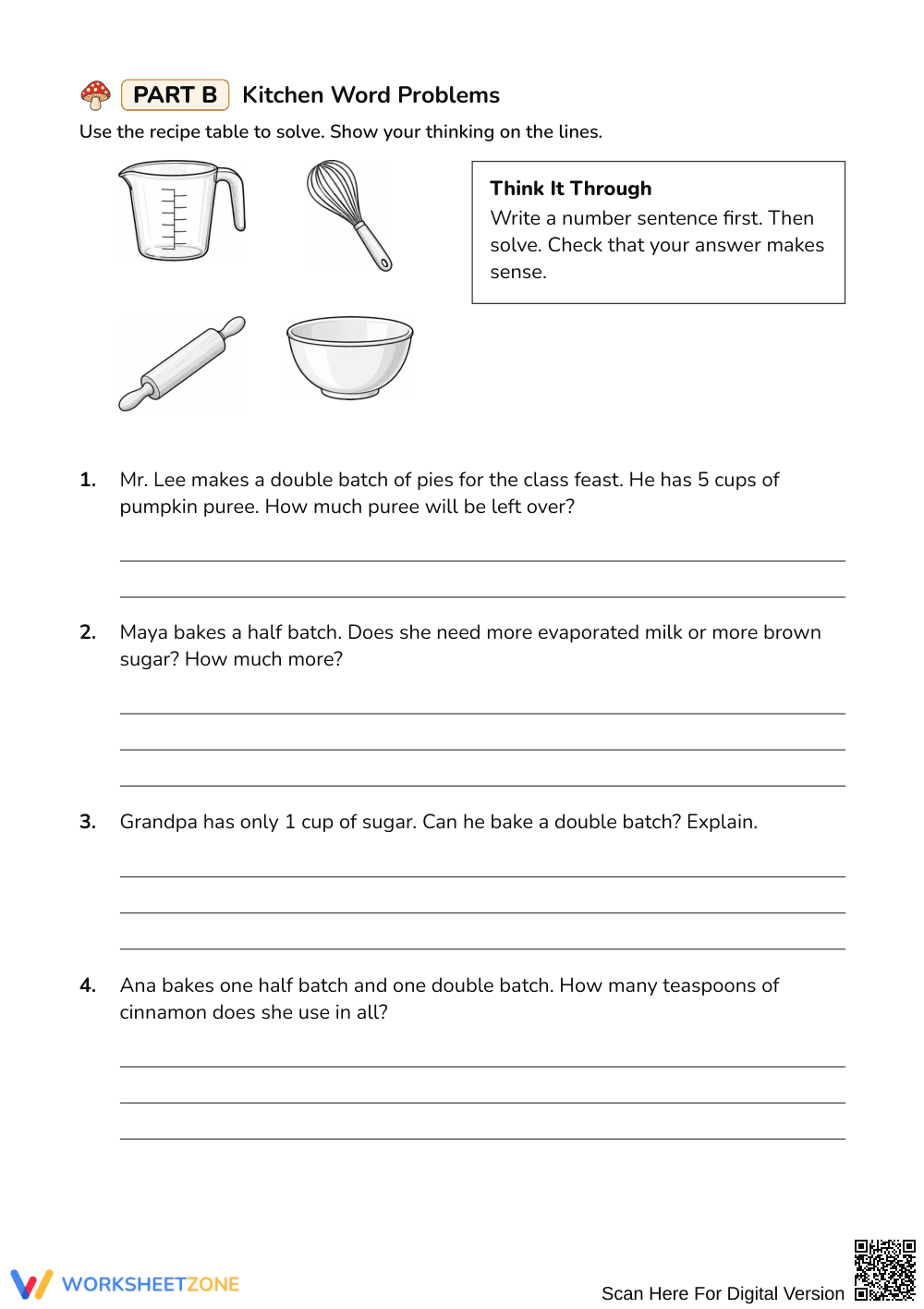
- Supported practice (Part B): Students solve 4 multi-step word problems requiring them to compare, add, and subtract their scaled recipe amounts using guided strategy prompts.
- Independent practice (Part C): Students complete a 6-item quick check combining fraction multiplication matching with multiple-choice application items without scaffolding.
This structure follows an intentional gradual-release model, shifting learners from guided tabular computation to autonomous contextual problem-solving.
Standards Alignment
This activity reinforces standard operations with fractions, specifically multiplying fractions by whole numbers and fractions to solve real-world problems involving mixed numbers and scaling. Both standard codes can be copied directly into lesson plans, IEP goals, or district curriculum mapping tools.
How to Use It
Implement this resource directly after completing whole-group direct instruction on multiplying fractions by whole numbers and unit fractions. It serves effectively as a high-engagement November math station or a collaborative partner activity. During work time, formatively check whether students remember to convert improper fractions into simplified mixed numbers when doubling quantities such as 3/4 cup. Expect students to finish within 35 to 45 minutes.
Who It's For
This worksheet is designed for general fifth-grade math classes, upper elementary intervention groups, or homeschool math units seeking seasonal applied mathematics. Pair this printable with a kitchen measurement anchor chart or physical measuring cups to support tactile learners visualizing half and double amounts.
Educational research synthesis from EdReports 2024 underscores that students achieve deeper conceptual mastery of fraction multiplication when operations are anchored in authentic, concrete contexts such as culinary scaling rather than isolated numerical drills. By requiring learners to multiply unit fractions, non-unit fractions, and mixed numbers across 26 structured tasks, this Thanksgiving worksheet bridges procedural fluency and contextual reasoning. Learners repeatedly operationalize scaling factors, discovering how whole-number multipliers expand values while fractional multipliers partition quantities, reinforcing critical fifth-grade arithmetic foundations. Furthermore, contextualizing fraction computations within culinary tasks supports active cognitive schema development, allowing fifth graders to connect abstract symbolic operations directly to tangible kitchen measurements. Systematic exposure to proportional reasoning through repeated ingredient adjustments solidifies proportional relationships and fractional equivalence. As students evaluate changing quantities, calculate required conversions, and solve multi-step recipe dilemmas, they cultivate robust mathematical communication skills and lasting analytical confidence essential for advanced middle school mathematics coursework.


