


























Views
Downloads

Printable Body Parts Worksheet | Grade 1 Science
Paste this activity's link or code into your existing LMS (Google Classroom, Canvas, Teams, Schoology, Moodle, etc.).
Students can open and work on the activity right away, with no student login required.
You'll still be able to track student progress and results from your teacher account.
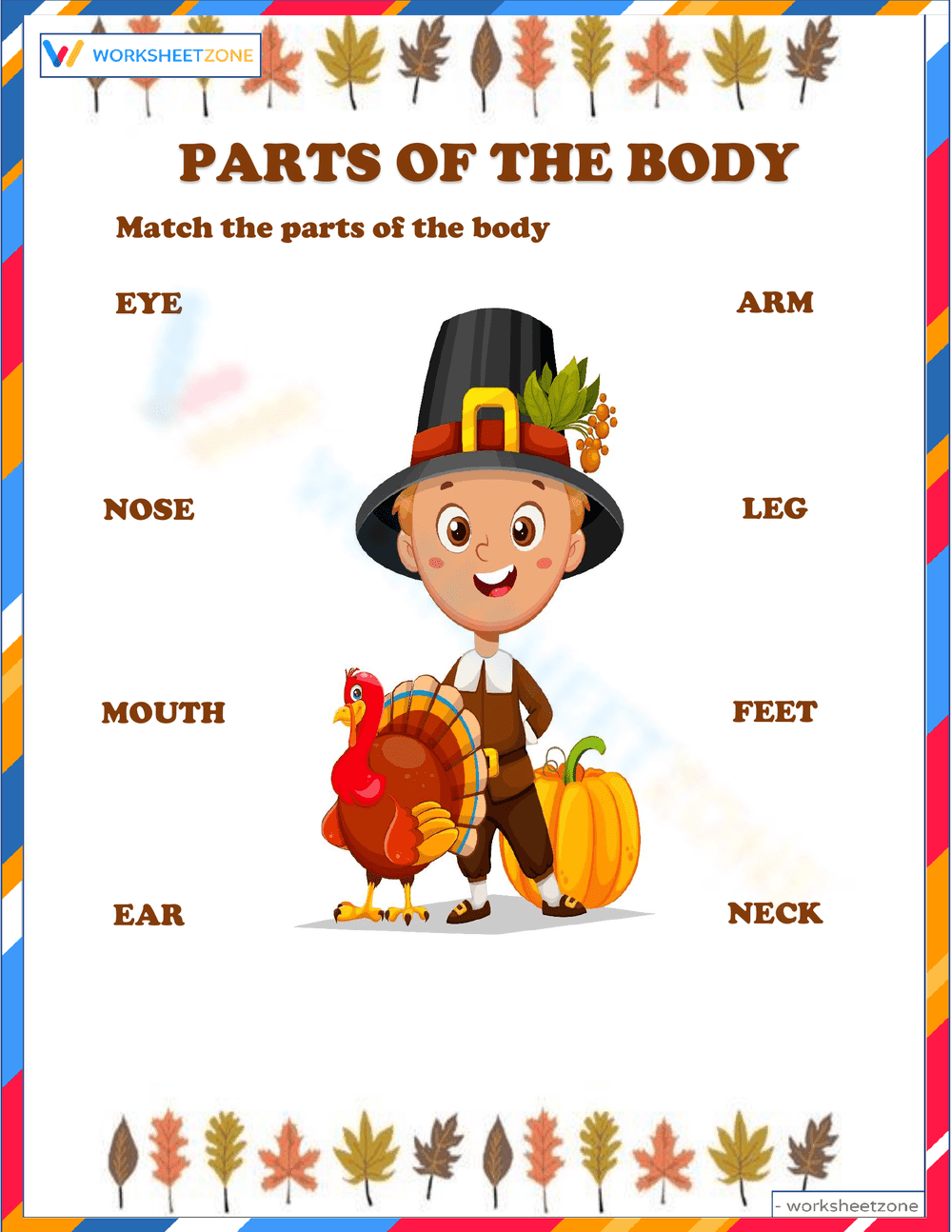
This Thanksgiving-themed human body parts worksheet helps early learners identify and match basic external anatomy. Students draw lines connecting vocabulary words to the correct locations on a festive character, reinforcing both life science concepts and early reading skills in one engaging, seasonal activity.
At a Glance
- Grade: 1 · Subject: Science
- Standard:
1-LS1-1— Identify external body parts- Skill Focus: Anatomy vocabulary matching
- Format: 1 page · 8 problems · PDF
- Best For: Morning work or science centers
- Time: 10–15 minutes
This single-page printable features a cheerful Thanksgiving pilgrim boy surrounded by eight foundational anatomy vocabulary words, including eye, nose, mouth, ear, arm, leg, feet, and neck. Students complete eight distinct matching tasks by drawing lines from the text to the corresponding physical feature on the illustration. The clear, uncluttered layout provides visual scaffolding for early readers, ensuring they can focus on word recognition and biological identification without overwhelming distractions.
This resource is designed for immediate classroom implementation with a streamlined zero-prep workflow:
- Print (1 minute): Simply download the PDF and print the required number of copies. The high-contrast design ensures crisp reproduction even in black and white.
- Distribute (1 minute): Hand out the worksheets along with pencils or crayons. No special materials or complex teacher modeling are required.
- Review (3 minutes): Quickly check student connections as a whole class or collect for rapid formative grading.
Total teacher preparation time is under two minutes, making this an ideal emergency sub plan or quick transition activity during the busy holiday season.
This activity aligns with primary standard 1-LS1-1, which requires students to understand how humans use external parts to survive and meet their needs. By identifying these structures, students build foundational vocabulary for deeper biological inquiry. It also supports early literacy standards for reading foundational skills. Both standard codes can be copied directly into lesson plans, IEP goals, or district curriculum mapping tools.
Teachers can deploy this worksheet during morning arrival as a festive bell-ringer that activates prior knowledge about the human body. Alternatively, it serves as an excellent independent practice station during science centers following direct instruction on external anatomy. As a formative assessment tip, observe whether students rely on initial consonant sounds to decode the vocabulary words before drawing their lines. Expect students to complete this matching exercise within a 10 to 15-minute timeframe.
This resource is primarily designed for kindergarten and first-grade students developing their science vocabulary and early reading skills. The visual nature of the matching task provides built-in differentiation for English Language Learners (ELLs) and visual learners who benefit from clear pictorial representations of text. It pairs perfectly with a read-aloud book about the human body or a seasonal Thanksgiving anchor chart discussing what we are thankful for, including our healthy bodies.
Mastering foundational anatomy vocabulary is a critical step in early childhood science education. This resource supports standard 1-LS1-1 by helping students identify external body parts, the prerequisite knowledge for understanding biological functions. According to a 2024 report by EdReports, integrating cross-curricular literacy tasks into primary science instruction significantly improves vocabulary retention and conceptual understanding. By combining seasonal engagement with targeted vocabulary matching, this worksheet provides the repeated exposure necessary for early readers to internalize domain-specific terminology. The visual scaffolding inherent in the matching format reduces cognitive load, allowing young learners to focus on the relationship between the written word and the physical structure. This evidence-based approach ensures foundational life science concepts are accessible and effectively retained by early elementary students.


