


























Views
Downloads

Synonym Knowledge Check Worksheet | Essential Grade 2 ELA
Paste this activity's link or code into your existing LMS (Google Classroom, Canvas, Teams, Schoology, Moodle, etc.).
Students can open and work on the activity right away, with no student login required.
You'll still be able to track student progress and results from your teacher account.
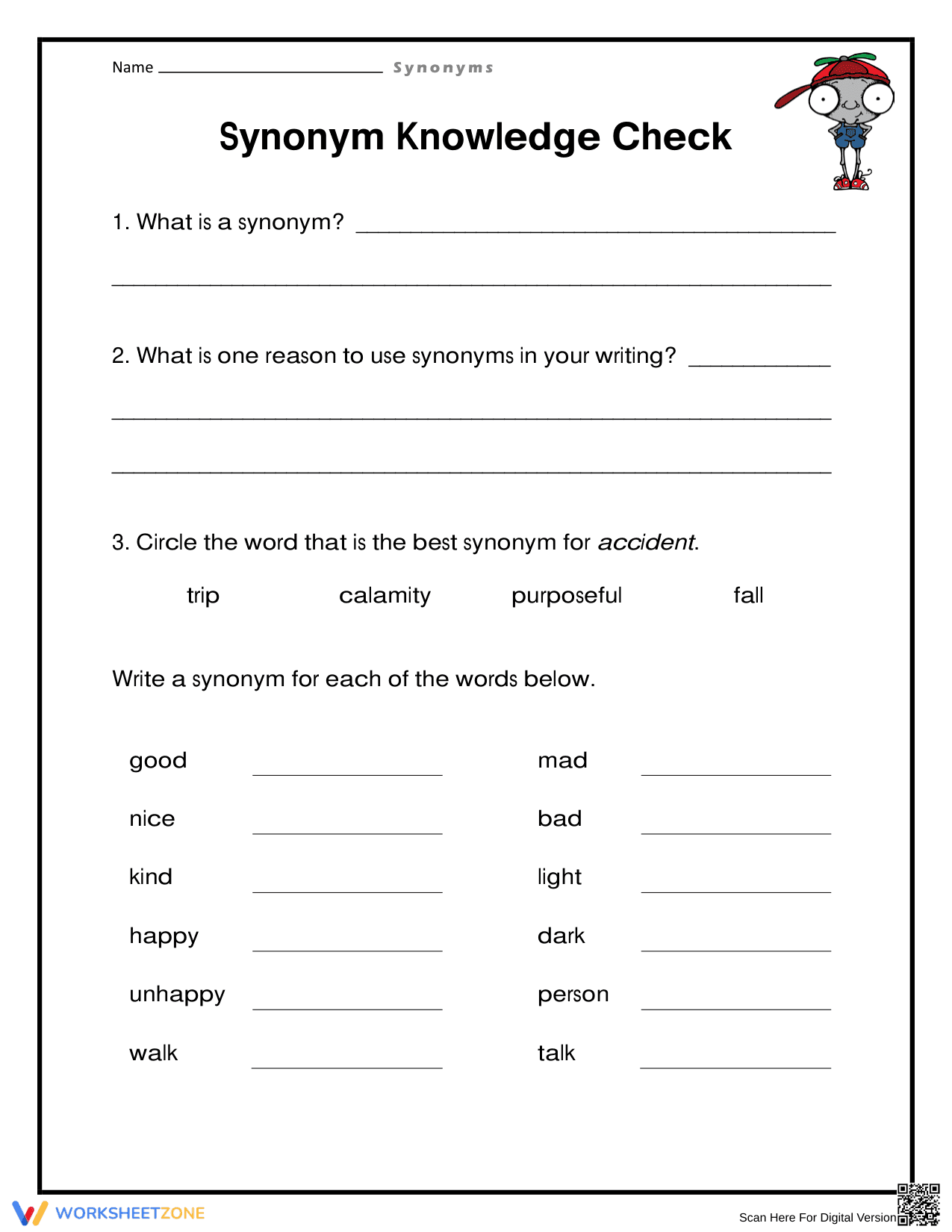
This Grade 2 synonym worksheet assesses a student's fundamental understanding of word relationships through a structured, multi-modal approach. Students begin by defining the concept and explaining its utility in writing, then transition to practical application by identifying and generating specific word pairs. It ensures learners can vary their vocabulary effectively to improve writing clarity.
At a Glance
- Grade: 2 · Subject: English Language Arts
- Standard:
CCSS.ELA-LITERACY.L.2.5— Understand and identify word relationships and nuances in word meanings- Skill Focus: Synonym definition and generation
- Format: 1 page · 15 problems · Answer key included · PDF
- Best For: Vocabulary assessments or homework review
- Time: 15–20 minutes
The worksheet contains 15 specific tasks across a single printable page. The layout starts with two conceptual short-answer questions to gauge deep understanding. Following this is a targeted multiple-choice identification task using the word "accident." The final section features a high-volume practice grid where students must provide synonyms for 12 common adjectives and verbs, such as "good," "happy," and "walk."
To use this resource efficiently, follow this three-step zero-prep workflow. Step 1: Print. This single-page PDF requires zero formatting adjustments; simply hit print for your entire class in under 30 seconds. Step 2: Distribute. With clear, self-explanatory instructions, the worksheet can be handed out as a bell-ringer or independent station activity. Step 3: Review. Use the included answer key to grade the 15 responses in less than 2 minutes per student.
Primary standard `CCSS.ELA-LITERACY.L.2.5` focuses on demonstrating an understanding of word relationships. By requiring students to define what a synonym is and generate them for common words, this resource directly supports the development of vocabulary nuances. Both standard codes can be copied directly into lesson plans, IEP goals, or district curriculum mapping tools.
This is an ideal formative assessment to use after a primary lesson on word relationships to check for individual mastery. Alternatively, it serves as an excellent sub plan or homework assignment to reinforce previous learning. Teachers should observe whether students can generate precise synonyms for "unhappy" or "calamity" as a signal of higher-order vocabulary acquisition and text comprehension.
Designed for Grade 2 and Grade 3 students mastering ELA vocabulary standards. It provides enough scaffolding for struggling readers while offering extension opportunities through the definition of more complex terms. This resource pairs naturally with a classroom anchor chart displaying common synonym pairs or a short reading passage focusing on descriptive language and word choice.
Research indicates that explicit instruction in word relationships is a critical component of lexical development. This Grade 2 ELA worksheet aligns with the standard `CCSS.ELA-LITERACY.L.2.5`, which mandates that students demonstrate an understanding of nuances in word meanings. According to the RAND AIRS 2024 report, students who engage in structured vocabulary practice involving both definition and active generation show significantly higher retention rates. By requiring students to think critically about why synonyms are used in writing, this resource bridges the gap between isolated vocabulary knowledge and expressive writing skills. The inclusion of 15 targeted tasks ensures comprehensive coverage of the skill. Educational professionals can reliably integrate this "knowledge check" into broader literacy blocks to track student progress toward meeting state-mandated vocabulary benchmarks. This assessment provides the measurable data needed for future instructional planning.


