




























Views
Downloads
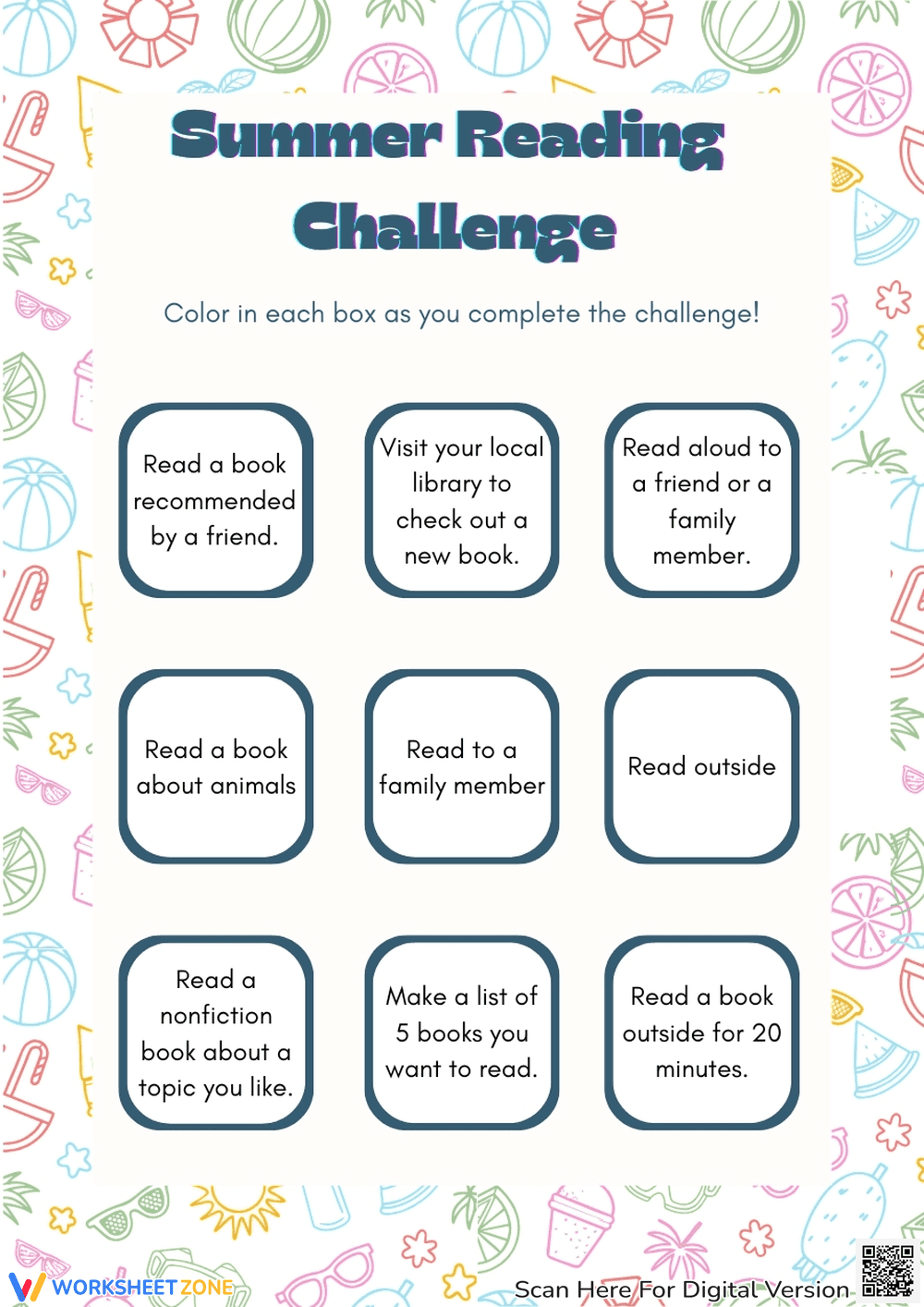

Summer Reading Challenge: Essential Grade 1-4 Printable

Paste this activity's link or code into your existing LMS (Google Classroom, Canvas, Teams, Schoology, Moodle, etc.).
Students can open and work on the activity right away, with no student login required.
You'll still be able to track student progress and results from your teacher account.
This Summer Reading Challenge worksheet provides elementary students with a structured way to maintain literacy skills during school breaks. By offering 9 engaging prompts, it transforms reading into a rewarding adventure, helping to prevent the "summer slide" and fostering a love for books across multiple genres.
At a Glance
- Grade: 1-4 · Subject: ELA / Reading
- Standard:
CCSS.ELA-LITERACY.RL.2.10— Read and comprehend literature independently and proficiently in the appropriate grade band.- Skill Focus: Reading Engagement & Habit Building
- Format: 1 page · 9 tasks · No answer key needed · PDF
- Best For: Summer break incentive or library program
- Time: 15–30 minutes per task
The worksheet features a 3x3 grid containing nine distinct reading challenges. Tasks range from social interactions, such as reading to a family member or getting a recommendation from a friend, to environmental changes like reading outside for 20 minutes. The visual design includes a playful summer-themed border, and students color in each box as they complete the activity, providing a satisfying sense of progress.
Zero-Prep Workflow:
- Print: Select the single-page PDF and print enough copies for your entire class or library group (30 seconds).
- Distribute: Hand out the sheets during the final week of school, explaining the "color-as-you-go" mechanic (1 minute).
- Review: Set a date for students to return their completed sheets for a small reward, requiring zero active grading time.
Total teacher prep time for this activity is under 2 minutes, making it an ideal end-of-year resource.
This resource aligns with `CCSS.ELA-LITERACY.RL.2.10`, which emphasizes the importance of students reading and comprehending literature independently and proficiently. By encouraging students to explore different texts—including nonfiction and peer recommendations—it supports the development of a broad reading foundation. Both standard codes can be copied directly into lesson plans, IEP goals, or district curriculum mapping tools.
Use this worksheet as a "send-home" packet during the last week of the spring semester to encourage independent reading over the break. Alternatively, it serves as an excellent formative assessment tool for summer school teachers; by observing which boxes students complete first, educators can gain insights into student preferences and social reading habits. Completion typically spans several weeks of the summer.
This resource is designed for students in Grades 1 through 4, with tasks that are accessible to emerging readers while remaining engaging for more fluent upper-elementary students. It pairs naturally with a local library summer reading list or a classroom "book talk" session where students share their favorite titles before the break begins.
Research from the RAND AIRS 2024 report highlights that consistent access to diverse reading materials and self-selected reading tasks significantly mitigates the "summer slide," particularly for students in the early elementary years. This Summer Reading Challenge worksheet addresses these findings by providing nine specific, actionable prompts that encourage students to engage with both fiction and nonfiction in varied environments. By aligning with CCSS.ELA-LITERACY.RL.2.10, the resource ensures that students are not just reading, but are building the stamina required for higher-level text complexity. Fisher & Frey (2014) emphasize that "volume matters," and providing students with a structured way to track their reading adventures increases the likelihood of sustained literacy engagement outside the traditional classroom setting. This printable tool serves as a bridge between school-year instruction and independent summer exploration, making it a vital component of any comprehensive literacy maintenance strategy for Grade 1-4 learners.


