


























Views
Downloads

Printable Suffixes -er and -ness Worksheet | Grade 3 ELA
Paste this activity's link or code into your existing LMS (Google Classroom, Canvas, Teams, Schoology, Moodle, etc.).
Students can open and work on the activity right away, with no student login required.
You'll still be able to track student progress and results from your teacher account.
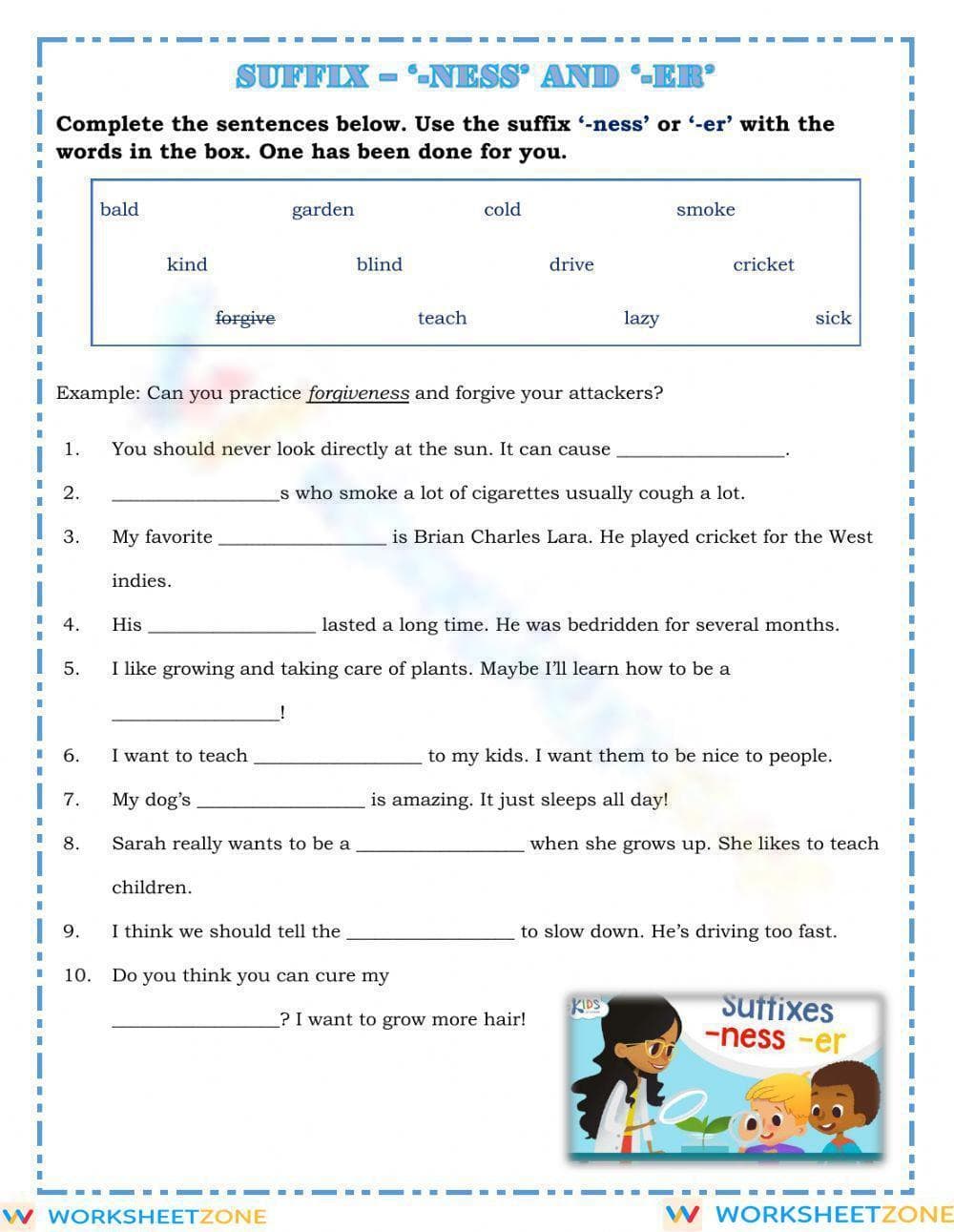
This suffixes -er and -ness worksheet provides students with targeted practice in word formation and morphology. By applying these specific affixes to a curated list of base words, learners master the transition from adjectives and verbs to nouns and agent nouns. This activity strengthens vocabulary and decoding skills, helping students build meaning.
At a Glance
- Grade: 3 · Subject: English Language Arts
- Standard:
CCSS.ELA-LITERACY.L.3.4.B— Determine the meaning of a new word formed when a known affix is added- Skill Focus: Morphology and Suffixes (-er, -ness)
- Format: 1 page · 10 problems · Answer key included · PDF
- Best For: Independent practice or quick formative assessment
- Time: 10–15 minutes
This resource features ten fill-in-the-blank sentences featuring the suffixes -er and -ness. A comprehensive word bank is provided, containing twelve base words such as "kind," "teach," and "sick." Students must select the correct base word and attach the appropriate suffix to complete the context of each sentence. The layout includes a clear example of the transformation from "forgive" to "forgiveness" to guide student work.
The zero-prep design of this worksheet ensures it is ready for immediate classroom use. Follow a simple workflow: Print the single-page PDF (30 seconds), distribute the copies to students (1 minute), and review the answers using the included key (30 seconds). Total preparation time is under two minutes, making this an ideal solution for emergency sub plans, morning work, or "bell-ringer" activities that require high student engagement with minimal setup.
This resource is directly aligned with CCSS.ELA-LITERACY.L.3.4.B, which requires students to determine the meaning of the new word formed when a known affix is added to a known word. It also supports CCSS.ELA-LITERACY.L.2.4.B by focusing on how suffixes change the meaning of base words. Both standard codes can be copied directly into lesson plans, IEP goals, or district curriculum mapping tools to document rigorous alignment.
Use this worksheet during the "Independent Practice" phase of a lesson on morphology after students have been introduced to the meanings of -er (one who does) and -ness (the state of being). It also serves as an excellent formative assessment tool; observe if students correctly distinguish between the agent noun "-er" and the state-of-being noun "-ness." Completion typically takes 10 to 15 minutes.
This activity is designed for Grade 3 students but is equally effective for Grade 2 enrichment or Grade 4 review. It supports English Language Learners (ELL) navigating word families and morphology. Pair this worksheet with a suffix anchor chart or a short reading passage that highlights "er" and "ness" words to reinforce the concept across multiple contexts for better retention.
According to the RAND AIRS 2024 report on literacy instruction, explicit morphological awareness is a critical predictor of reading comprehension success in the upper elementary grades. This worksheet targets the specific sub-skills of suffix application and word-part decoding, which are essential for students as they transition from "learning to read" to "reading to learn." By practicing the addition of "-er" and "-ness" to familiar base words, students build a mental model of English word structure that allows them to access the meaning of unfamiliar multi-syllabic words in complex texts. Research from Fisher & Frey (2014) suggests that such focused, scaffolded practice with word parts significantly reduces the cognitive load during independent reading, allowing students to focus on deeper textual analysis rather than basic decoding.


