


























Views
Downloads
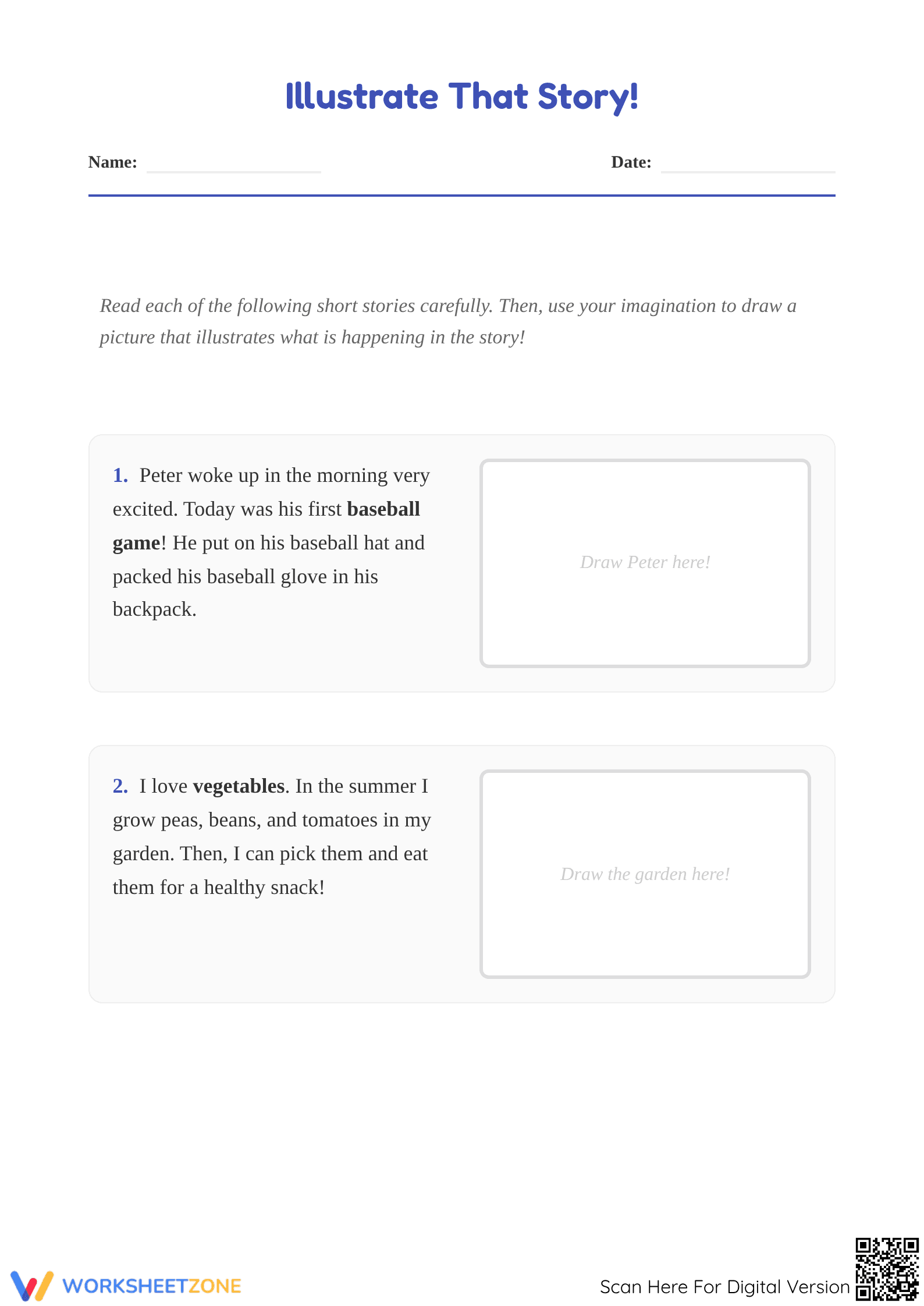


Printable Story Illustration Worksheet | Grade 2-3 ELA
Paste this activity's link or code into your existing LMS (Google Classroom, Canvas, Teams, Schoology, Moodle, etc.).
Students can open and work on the activity right away, with no student login required.
You'll still be able to track student progress and results from your teacher account.
Strengthen reading comprehension and creative visualization with this 'Illustrate That Story!' worksheet. Students practice active reading by processing short narratives and translating text-based details into original drawings. This essential ELA resource bridges the gap between decoding words and internalizing meaning through artistic expression, ensuring foundational literacy skills are firmly rooted in comprehension.
At a Glance
- Grade: 2–3 · Subject: ELA
- Standard:
CCSS.ELA-LITERACY.RL.2.7— Use information from words and illustrations to understand characters, setting, or plot- Skill Focus: Reading Comprehension and Visualization
- Format: 2 pages · 5 problems · Answer key included · PDF
- Best For: Independent practice or early finisher activity
- Time: 15–20 minutes
What's Inside
This 2-page PDF features four structured story boxes and one 'Bonus Challenge' extension. Each prompt includes a focused paragraph with bolded key terms to guide visualization. The layout provides ample white space for student illustrations, alongside a self-directed creative writing component that encourages students to author and illustrate their own unique story scenario.
Zero-Prep Workflow
Implementing this activity requires zero teacher preparation. Simply print the double-sided document in under 1 minute. Distribute to the class during your ELA block or use it as a standalone substitute lesson. Reviewing student work takes approximately 3 minutes, focusing on how accurately the visual details match the textual evidence provided in each story prompt.
Standards Alignment
Aligned to CCSS.ELA-LITERACY.RL.2.7, which requires students to use information gained from the illustrations and words in a text to demonstrate understanding. This worksheet provides the 'words' and tasks students with creating the 'illustrations' to prove comprehension. This standard code can be copied directly into lesson plans, IEP goals, or district curriculum mapping tools.
How to Use It
Use this during small-group instruction to observe how students decode specific adjectives and nouns to inform their drawings. It also serves as an excellent formative assessment for visualization strategies; check if students included the 'bright silver moon' or 'baseball hat' as specified in the text. Completion typically takes 20 minutes.
Who It's For
Designed for Grade 2 and Grade 3 students developing early literacy skills. It is particularly effective for visual learners and English Language Learners (ELL) who benefit from non-verbal ways to demonstrate understanding. Pair this with a high-interest picture book or an anchor chart on visualization to deepen the learning experience.
The 'Illustrate That Story!' worksheet is a research-informed tool designed to foster visualization, a critical component of reading comprehension. According to Fisher & Frey (2014), visualization allows students to create mental images that serve as 'placeholders' for meaning, significantly improving retention and deep processing of narrative structures. By requiring students to translate textual evidence into visual representation, this worksheet aligns with the CCSS.ELA-LITERACY.RL.2.7 standard, ensuring that literacy development moves beyond simple decoding into conceptual synthesis. Recent findings from the RAND AIRS 2024 report highlight that multi-modal literacy activities—those combining reading with creative output—help solidify neurological connections between lexical processing and imaginative reasoning. This 2-page printable provides a structured, no-prep environment for students to demonstrate mastery of plot and character details, making it an essential addition to any primary grade ELA curriculum or sub plan folder.


