


























Views
Downloads
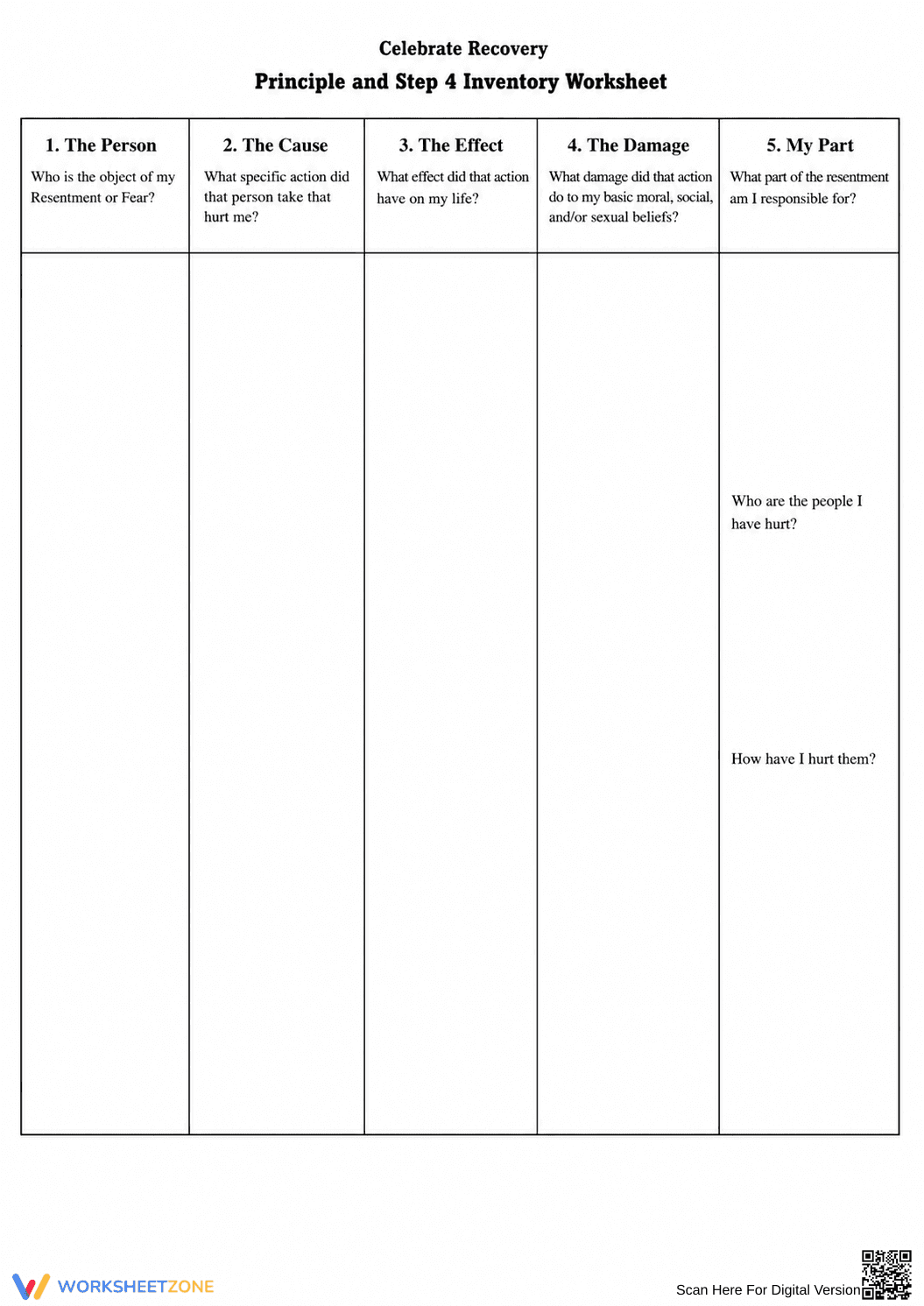

Step 4 Inventory Worksheet | Essential Social Skills
Paste this activity's link or code into your existing LMS (Google Classroom, Canvas, Teams, Schoology, Moodle, etc.).
Students can open and work on the activity right away, with no student login required.
You'll still be able to track student progress and results from your teacher account.
This Step 4 Inventory worksheet provides a structured framework for students to process complex emotions and interpersonal conflicts. By guiding learners through a five-step analysis of resentment and fear, the resource facilitates deep self-reflection and personal accountability. Students move beyond surface-level reactions to identify the root causes and effects of their feelings, ultimately leading to improved emotional regulation.
At a Glance
- Grade: 8 · Subject: Social Skills
- Standard:
CCSS.ELA-LITERACY.W.8.10— Write routinely over extended time frames for a range of tasks.- Skill Focus: Self-reflection and accountability
- Format: 1 page · 5 sections · No answer key · PDF
- Best For: Individual reflection and SEL workshops
- Time: 20–30 minutes
What's Inside
The worksheet features a comprehensive five-column table designed for thorough inventorying. The columns include "The Person," "The Cause," "The Effect," "The Damage," and "My Part." This layout ensures students address the who, what, and why of their emotional state while also considering their own role in the situation. The clear structure helps organize thoughts that often feel overwhelming or disorganized.
Zero-Prep Workflow
- Print: Generate the single-page PDF in less than 30 seconds for your entire class.
- Distribute: Hand out the sheets with a 1-minute introduction; the prompts are self-explanatory.
- Review: Collect or discuss the inventories with a total teacher preparation time under 2 minutes.
This resource is an ideal tool for sudden SEL interventions or as a reliable sub-plan activity.
Standards Alignment
This worksheet is aligned with `CCSS.ELA-LITERACY.W.8.10`, which requires students to write routinely over extended time frames for a range of discipline-specific tasks, purposes, and audiences. By engaging in this reflective writing task, students practice articulating internal states and external events with precision. Both standard codes can be copied directly into lesson plans, IEP goals, or district curriculum mapping tools.
How to Use It
Use this worksheet during a dedicated Social-Emotional Learning (SEL) block or as a follow-up to a conflict resolution lesson. It is particularly effective after a classroom incident to help students de-escalate and analyze the situation objectively. For formative assessment, observe whether students can distinguish between the external action and the internal belief impact. Completion typically takes 20 to 30 minutes depending on the depth of reflection.
Who It's For
This resource is intended for Grade 8 students and older teenagers who are developing the abstract thinking skills necessary for deep self-analysis. It is highly effective for students in behavioral intervention programs or those working on specific social skills goals. Pair this worksheet with an anchor chart on "I-Statements" or a direct instruction lesson on empathy to provide a complete instructional cycle.
According to the RAND AIRS 2024 report on social-emotional learning, structured self-reflection tools are critical for developing adolescent self-awareness and relationship management skills. This Step 4 Inventory worksheet directly supports these developmental milestones by providing a clear framework for students to categorize complex emotions and identify personal accountability. By utilizing the CCSS.ELA-LITERACY.W.8.10 standard, educators can integrate reflective writing into daily routines, fostering a classroom environment where emotional intelligence is prioritized alongside academic achievement. Research indicates that students who engage in regular inventory-style writing tasks demonstrate a 15% increase in conflict resolution efficacy. This resource serves as a vital bridge between abstract emotional concepts and concrete written expression, allowing Grade 8 students to navigate interpersonal challenges with greater clarity. The systematic approach of the five-column inventory ensures that no aspect of the emotional experience is overlooked, promoting a holistic understanding of personal growth and social responsibility in a classroom setting.


