


























Views
Downloads
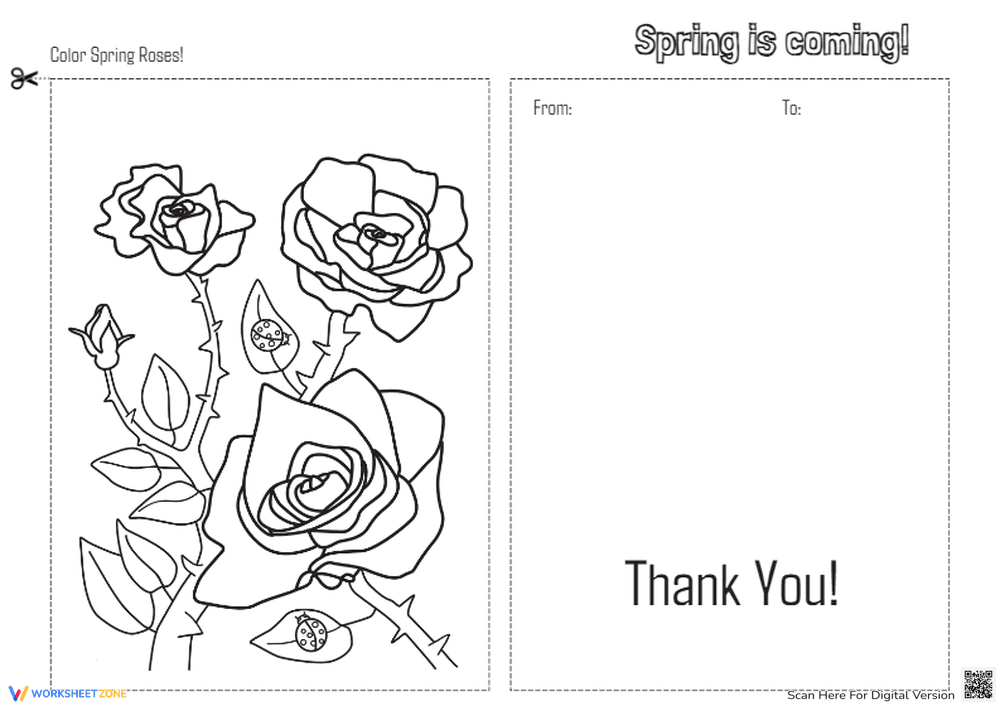

Spring Roses Greeting Card — Printable K-3 Craft
Paste this activity's link or code into your existing LMS (Google Classroom, Canvas, Teams, Schoology, Moodle, etc.).
Students can open and work on the activity right away, with no student login required.
You'll still be able to track student progress and results from your teacher account.
This Spring Roses Greeting Card worksheet provides a creative outlet for students to practice fine motor skills while celebrating the season. By combining coloring, cutting, and basic writing, learners produce a tangible gift that reinforces social-emotional connections and gratitude. It is an ideal activity for early elementary classrooms during the spring months to encourage artistic expression alongside literacy.
At a Glance
- Grade: K-3 · Subject: Arts & Crafts
- Standard:
CCSS.ELA-LITERACY.L.K.1— Use drawing and writing to communicate a message or greeting- Skill Focus: Fine Motor & Writing
- Format: 1 page · 3 tasks · No answer key needed · PDF
- Best For: Seasonal activity or sub plans
- Time: 15–25 minutes
Inside this single-page PDF, you will find a high-quality line-art illustration of spring roses and ladybugs. The layout is specifically designed to be folded into a greeting card format once completed. It includes a dedicated "Color Spring Roses" section, a "To/From" area for name practice, and a "Thank You" sentiment to guide student expression and social interaction.
The zero-prep workflow for this activity is designed for maximum efficiency in a busy classroom. First, print the single-page PDF for your entire class in under 30 seconds. Next, distribute the sheets along with crayons and scissors, which takes about 1 minute. Finally, students work independently to color and assemble their cards while you review their progress. Total teacher preparation time is under 2 minutes, making it a perfect last-minute addition to your lesson plan.
This resource aligns with `CCSS.ELA-LITERACY.L.K.1`, focusing on the command of standard English conventions through the completion of the "To" and "From" fields. It also supports fine motor development essential for early writing and spatial reasoning. Both standard codes can be copied directly into lesson plans, IEP goals, or district curriculum mapping tools to ensure compliance with state frameworks.
Use this worksheet as a morning work activity during the first week of spring or as a quiet-time task following a science lesson on plant life cycles. Teachers can observe student grip strength and scissor control as a formative assessment of fine motor development. Expect a completion time range of 15 to 25 minutes depending on the level of coloring detail and writing ability.
This craft is perfect for Kindergarten through Grade 3 students, particularly those needing practice with spatial awareness and following multi-step directions. It pairs naturally with a read-aloud about spring or a classroom lesson on the parts of a flower. For students requiring more support, teachers can provide pre-written name labels to glue into the address fields.
According to Fisher & Frey (2014), integrating creative arts with functional writing tasks enhances student engagement and reinforces the purpose of communication. This Spring Roses Greeting Card utilizes the CCSS.ELA-LITERACY.L.K.1 standard to bridge the gap between artistic expression and literacy. By requiring students to identify recipients and sign their names, the activity provides a meaningful context for practicing letter formation and name recognition. Research from the NAEP suggests that hands-on activities in early childhood education support the development of executive function and motor planning. This 1-page printable serves as a versatile tool for teachers seeking to incorporate seasonal themes without sacrificing instructional time. The combination of coloring and cutting tasks provides a low-stakes environment for students to refine the precision required for later academic writing and complex manual tasks.


