


























Views
Downloads

Spring Greeting Card Worksheet | Grade 1-3 Essential
Paste this activity's link or code into your existing LMS (Google Classroom, Canvas, Teams, Schoology, Moodle, etc.).
Students can open and work on the activity right away, with no student login required.
You'll still be able to track student progress and results from your teacher account.
This seasonal Spring greeting card worksheet provides Grade 1-3 students with a structured template to practice creative writing and personal expression. By combining artistic elements with lined writing space, students develop fine motor skills and composition abilities while celebrating the change of seasons. It is an ideal activity for morning work or literacy centers.
At a Glance
- Grade: 1-3 · Subject: ELA & Arts
- Standard:
CCSS.ELA-LITERACY.W.2.3— Write narratives or personal messages to recount events or express feelings.- Skill Focus: Creative Writing & Fine Motor
- Format: 1 page · 1 task · No answer key · PDF
- Best For: Seasonal literacy centers and morning work
- Time: 15–20 minutes
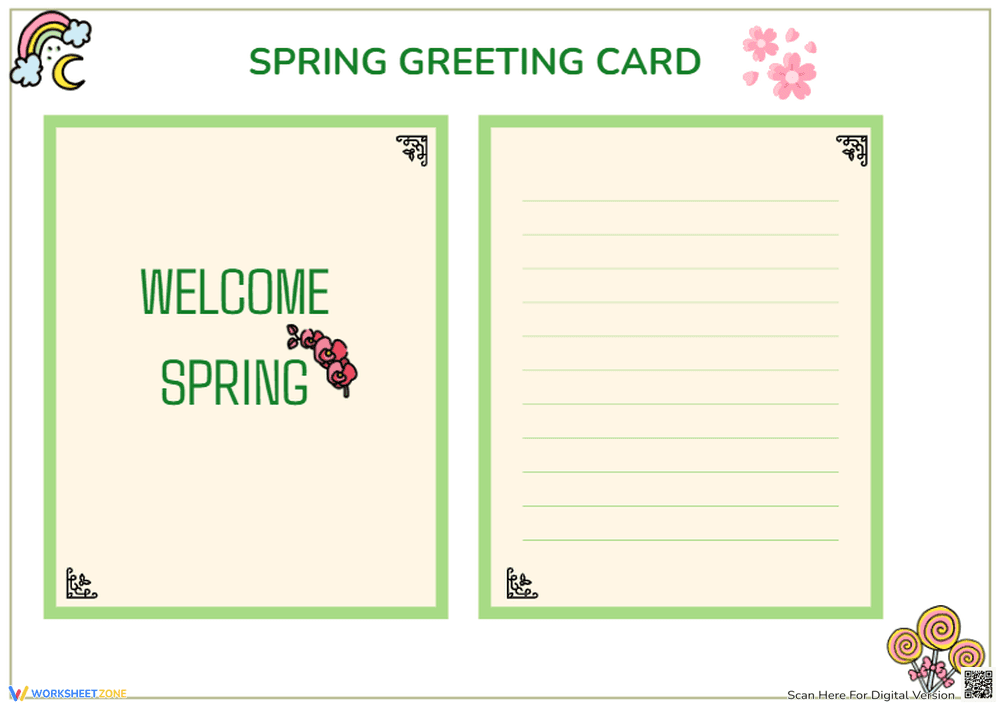
The download features a single-page PDF containing a two-panel greeting card design. The left panel serves as the cover, featuring a "Welcome Spring" headline and floral illustrations ready for coloring. The right panel provides 10 wide-ruled lines, offering ample space for young writers to draft a personalized message, poem, or seasonal greeting to a friend or family member.
This resource is designed for immediate classroom implementation with a total teacher prep time of under 2 minutes. First, print the desired number of copies (30 seconds). Second, distribute the sheets along with scissors and crayons (1 minute). Finally, students spend 15 minutes writing and decorating, requiring only a quick review of their spelling and punctuation before folding. It serves as a perfect emergency sub plan or transition activity.
The primary focus is `CCSS.ELA-LITERACY.W.2.3`, which requires students to write narratives or personal communications that recount a well-elaborated event or short sequence of events. Additionally, it supports fine motor development and visual arts standards related to creating personal works of art. Both standard codes can be copied directly into lesson plans, IEP goals, or district curriculum mapping tools.
Use this worksheet during a "Signs of Spring" unit to integrate science and literacy. After a class discussion about seasonal changes, have students write three things they are looking forward to this spring. Formatively assess student progress by observing their ability to stay within the lines and use appropriate capitalization. Expect completion within 20 minutes, including coloring time.
This activity is tailored for first through third-grade students, including English Language Learners who benefit from the visual cues of the floral theme. It pairs naturally with a seasonal anchor chart of spring-themed vocabulary words like "blossom," "equinox," and "renewal" to support student writing.
According to Fisher & Frey (2014), integrating creative expression with structured writing tasks enhances student engagement and retention of literacy skills. This worksheet aligns with CCSS.ELA-LITERACY.W.2.3 by providing a functional context for personal writing, allowing Grade 1-3 students to apply grammar and mechanics in a meaningful way. Research from the NAEP suggests that frequent, short-form writing opportunities are critical for developing fluency in early elementary learners. By utilizing this seasonal template, educators provide a low-stakes environment for students to practice sentence construction and penmanship. The inclusion of artistic elements further supports the "whole child" approach to learning, ensuring that fine motor development and creative thinking are prioritized alongside core academic standards. This resource is a reliable tool for meeting diverse classroom needs while maintaining high standards for student output and instructional alignment.


