


























Views
Downloads

Essential Letter H Spelling Worksheet | Preschool ELA
Paste this activity's link or code into your existing LMS (Google Classroom, Canvas, Teams, Schoology, Moodle, etc.).
Students can open and work on the activity right away, with no student login required.
You'll still be able to track student progress and results from your teacher account.
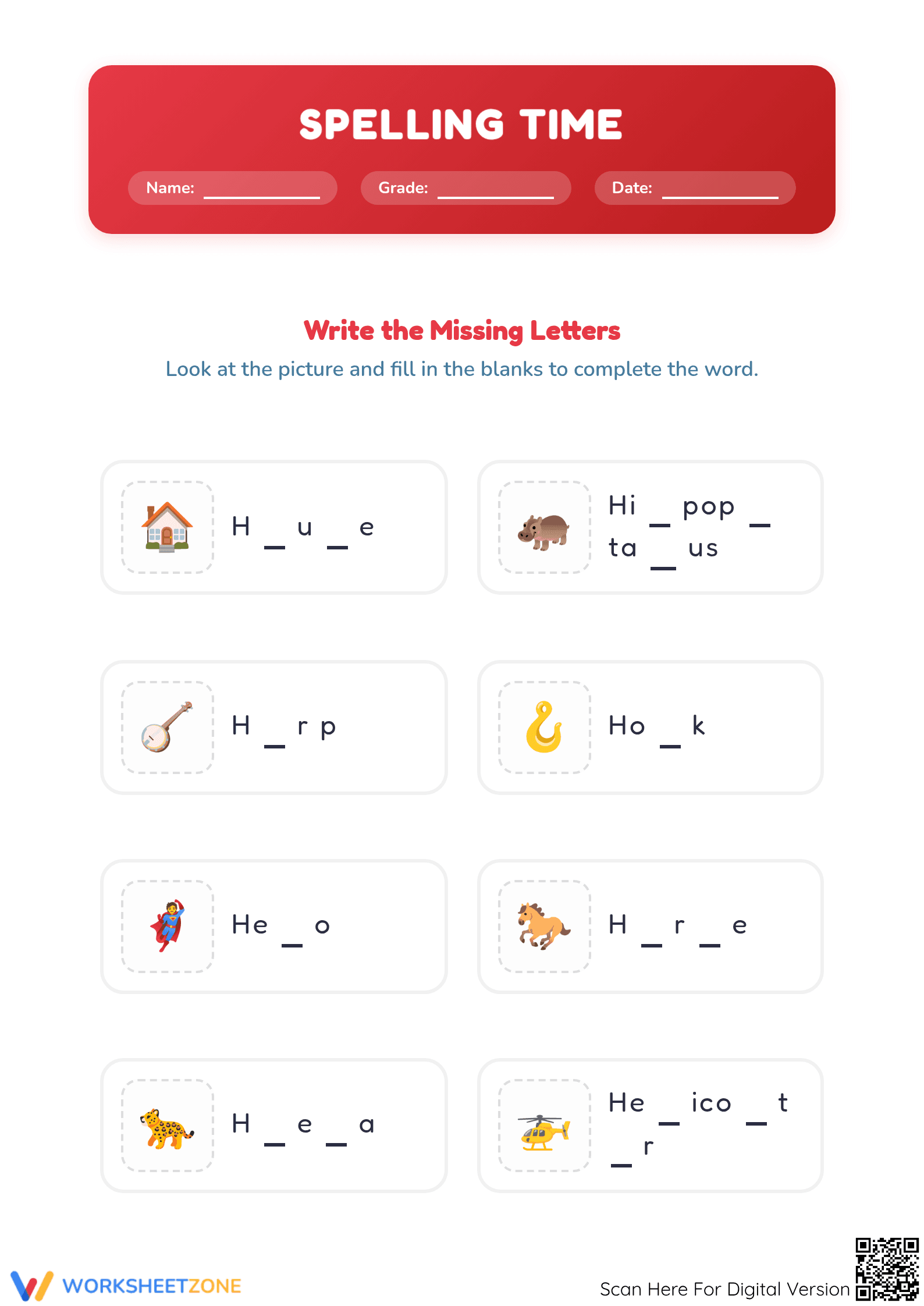
This Preschool Letter H spelling worksheet provides young learners with 15 engaging tasks to strengthen their phonics and word-building skills. By identifying missing letters in familiar words like "house" and "helicopter," students develop a concrete connection between the 'H' sound and its written form. This resource ensures early writers build the confidence needed for literacy success.
At a Glance
- Grade: Preschool · Subject: ELA Alphabet
- Standard:
CCSS.ELA-LITERACY.L.PK.2.C— Attempt to write letters to represent sounds in words- Skill Focus: Initial 'H' Phonics & Spelling
- Format: 2 pages · 15 problems · Answer key included · PDF
- Best For: Early phonics practice and letter recognition
- Time: 15–20 minutes
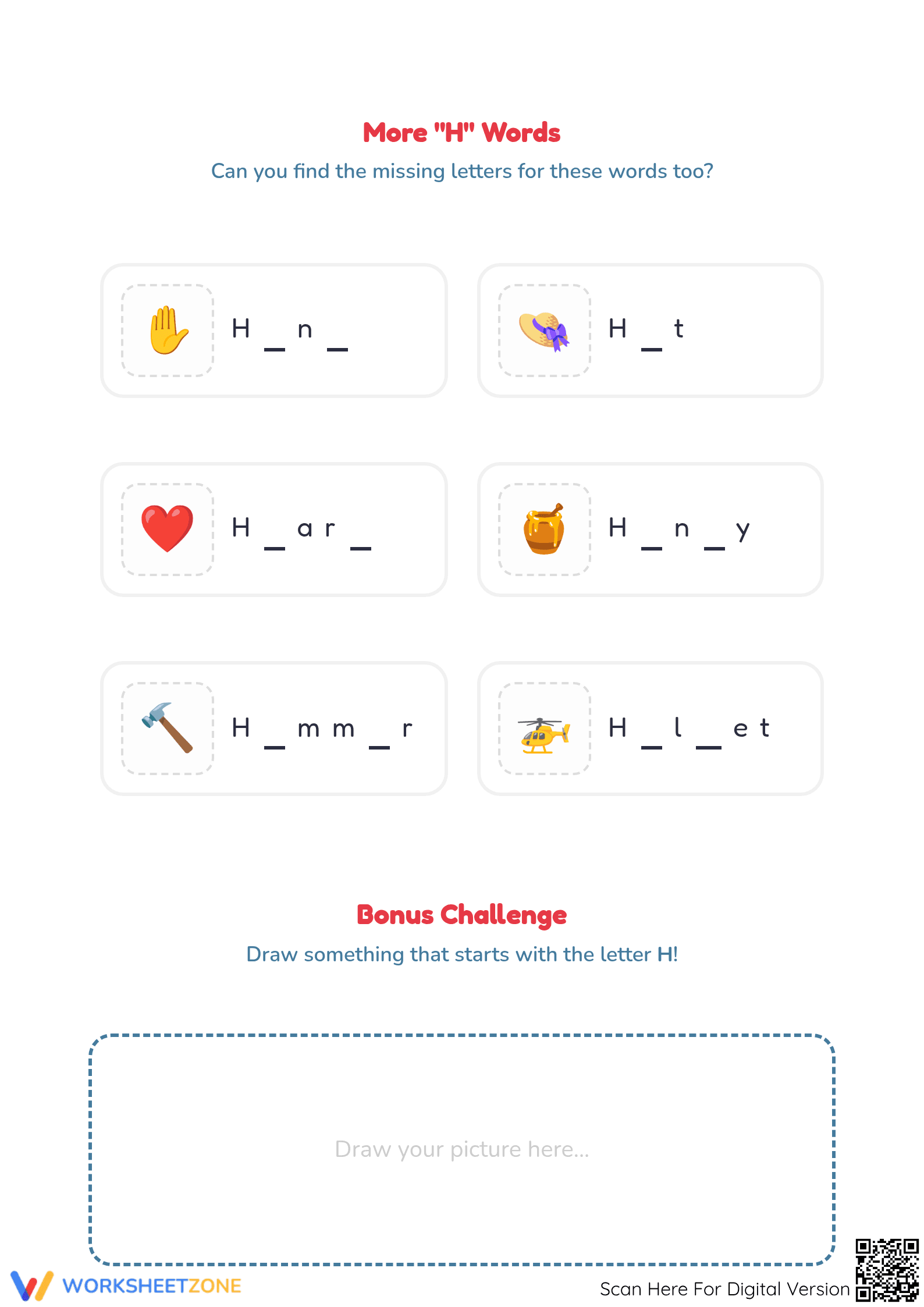
This 2-page PDF features 14 word-completion exercises accompanied by vibrant visual cues to support vocabulary acquisition. The first page focuses on multi-syllabic and simple words, while the second page introduces "More 'H' Words" and a creative "Bonus Challenge" drawing area. A full answer key is provided to facilitate quick checking and immediate feedback for students.
- Guided practice: Students begin with highly recognizable objects like a house or hat, using visual icons to anchor their phonemic awareness with 8 initial problems.
- Supported practice: Learners progress to longer words such as "hippopotamus" and "helicopter," requiring them to identify vowel placements and ending sounds across 6 additional tasks.
- Independent practice: The final bonus challenge asks students to synthesize their learning by brainstorming and drawing their own 'H' word, moving from recognition to creation.
This sequence follows a gradual-release model, moving from simple identification to creative application.
The primary focus is `CCSS.ELA-LITERACY.L.PK.2.C`, which requires students to "Attempt to write a letter or letters to represent a sound." This worksheet also supports `CCSS.ELA-LITERACY.RF.K.1.B` by demonstrating that spoken words are represented by specific sequences of letters. Both standard codes can be copied directly into lesson plans, IEP goals, or district curriculum mapping tools.
Use this worksheet during small-group literacy rotations after introducing the letter 'H' sound. It serves as an excellent formative assessment; observe if students can phonetically segment the words before writing. Expect completion in 15–20 minutes, making it an ideal activity for early writers or a supplemental homework assignment.
This resource is designed for preschool and early kindergarten students who are beginning to explore letter-sound relationships. It is particularly helpful for English Language Learners (ELLs) who benefit from the clear pictorial representations. Pair this with a "Letter H" anchor chart or a tactile sand-writing activity for a multi-sensory learning experience.
According to the RAND AIRS 2024 report on early childhood literacy, the integration of visual scaffolds with phonemic tasks significantly accelerates letter-sound correspondence in preschool populations. This worksheet targets CCSS.ELA-LITERACY.L.PK.2.C by providing 15 structured opportunities for students to map the 'H' phoneme to its corresponding grapheme. Research by Fisher & Frey (2014) emphasizes that word-building activities with pictorial support allow students to bridge the gap between oral language and written text. By requiring students to fill in missing letters rather than just tracing, this resource promotes active cognitive engagement with spelling patterns. This evidence-based approach ensures that learners are not merely memorizing shapes but are understanding the functional role of letters in constructing meaning, a critical precursor to fluent reading and writing in later grades.


