


























Views
Plays
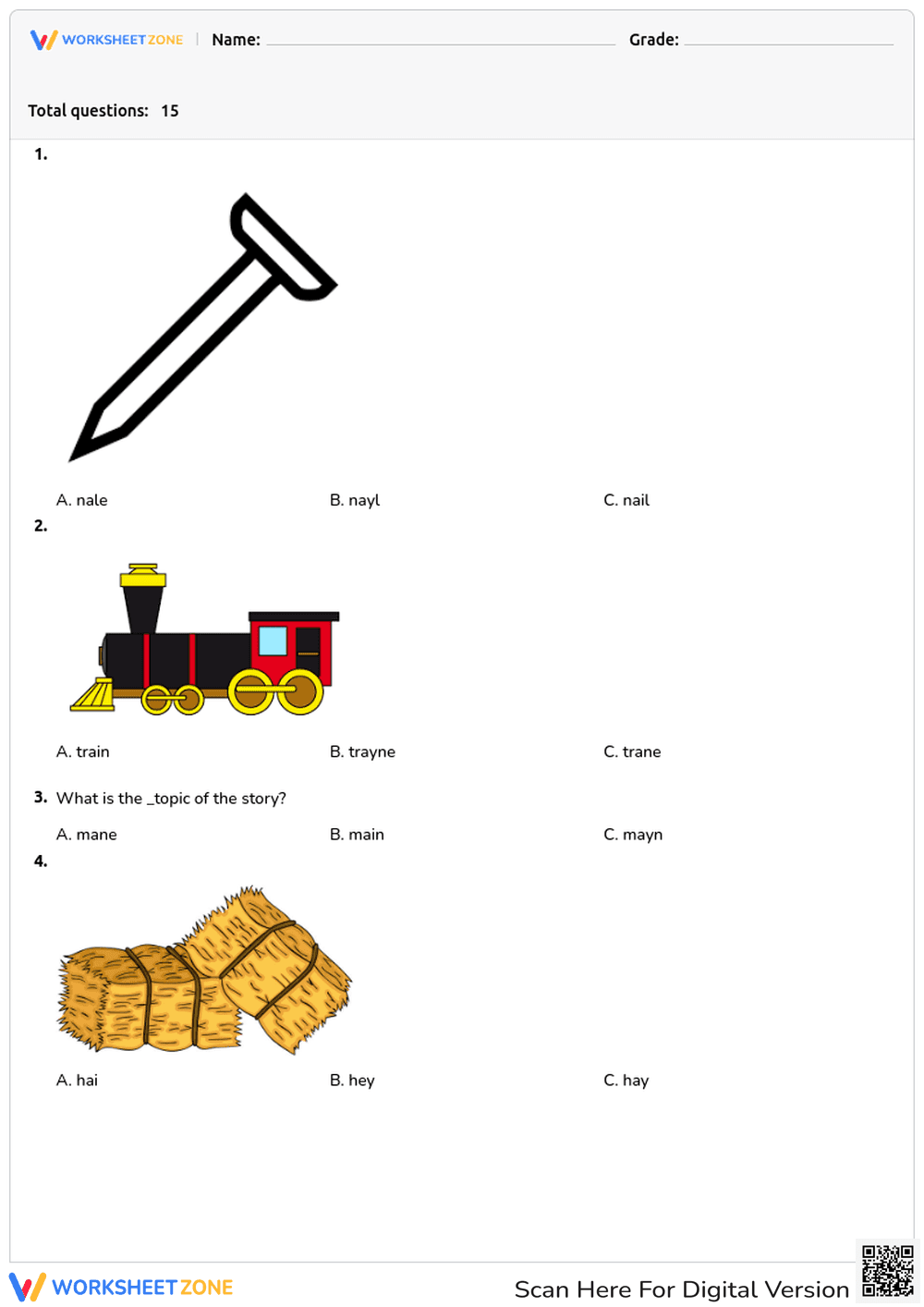

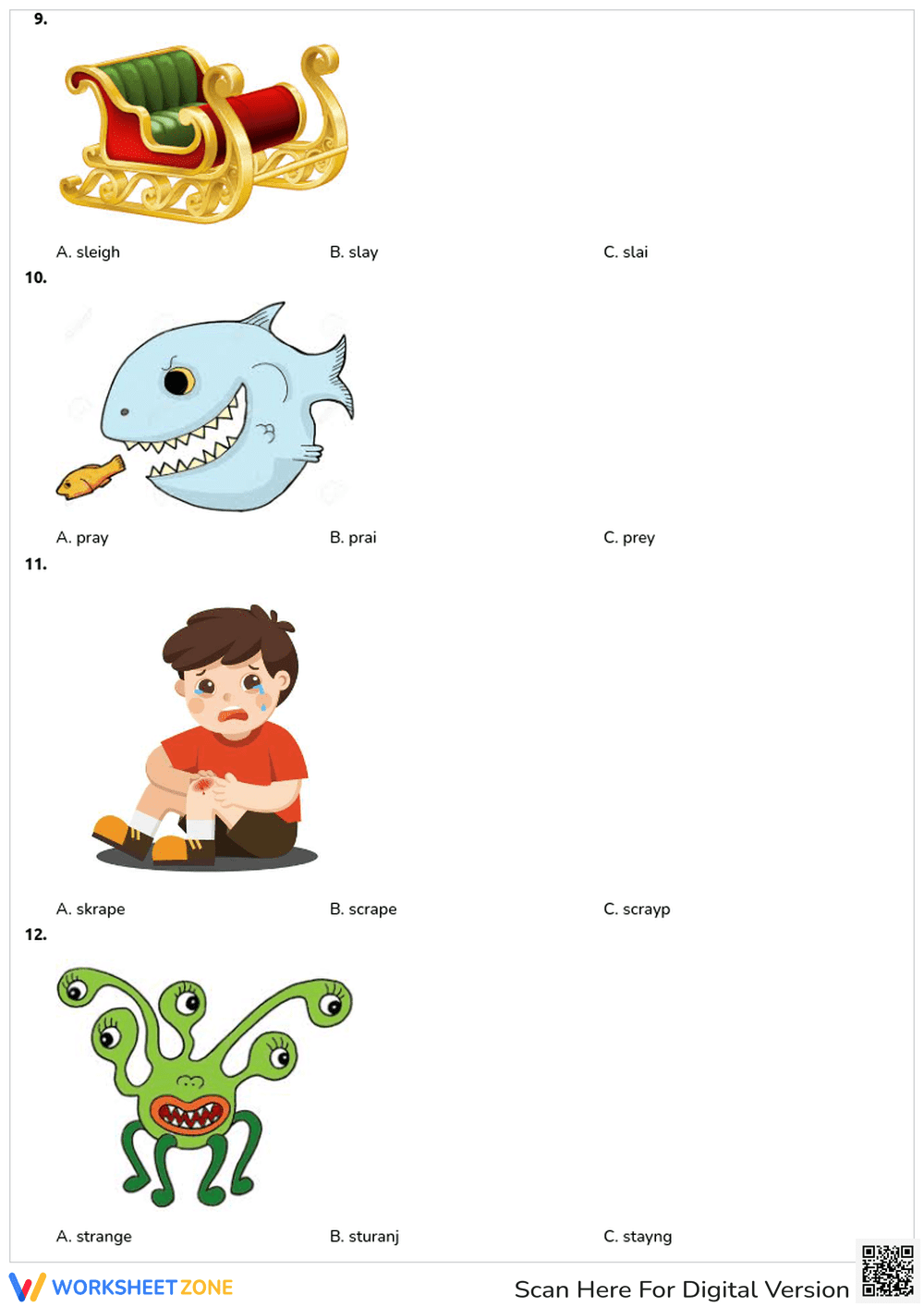
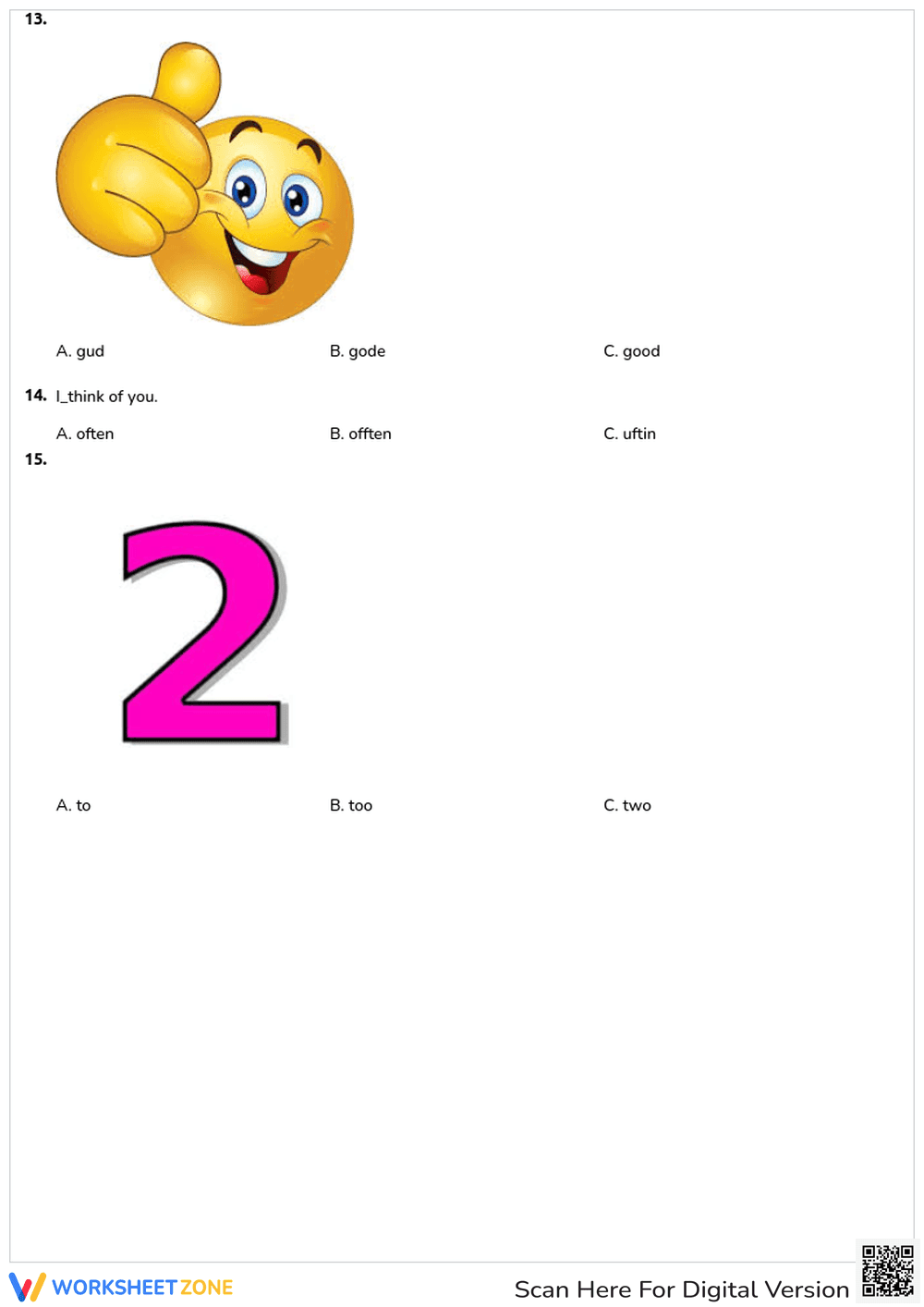

Grade 2 Spelling Practice — Essential No-Prep Worksheet
Paste this activity's link or code into your existing LMS (Google Classroom, Canvas, Teams, Schoology, Moodle, etc.).
Students can open and work on the activity right away, with no student login required.
You'll still be able to track student progress and results from your teacher account.
This Grade 2 spelling worksheet helps students master complex vowel patterns and homophones through 15 visual multiple-choice questions. By identifying the correct spelling for common objects and concepts, learners strengthen their orthographic mapping and phonics skills. It provides an immediate way to assess spelling accuracy in a low-stakes, engaging format.
At a Glance
- Grade: 2 · Subject: English Language Arts
- Standard:
CCSS.ELA-LITERACY.L.2.2.D— Generalize learned spelling patterns when writing words accurately- Skill Focus: Phonics and Homophone Spelling
- Format: 4 pages · 15 problems · Answer key included · PDF
- Best For: Independent practice or morning work
- Time: 15–20 minutes
The PDF contains 4 pages featuring 15 multiple-choice questions. Each question pairs a high-quality illustration with three spelling options, including common phonetic distractors. The layout is spacious, making it accessible for young writers. A full answer key is provided to facilitate quick grading or student self-correction.
Zero-Prep Workflow
- Print: Generate the 4-page set in under 1 minute for your entire class.
- Distribute: Hand out the sheets for a 15-minute independent practice session or literacy center.
- Review: Use the included answer key to review results as a whole group in under 2 minutes.
This resource is a perfect fit for sub plans or as a quiet transition activity between core lessons.
Standards Alignment
The primary focus is `CCSS.ELA-LITERACY.L.2.2.D`, which requires students to generalize learned spelling patterns. It also supports `CCSS.ELA-LITERACY.L.3.2.F` by addressing common homophones like "main" and "mane." Both standard codes can be copied directly into lesson plans, IEP goals, or district curriculum mapping tools.
How to Use It
Use this worksheet as a formative assessment after a unit on long vowel teams (ai, ay, ea). Assign it during literacy centers to observe which students struggle with homophone distinctions. Completion typically takes 15 to 20 minutes, allowing for a quick check of student mastery before moving to sentence-level writing.
Who It's For
This is designed for Grade 2 students, though it provides excellent remediation for Grade 3 or enrichment for Grade 1. It is particularly effective for visual learners and English Language Learners (ELLs) who benefit from the clear pictorial support paired with vocabulary.
Research by Fisher & Frey (2014) emphasizes the importance of visual scaffolding in developing orthographic awareness for early readers. This worksheet aligns with those findings by providing 15 targeted spelling tasks that require students to discriminate between correct and incorrect phonetic representations. By focusing on CCSS.ELA-LITERACY.L.2.2.D, the activity reinforces the generalization of spelling patterns across different word families. According to the RAND AIRS 2024 report, consistent exposure to multiple-choice spelling formats helps students recognize common patterns and homophones, leading to higher accuracy in independent writing. This resource provides the structured repetition necessary for students to move from phonetic spelling to conventional mastery. It is a reliable tool for teachers seeking to bridge the gap between phonics instruction and applied spelling in the elementary classroom.


