




























0
Views
0
Downloads

Save
0 Likes
Share
Sound and Light Vocabulary
0 Views
0 Downloads

Paste this activity's link or code into your existing LMS (Google Classroom, Canvas, Teams, Schoology, Moodle, etc.).
Students can open and work on the activity right away, with no student login required.
You'll still be able to track student progress and results from your teacher account.
Information
Description
What It Is:
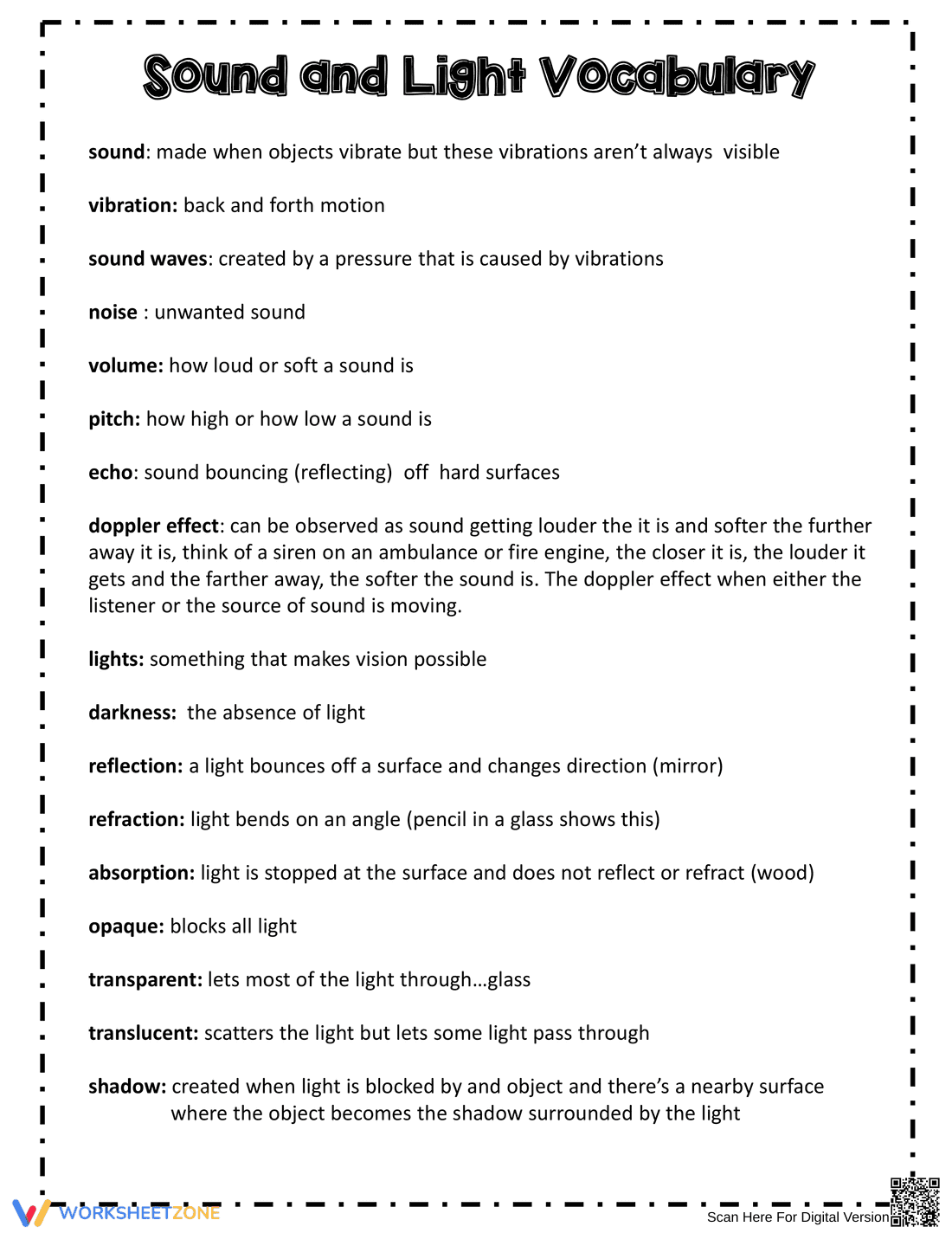
This is a vocabulary worksheet focused on sound and light. It provides definitions for terms like 'sound,' 'vibration,' 'sound waves,' 'noise,' 'volume,' 'pitch,' 'echo,' 'Doppler effect,' 'lights,' 'darkness,' 'reflection,' 'refraction,' 'absorption,' 'opaque,' 'transparent,' 'translucent,' and 'shadow.' Each term is followed by a brief, simplified explanation or example.
Grade Level Suitability:
This worksheet is suitable for upper elementary and middle school students (Grades 4-7). The definitions are straightforward and accessible, making it appropriate for introducing or reinforcing these scientific concepts. The inclusion of real-world examples like a siren for Doppler effect and a pencil in a glass for refraction helps with understanding.
Why Use It:
This worksheet provides a clear and concise introduction to key concepts related to sound and light. It helps students build their scientific vocabulary and understand the basic principles of how sound and light behave. It's a useful tool for pre-teaching, review, or as a reference sheet.
How to Use It:
This worksheet can be used in several ways. Students can read through the definitions individually or in groups. It can be used as a study guide or as a reference during science activities and experiments. Teachers can use it as a basis for discussions or quizzes. Students could also create their own examples or illustrations for each term.
Target Users:
The target users are elementary and middle school students learning about sound and light, as well as teachers who need a simple vocabulary resource for their science lessons. Homeschooling parents could also use this as part of their science curriculum.
This is a vocabulary worksheet focused on sound and light. It provides definitions for terms like 'sound,' 'vibration,' 'sound waves,' 'noise,' 'volume,' 'pitch,' 'echo,' 'Doppler effect,' 'lights,' 'darkness,' 'reflection,' 'refraction,' 'absorption,' 'opaque,' 'transparent,' 'translucent,' and 'shadow.' Each term is followed by a brief, simplified explanation or example.
Grade Level Suitability:
This worksheet is suitable for upper elementary and middle school students (Grades 4-7). The definitions are straightforward and accessible, making it appropriate for introducing or reinforcing these scientific concepts. The inclusion of real-world examples like a siren for Doppler effect and a pencil in a glass for refraction helps with understanding.
Why Use It:
This worksheet provides a clear and concise introduction to key concepts related to sound and light. It helps students build their scientific vocabulary and understand the basic principles of how sound and light behave. It's a useful tool for pre-teaching, review, or as a reference sheet.
How to Use It:
This worksheet can be used in several ways. Students can read through the definitions individually or in groups. It can be used as a study guide or as a reference during science activities and experiments. Teachers can use it as a basis for discussions or quizzes. Students could also create their own examples or illustrations for each term.
Target Users:
The target users are elementary and middle school students learning about sound and light, as well as teachers who need a simple vocabulary resource for their science lessons. Homeschooling parents could also use this as part of their science curriculum.


