


























Views
Downloads
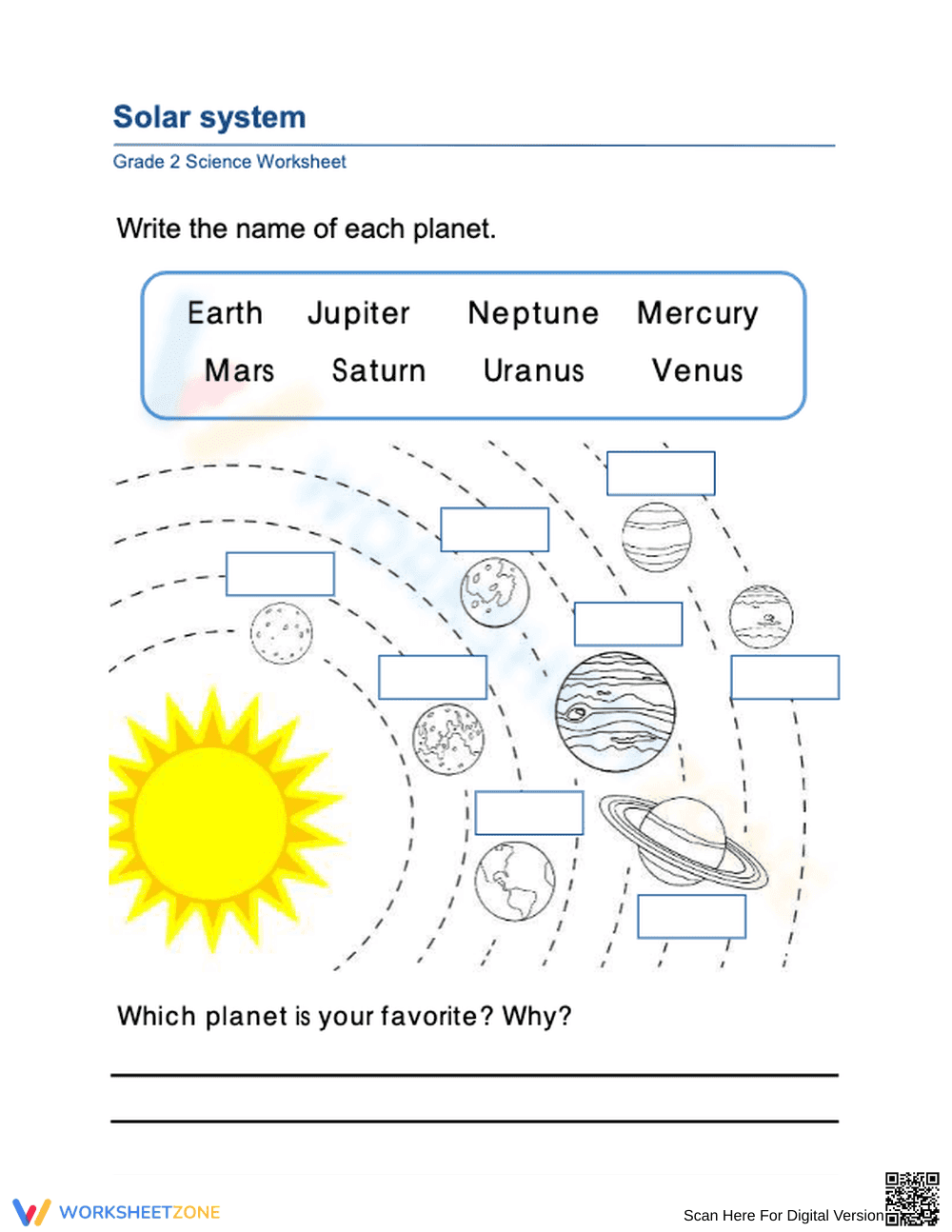

Essential Solar System Worksheet | Grade 2 Science
Paste this activity's link or code into your existing LMS (Google Classroom, Canvas, Teams, Schoology, Moodle, etc.).
Students can open and work on the activity right away, with no student login required.
You'll still be able to track student progress and results from your teacher account.
This Grade 2 solar system worksheet provides a comprehensive way for students to identify and label the planets in our orbital neighborhood. By matching planet names to their visual representations in a diagram, learners build foundational astronomical vocabulary and spatial awareness. The inclusion of a reflection question encourages personal connection to the scientific content.
At a Glance
- Grade: 2 · Subject: Science
- Standard:
2-ESS1-1— Use information from several sources to identify planets and their orbital patterns.- Skill Focus: Solar system identification and planet naming
- Format: 1 page · 9 problems · Answer key included · PDF
- Best For: Earth and space systems unit introduction
- Time: 15–20 minutes
What's Inside
Inside this printable resource, you will find a detailed diagram of the solar system featuring the sun and the eight major planets. The worksheet includes a clear word bank to support spelling and recognition, alongside eight specific labeling boxes. A final section asks students to identify their favorite planet and provide a rationale, fostering critical thinking skills. A full-page answer key is also provided for quick grading.
Zero-Prep Workflow
The zero-prep workflow for this resource is designed for maximum efficiency in the classroom. First, print the single-page worksheet for your entire class, which takes less than one minute. Second, distribute the materials and provide a brief overview of the word bank, taking another minute of teacher time. Finally, review student work using the included answer key during a five-minute wrap-up session.
Standards Alignment
This worksheet is aligned with standard 2-ESS1-1, which emphasizes identifying Earth's place in the universe and recognizing patterns in space systems. By labeling the planets, students demonstrate their ability to categorize celestial objects based on their characteristics and position. This standard code can be copied directly into lesson plans, IEP goals, or district curriculum mapping tools to ensure instructional consistency.
How to Use It
Use this worksheet as a formative assessment after an introductory lesson on the solar system. It works best during the "Independent Practice" phase of a direct instruction model, allowing you to observe which students can accurately sequence planets without assistance. Expect most second graders to complete the labeling and reflection tasks within 15 to 20 minutes, depending on their writing speed.
Who It's For
This resource is designed for second-grade science students but is also appropriate for first-grade extension or third-grade review. It supports English Language Learners with its clear visual cues and word bank support. Naturally pair this worksheet with a short passage about the planets or a classroom anchor chart showing the order of the solar system to maximize student success.
This Grade 2 solar system worksheet aligns with the 2-ESS1-1 standard, focusing on the essential skill of identifying celestial bodies within our Earth and space systems. According to EdReports 2024, high-quality science instruction in the early grades requires visual models and scaffolded vocabulary to help students conceptualize astronomical scales. This resource provides a clear diagram of the solar system, allowing second-grade learners to practice the plain-English skill of naming and sequencing the eight major planets relative to the sun. By integrating a word bank and a short-response reflection question, the worksheet supports diverse learners in building scientific literacy and vocabulary retention. The structured layout ensures that students can independently navigate the task while teacher prep remains minimal. This educational asset is designed to serve as a reliable formative assessment or a direct-instruction supplement, ensuring that students achieve foundational mastery of planetary science concepts within their primary curriculum.


