




























Views
Downloads
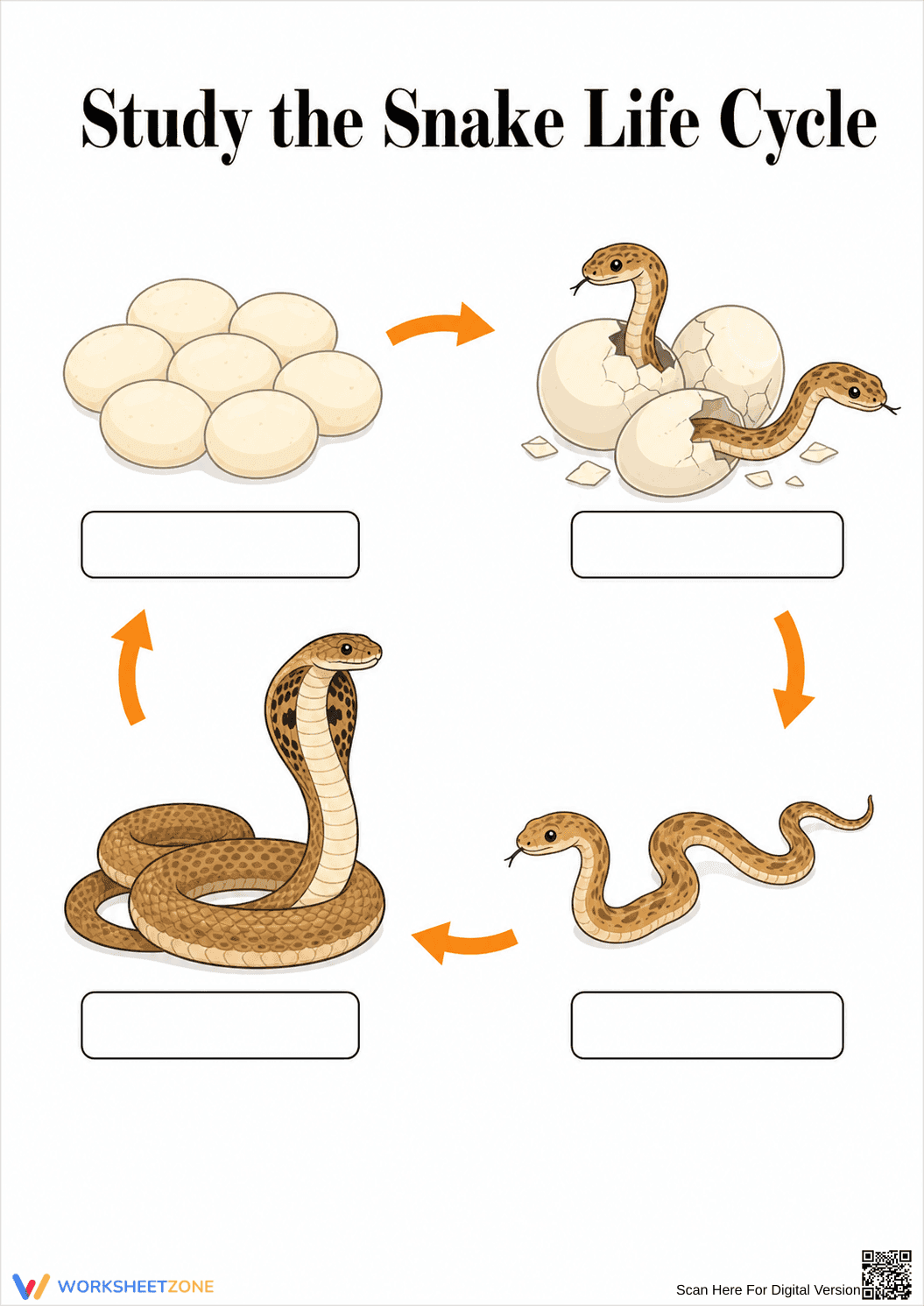

Snake Life Cycle Worksheet | Grade 3 Essential Science

Paste this activity's link or code into your existing LMS (Google Classroom, Canvas, Teams, Schoology, Moodle, etc.).
Students can open and work on the activity right away, with no student login required.
You'll still be able to track student progress and results from your teacher account.
This Grade 3 snake life cycle worksheet helps students identify and sequence the four primary stages of reptile development. By labeling the eggs, hatching, juvenile, and adult phases, learners build a concrete mental model of biological growth. It provides a clear visual framework for understanding how organisms change over time.
At a Glance
- Grade: 3 · Subject: Science
- Standard:
3-LS1-1— Develop models to describe that organisms have unique and diverse life cycles- Skill Focus: Life cycle sequencing and identification
- Format: 1 page · 4 problems · Answer key included · PDF
- Best For: Introduction to reptile biology and growth
- Time: 10–15 minutes
This single-page PDF features a high-quality circular diagram of a cobra's life cycle. It includes four distinct illustrations representing the egg clutch, the hatching process, the juvenile stage, and the mature adult. Beneath each illustration is a dedicated text box for students to write the correct stage name. The layout is clean and uncluttered, making it accessible for young learners.
The workflow for this resource is designed for maximum efficiency. Teachers can print the single-page document in under 30 seconds. Distribution to a standard class takes approximately 1 minute. Students can then independently review the visual cues and complete the labeling task, allowing for a total teacher prep time of under 2 minutes. It is an ideal zero-prep resource for sub plans or morning work.
This resource is aligned with 3-LS1-1, which requires students to develop models to describe that organisms have unique and diverse life cycles but all have in common birth, growth, reproduction, and death. By mapping the specific stages of a snake, students fulfill the modeling requirement of the Next Generation Science Standards. This standard code can be copied directly into lesson plans, IEP goals, or district curriculum mapping tools.
Use this worksheet as a formative assessment after a direct instruction lesson on reptiles. It works well as a check for understanding to see if students can distinguish between the hatching and juvenile phases. Alternatively, assign it as a quiet independent activity during science centers. Expect students to complete the labeling and optional coloring in 10 to 15 minutes.
This worksheet is designed for elementary students in grades 2 through 4 who are beginning their study of life sciences. It is particularly helpful for visual learners and English Language Learners who benefit from clear pictorial representations. It pairs naturally with a non-fiction text about snakes or a classroom anchor chart on animal life cycles.
According to the RAND AIRS 2024 report on elementary science instruction, visual modeling of biological processes significantly improves long-term retention of core concepts in early learners. This worksheet utilizes the 3-LS1-1 standard to provide a structured environment where students can practice identifying the birth, growth, and maturation stages of a reptile. By focusing on the snake life cycle, the resource bridges the gap between abstract biological theories and observable natural phenomena. Research from Fisher & Frey (2014) suggests that such scaffolded visual tasks are essential for developing scientific literacy before students move on to more complex comparative biology. This resource serves as a foundational tool for meeting NGSS requirements while maintaining high student engagement through clear, professional illustrations that are easily extractable for inclusion in student portfolios or science journals.


