


























Views
Downloads

Identifying Verbs Worksheet | Grade 3 Essential Grammar
Paste this activity's link or code into your existing LMS (Google Classroom, Canvas, Teams, Schoology, Moodle, etc.).
Students can open and work on the activity right away, with no student login required.
You'll still be able to track student progress and results from your teacher account.
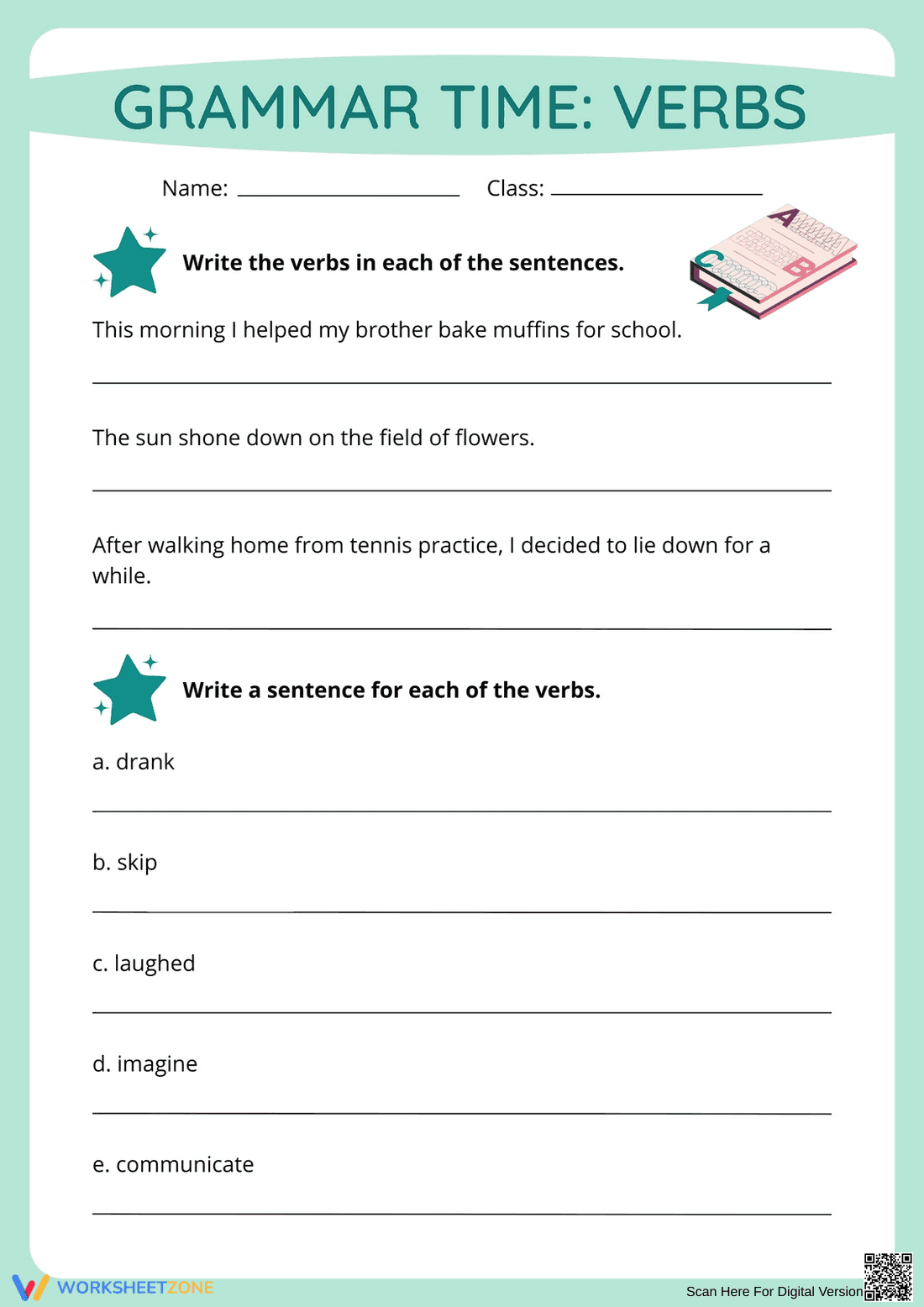
This Grade 3 verbs worksheet helps students identify action words within complex sentences and apply them in original writing. By focusing on both recognition and production, students build a solid foundation for grammatical fluency and sentence variety. It provides a clear, structured path for mastering basic parts of speech and improving overall literacy.
At a Glance
- Grade: 3 · Subject: ELA
- Standard:
CCSS.ELA-LITERACY.L.3.1— Explain the function of verbs in general and in particular sentences- Skill Focus: Verb identification and usage
- Format: 1 page · 8 problems · Answer key included · PDF
- Best For: Independent practice or quick assessment
- Time: 15–20 minutes
Inside this single-page PDF, you will find two distinct sections designed to reinforce grammar mechanics. The first section presents 3 sentences where students must extract the verbs, including past and present tense examples. The second section provides 5 specific verbs—ranging from simple actions like "skip" to more complex concepts like "communicate"—requiring students to draft their own original sentences to demonstrate usage mastery.
This resource is designed for a zero-prep classroom workflow. First, print the single-page PDF in about 30 seconds. Next, distribute the sheets to students as a morning warm-up or a quick exit ticket. Finally, review the answers using the included key or through a quick peer-check session. Total teacher preparation time is under 2 minutes, making it an ideal choice for busy educators or substitute plans.
Standards Alignment
Aligned to `CCSS.ELA-LITERACY.L.3.1`, this worksheet ensures students can "demonstrate command of the conventions of standard English grammar and usage when writing or speaking." It specifically targets the ability to recognize the role of verbs in conveying action and state of being. This standard code can be copied directly into lesson plans, IEP goals, or district curriculum mapping tools.
Use this worksheet during the independent practice phase of a grammar lesson. It works well as a formative assessment after teaching the difference between nouns and verbs. Teachers should observe if students can identify multiple verbs in the first section, which serves as a great indicator of their reading comprehension and syntactic awareness. Expect completion within a 15 to 20-minute window.
This resource is ideal for third-grade students, though it serves as an excellent review for fourth graders or a challenge for advanced second graders. It pairs naturally with a parts-of-speech anchor chart or a direct instruction lesson on action verbs. The clear layout and ample writing space support English Language Learners (ELL) by providing specific word prompts to guide their sentence construction.
According to the RAND AIRS 2024 report, structured grammar practice that combines identification with generative writing significantly improves long-term retention of linguistic rules. This worksheet addresses CCSS.ELA-LITERACY.L.3.1 by requiring students to not only find verbs like "shone" and "helped" but also to synthesize new sentences using words like "imagine" and "communicate." Research from Fisher & Frey (2014) emphasizes that the gradual release of responsibility—moving from identifying examples in provided text to creating original content—is essential for mastery of English conventions. By engaging with 8 targeted tasks, students move beyond rote memorization toward functional application. This printable resource provides the necessary scaffolding for Grade 3 learners to bridge the gap between recognizing parts of speech and using them effectively to enhance their own narrative and informational writing.


