


























Views
Downloads

Printable Long Vowels Matching Worksheet | Grade 2-4 ELA
Paste this activity's link or code into your existing LMS (Google Classroom, Canvas, Teams, Schoology, Moodle, etc.).
Students can open and work on the activity right away, with no student login required.
You'll still be able to track student progress and results from your teacher account.
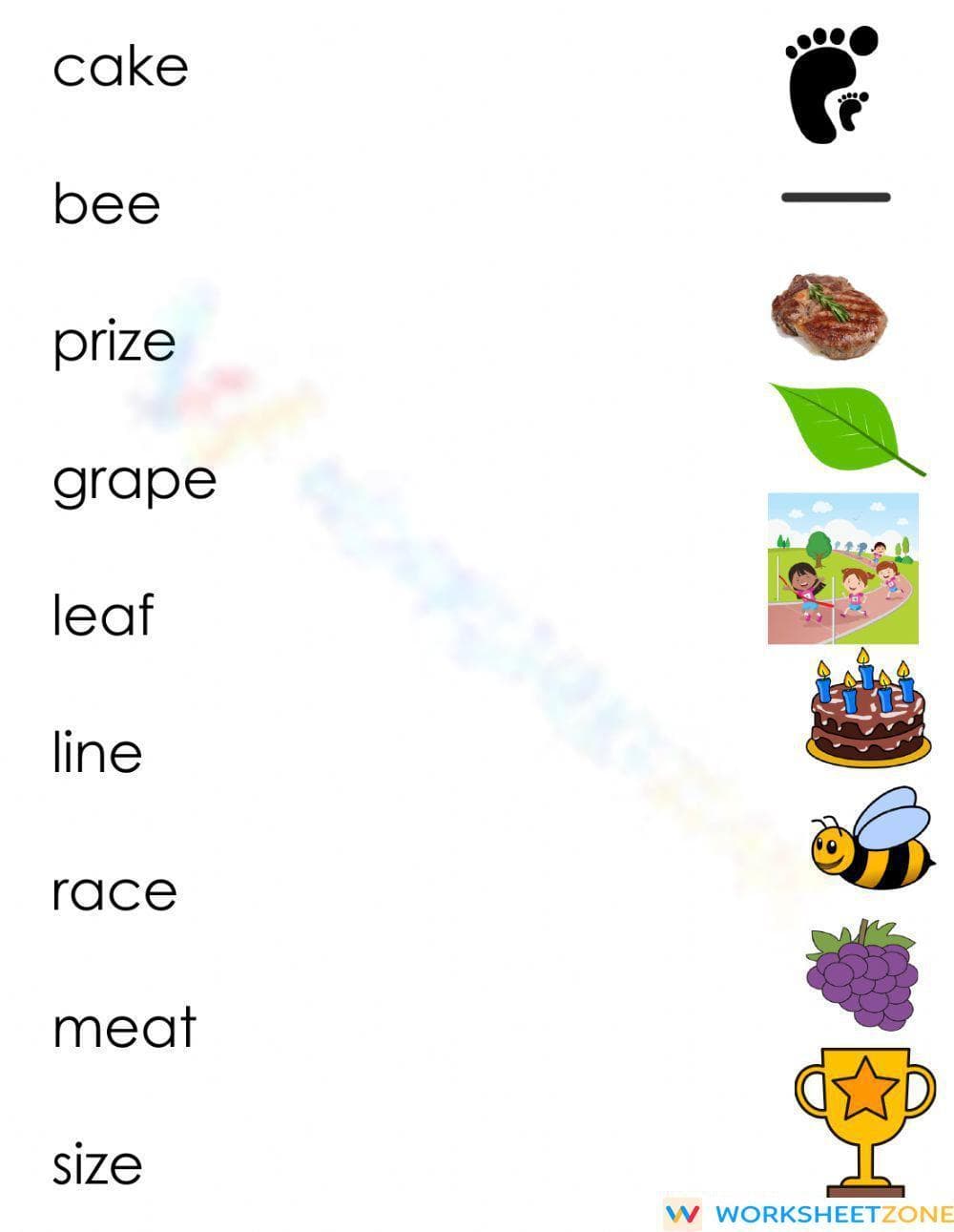
This long vowels matching worksheet provides Grade 2-4 students with a targeted phonics drill to reinforce vowel pronunciation. By connecting high-frequency words to visual representations, learners develop the ability to recognize long vowel sounds in one-syllable words, improving reading fluency and decoding accuracy for foundational literacy success.
At a Glance
- Grade: 2-4 · Subject: ELA - Phonics
- Standard:
CCSS.ELA-LITERACY.RF.2.3.A— Distinguish long and short vowels when reading regularly spelled one-syllable words- Skill Focus: Long Vowel Recognition
- Format: 1 page · 9 problems · Answer key included · PDF
- Best For: Independent phonics practice and literacy centers
- Time: 10–15 minutes
What's Inside
This focused one-page resource features a clear layout to maximize engagement. Students encounter nine common one-syllable words—including cake, prize, and leaf—all featuring long vowel sounds. Vibrant illustrations on the right provide visual cues for making accurate phonetic connections. A complete answer key is included for rapid grading or student self-correction.
Skill Progression
- Guided Identification: Students begin by observing 9 visual icons and pairing them with familiar vocabulary through initial consonant recognition.
- Supported Practice: Learners use the limited choice pool to eliminate incorrect phonemes, focusing on medial long vowel sounds like silent-e.
- Independent Practice: Students decode regularly spelled one-syllable words without scaffolds to achieve perfect semantic matching.
This gradual-release model follows the I Do, We Do, You Do instructional framework to build decoding confidence before tackling multi-syllable words.
Standards Alignment
This worksheet aligns with CCSS.ELA-LITERACY.RF.2.3.A, requiring students to decode regularly spelled one-syllable words. It specifically addresses the distinction between vowel sounds. The resource supports broader literacy by reinforcing grapheme-phoneme connections. These standard codes can be copied directly into lesson plans, IEP goals, or district curriculum mapping tools to track student progress toward grade-level mastery.
How to Use It
Use this worksheet as a warm-up during phonics blocks or as a formative assessment after introducing CVCe patterns. For an observation tip, watch students matching "line" and "size" to see if they decode the medial vowel or guess based on consonants. Most students complete the exercise within 10-15 minutes, making it an ideal exit ticket or center activity.
Who It's For
This resource is for Grade 2-4 students mastering foundational reading. It is highly effective for English Language Learners (ELLs) who benefit from image-to-word association to build vocabulary. It pairs naturally with direct instruction on silent-e rules or vowel team anchor charts to support differentiation and diverse learning needs.
According to the RAND AIRS 2024 report, phonics instruction integrating visual aids significantly accelerates decoding speed in early readers. This Grade 2-4 worksheet focuses on the CCSS.ELA-LITERACY.RF.2.3.A standard, providing essential practice in recognizing long vowel sounds within one-syllable words. By utilizing high-frequency vocabulary like "cake" and "prize," the resource ensures students practice phonetic rules while reinforcing their functional lexicon. Research from Fisher & Frey (2014) emphasizes that matching tasks serve as effective formative assessment tools, allowing educators to identify phonetic gaps in a student's reading profile. This printable PDF offers a structured environment for independent practice, ensuring the transition from phonemic awareness to fluent reading is supported by evidence-based materials that integrate into any ELA curriculum.


