




























Views
Plays
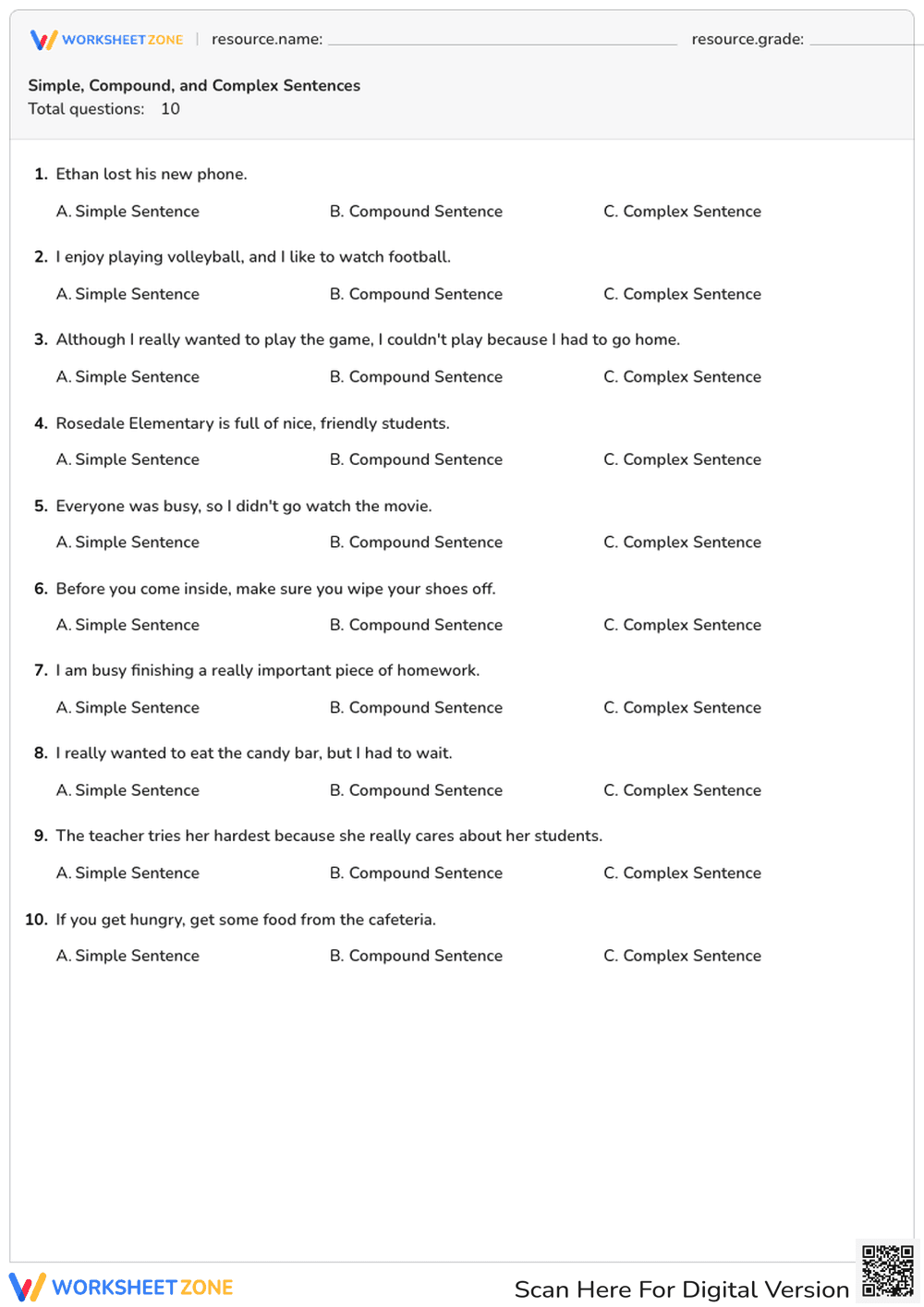

Sentence Structure Worksheet | Grade 7 Essential

Paste this activity's link or code into your existing LMS (Google Classroom, Canvas, Teams, Schoology, Moodle, etc.).
Students can open and work on the activity right away, with no student login required.
You'll still be able to track student progress and results from your teacher account.
This Grade 7 grammar worksheet helps students master sentence variety by identifying simple, compound, and complex structures. By analyzing 10 distinct examples, learners develop the ability to recognize independent and dependent clauses. This practice ensures students can effectively signal relationships between ideas in their writing, leading to improved syntactic fluency and clarity.
At a Glance
- Grade: 7 · Subject: ELA
- Standard:
CCSS.ELA-LITERACY.L.7.1.B— Choose among simple, compound, and complex sentences to signal relationships- Skill Focus: Sentence Classification
- Format: 1 page · 10 problems · Answer key included · PDF
- Best For: Quick formative assessment or grammar review
- Time: 10–15 minutes
What's Inside
This single-page PDF features 10 multiple-choice questions designed for rapid assessment. Each item presents a complete sentence—ranging from basic subject-verb constructions to those with subordinating conjunctions—and asks students to select the correct classification. The layout is clean and distraction-free, including a dedicated space for student names and grades at the top. A full answer key is provided for efficient grading.
Zero-Prep Workflow
- Print: Generate the single-page PDF in under 30 seconds.
- Distribute: Hand out the sheets as a bell-ringer or exit ticket for immediate engagement.
- Review: Use the included key for self-correction or peer-grading in about 1 minute.
Total teacher preparation time is under two minutes, making it an ideal resource for sub-plans or unexpected schedule shifts.
Standards Alignment
This resource aligns directly with CCSS.ELA-LITERACY.L.7.1.B: "Choose among simple, compound, complex, and compound-complex sentences to signal differing relationships among ideas." It also supports Grade 6 standards regarding sentence patterns and variety. Both standard codes can be copied directly into lesson plans, IEP goals, or district curriculum mapping tools.
How to Use It
Use this worksheet as a formative assessment after a direct instruction lesson on coordinating and subordinating conjunctions. Observe if students struggle specifically with complex sentences containing "because" or "although," as this indicates a need for further instruction on dependent clauses. The expected completion time is 10 to 15 minutes, making it perfect for the start of a period.
Who It's For
This practice is intended for Grade 6 and 7 students who are refining their understanding of grammar and mechanics. It is particularly helpful for English Language Learners (ELLs) who need to see concrete examples of how clauses are joined. Pair this worksheet with an anchor chart on FANBOYS and AAAWWUBBIS words for a comprehensive grammar workshop.
Mastery of sentence structure is a foundational component of middle school literacy, as identified in the CCSS.ELA-LITERACY.L.7.1.B standard. Research from Fisher & Frey (2014) emphasizes that the gradual release of responsibility—moving from identifying sentence types to generating them—is critical for developing sophisticated writing skills. This worksheet provides the essential "check for understanding" phase of that instructional cycle. By isolating simple, compound, and complex sentences, students learn to recognize the structural signals that convey logic and emphasis. Data from the NAEP suggests that students who can manipulate varied sentence structures score significantly higher on writing assessments. This 10-question tool offers a high-frequency practice opportunity that fits into any curriculum. It allows educators to pinpoint exactly where syntactic breakdowns occur, whether in identifying independent clauses or recognizing subordinating conjunctions. This targeted approach ensures that students build the grammatical stamina required for high-school-level composition and complex text analysis.


