


























Views
Downloads

Printable Scribble Stone Worksheet | Grade 1 ELA
Paste this activity's link or code into your existing LMS (Google Classroom, Canvas, Teams, Schoology, Moodle, etc.).
Students can open and work on the activity right away, with no student login required.
You'll still be able to track student progress and results from your teacher account.
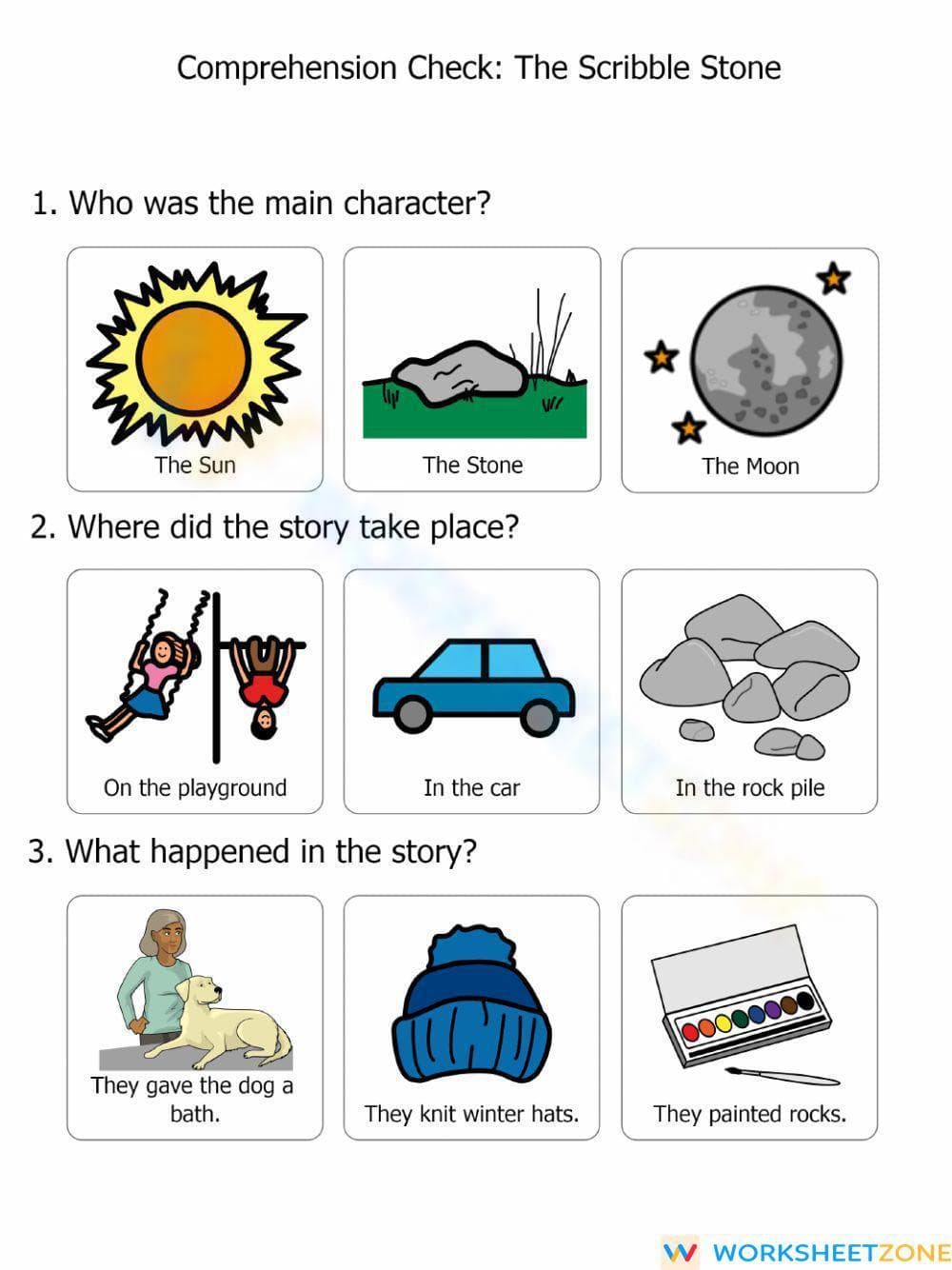
This printable Scribble Stone comprehension check helps students demonstrate their understanding of character, setting, and plot through visual response options. By pairing accessible imagery with key questions, the worksheet ensures that early readers can successfully identify story elements without being hindered by complex text decoding. It is an essential tool for assessing primary grade literacy.
At a Glance
- Grade: 1 · Subject: ELA
- Standard:
CCSS.ELA-LITERACY.RL.1.1— Ask and answer questions about key details in a text- Skill Focus: Story Elements (Character, Setting, Plot)
- Format: 1 page · 3 problems · Answer key included · PDF
- Best For: Post-reading assessment and checking for understanding
- Time: 5–10 minutes
The worksheet consists of a single-page assessment focused on the story "The Scribble Stone." It features three multiple-choice questions, each providing three distinct visual options to support diverse learners. The structure includes identifying the main character, the story's setting, and a primary plot point. A clear, easy-to-grade answer key is provided to streamline the review process for teachers and parents.
Implementing this activity into your classroom routine requires zero preparation. First, print the required number of copies for your small group or whole class in under 30 seconds. Second, distribute the worksheets to students immediately following the story reading or listening session which takes about 1 minute. Finally, use the visual cues to quickly review student answers as a group or collect them for individual formative assessment data in less than 2 minutes.
The primary focus is `CCSS.ELA-LITERACY.RL.1.1`: "Ask and answer questions about key details in a text." Students must process the auditory or visual information from the narrative and select the corresponding image that represents the factual details of the story. This standard code can be copied directly into lesson plans, IEP goals, or district curriculum mapping tools to ensure instructional compliance.
How to Use It
Use this worksheet as an exit ticket immediately after a read-aloud session to gauge immediate recall of story facts. Alternatively, it serves as a perfect independent center activity where students listen to the story via an audiobook and then complete the check to verify their listening engagement. Observe if students can point to specific details in the illustrations to justify their choices during the review phase.
Who It's For
This resource is designed for Kindergarten through 2nd-grade students who are developing foundational literacy skills. The use of image-based answers makes it particularly effective for English Language Learners and students with IEP accommodations who require visual scaffolding. It pairs naturally with the Scribble Stone picture book or a direct instruction lesson on identifying the who, where, and what of a narrative.
The integration of visual scaffolds in reading comprehension assessments for primary grades is a proven strategy for accurately measuring student understanding. According to the RAND AIRS 2024 report on early literacy interventions, reducing the cognitive load of decoding while testing for high-level comprehension allows teachers to isolate and identify specific gaps in narrative processing. By focusing on CCSS.ELA-LITERACY.RL.1.1, this worksheet aligns with best practices for evidence-based questioning. Research indicates that when students in the K-2 range engage with 3 targeted visual tasks like those found in this resource, their ability to recall story elements increases by significant margins compared to purely textual checks. This visual-first approach ensures that assessment data reflects actual comprehension rather far than just reading fluency. Educators can confidently use this summary to support the implementation of standardized comprehension checks within their daily literacy block.


